


Blog
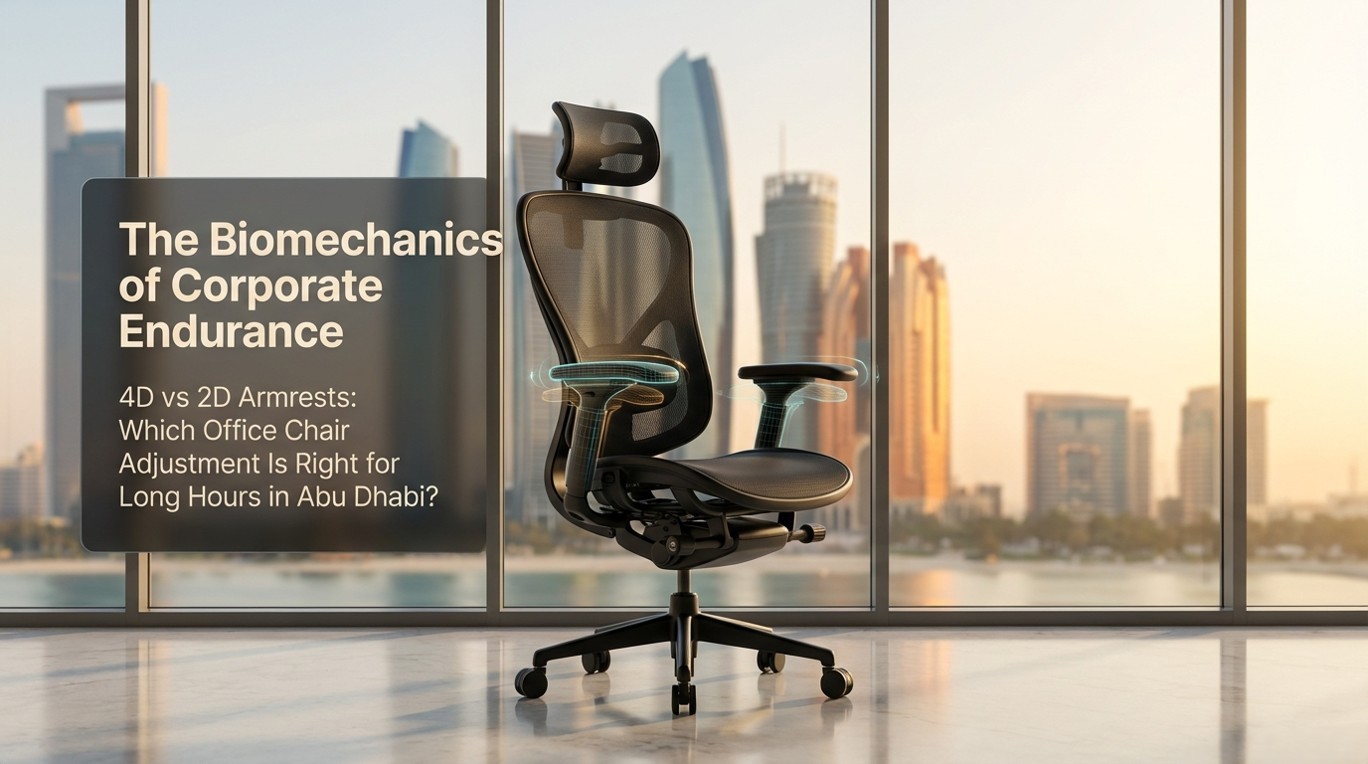
4D vs 2D Armrests: Which Office Chair Adjustment Is Right for Long Hours in Abu Dhabi?
Apr
The Armrest Debate That Could Be Costing You Your Health
Picture this: you arrive at your Abu Dhabi office at 8:00 a.m., settle into your chair, open your laptop, and begin what will become a nine-hour working day. By mid-afternoon, your shoulders ache, your wrists feel compressed, and a familiar tension has settled into your neck. You blame deadlines, stress, even the air conditioning. But the real culprit? The two rigid plastic armrests locked permanently at a height that was never designed for your body.
Across the UAE’s fast-growing corporate landscape, from the gleaming towers of Abu Dhabi’s Central Business District to the co-working hubs of Dubai Internet City, professionals are spending more hours seated than ever before. Research consistently shows that workers in knowledge-economy roles log an average of 7 to 9 seated hours per day, and in high-intensity sectors like finance, government, and technology, that figure climbs higher still.
In this environment, the type of armrest built into your office chair is not a cosmetic detail. It is a biomechanical decision with direct consequences for posture, joint health, and long-term productivity. Two dominant standards have emerged in the global and UAE office furniture market: the 2D armrest and the 4D armrest. Understanding the difference between them, and knowing which one suits your specific work context, is one of the most impactful ergonomic choices you can make.
This in-depth guide from OfficeMaster.ae breaks down everything you need to know about 4D armrests vs 2D armrests, tailored specifically for professionals working long hours in Abu Dhabi, Dubai, and across the UAE.
1. What Are 2D Armrests? Definition, Features, and Limitations
Defining the 2D Armrest
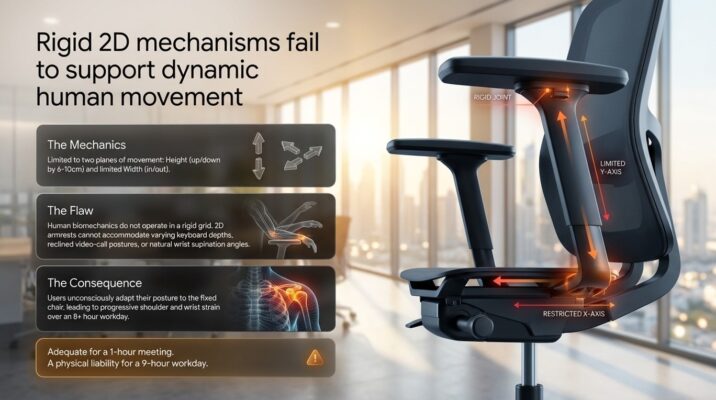
The “2D” in 2D armrests refers to two planes of adjustment: height and width. A chair equipped with 2D armrests allows the user to raise or lower the armrest along a vertical axis, and on some models, to slide the armrests inward or outward to adjust the distance between them. That is the full extent of the customization available.
For decades, 2D armrests were considered adequate for office use. In an era when office chairs were primarily evaluated on price and appearance rather than biomechanical precision, the ability to adjust height was seen as sufficient. Today, as the UAE’s workforce becomes increasingly health-conscious and productivity-driven, the limitations of 2D armrests are becoming harder to overlook.
What 2D Armrests Do Well
It would be unfair to dismiss 2D armrests entirely. In certain contexts, they remain a practical choice:
- They are mechanically simpler, meaning fewer components that can fail over time.
- They are less expensive to manufacture, keeping the chair’s overall price lower.
- For light, intermittent computer use or meeting-room seating, 2D adjustability is often sufficient.
- They are easier to operate, with no learning curve for new users.
The Core Limitations of 2D Armrests
The fundamental problem with 2D armrests is that the human body does not move in just two dimensions. Consider a typical knowledge-worker’s day in Abu Dhabi: they type on a keyboard, reach across a desk for documents, participate in video calls requiring a slightly reclined posture, and rotate to engage with colleagues or secondary monitors. Throughout all of these movements, the forearms need support at different heights, angles, and orientations. A 2D armrest cannot accommodate any of this variation.
- No pivot or swivel function, meaning the arm pad cannot angle to match a natural forearm position.
- No forward or backward slide, so users whose desks or keyboards are positioned at varying depths cannot align support correctly.
- Wrist and shoulder strain accumulate as users unconsciously adapt their bodies to a fixed armrest rather than the reverse.
- Incompatibility with ergonomic posture principles such as the 90-110 degree elbow rule when the desk height or monitor position varies.
2. What Are 4D Armrests? The Full Spectrum of Adjustability
Defining the 4D Armrest
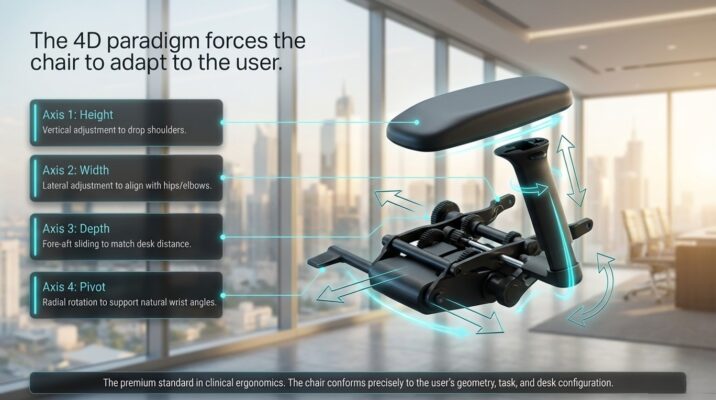
The 4D armrest represents the premium standard in ergonomic chair arm support. The four dimensions of adjustment are: height (up/down), width (in/out), depth (forward/backward slide of the arm pad), and pivot (rotation of the arm pad surface, typically 30 to 45 degrees in either direction). Some manufacturers market a subset of these features as 3D armrests, which typically omit the pivot function.
The goal of 4D adjustability is to allow the armrest to precisely conform to the user’s natural arm position regardless of their body geometry, task type, desk configuration, or posture preference. Rather than forcing the user to adapt to the chair, the chair adapts to the user.
Breaking Down Each Dimension
- Height Adjustment: Allows the armrest to be raised or lowered, typically across a range of 60mm to 100mm, so the forearm rests parallel to the floor with the shoulder relaxed.
- Width Adjustment: Allows the armrests to be moved inward or outward to align with the natural width of the user’s hips and elbows, preventing lateral shoulder strain.
- Depth Adjustment (Fore-Aft Slide): Allows the arm pad surface to slide forward or backward so that users working with keyboards positioned at varying depths always receive support at the correct point of the forearm.
- Pivot Adjustment: Allows the arm pad to rotate inward or outward, matching the natural angle of the forearm during keyboard use, mouse work, or neutral rest, and is particularly critical for preventing ulnar deviation and carpal tunnel stress.
The Biomechanical Case for 4D Armrests
From a clinical ergonomics perspective, the pivot dimension is the most underappreciated feature. When a user types on a standard keyboard, the forearm naturally supinates slightly inward. A flat, fixed arm pad forces the forearm into an unnatural angle, creating a torque load at the wrist and elbow over time. A pivoting arm pad that angles inward by even 15 degrees eliminates this torque and distributes the forearm’s weight more evenly across the soft tissue.
Similarly, the fore-aft depth adjustment addresses one of the most common ergonomic misalignments in UAE office setups: chairs positioned close to a desk but with the keyboard pushed far back on the desk surface. In this configuration, a fixed-depth armrest either prevents the user from reaching the keyboard comfortably or provides no support at all. A 4D armrest with forward-sliding depth resolves this instantly.
3. 4D vs 2D Armrests: Head-to-Head Comparison Tables
Feature-by-Feature Comparison
| Feature | 2D Armrests | 4D Armrests |
|---|---|---|
| Height Adjustment | Yes (typically 6–10cm range) | Yes (typically 8–12cm range) |
| Width Adjustment | Yes (limited range) | Yes (wider range, finer control) |
| Depth / Fore-Aft Slide | No | Yes (typically 5–8cm range) |
| Pivot / Rotation | No | Yes (typically 30–45°) |
| Arm Pad Material Options | Basic foam or PU | Memory foam, PU, gel-infused pads |
| Suitable for Long Hours | Moderate | Excellent |
| Adjustment Ease | Simple levers | Multi-mechanism (push-button, lever, slide) |
| Durability | High (fewer parts) | High (quality-engineered mechanisms) |
| Price Range (AED) | 200 – 600 additional | 600 – 1,800 additional over base chair |
| Ergonomic Certification Fit | Basic | Meets BIFMA & EN 1335 standards |

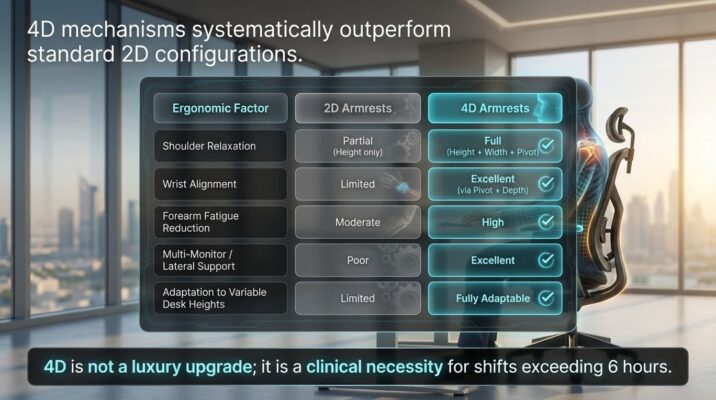
Ergonomic Impact Comparison
| Ergonomic Factor | 2D Armrests Impact | 4D Armrests Impact |
|---|---|---|
| Shoulder Relaxation | Partial – height only | Full – height + width + pivot |
| Wrist Alignment | Limited | Excellent via pivot + depth |
| Neck Strain Reduction | Indirect benefit | Direct benefit via shoulder lowering |
| Carpal Tunnel Risk | Moderate reduction | Significant reduction |
| Posture Support (8+ hrs.) | Moderate | Excellent |
| Forearm Fatigue | Moderate reduction | High reduction |
| Adaptation to Desk Height | Limited | Fully adaptable |
| Support During Reclining | Poor (fixed angle) | Good (adjusts per posture) |
| Multi-Monitor Setup Support | Poor | Excellent |
| Voice/Video Call Posture | Neutral | Actively supportive |
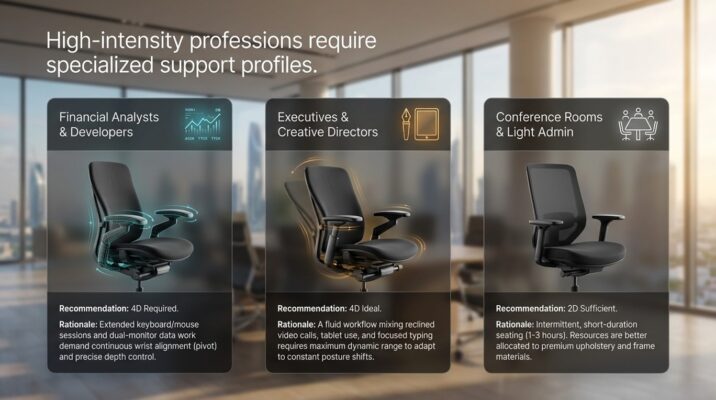
Use Case Suitability by Profession
| Profession / Role | Recommended Armrest Type | Key Reason |
|---|---|---|
| Software Developer / Coder | 4D | Extended keyboard/mouse use requires pivot + depth |
| Graphic Designer / Creative | 4D | Stylus and tablet use demands precise fore-aft depth |
| Executive / Manager | 4D or Premium 3D | Reclined posture + mixed tasks benefit from full range |
| Receptionist / Admin | 3D or 2D | Task variety is lighter; cost efficiency matters |
| Financial Analyst | 4D | Long data-entry sessions demand wrist alignment |
| Architect / Engineer | 4D | Drawing tablet use requires pivoting arm pads |
| Call Centre / Customer Service | 3D | Headset use changes arm position frequently |
| Government Desk Officer | 3D or 4D | Long sitting durations in UAE government offices |
| Remote / Home Office Worker | 4D | Non-standard desk setups need maximum adaptability |
| Conference Room User | 2D | Short-duration, intermittent use only |
Price vs Value Analysis (UAE Market, 2025-2026)
| Category | Chair Price Range (AED) | Armrest Type | Value for Long Hours |
|---|---|---|---|
| Entry-Level Task Chair | 500 – 1,200 | Fixed or 1D | Poor for 6+ hrs |
| Mid-Range Ergonomic Chair | 1,200 – 2,800 | 2D standard | Acceptable for 5–7 hrs |
| Premium Ergonomic Chair | 2,800 – 5,500 | 3D or 4D | Excellent for 8–10 hrs |
| Executive / High-End Chair | 5,500 – 12,000+ | 4D with premium pad | Optimal for all-day use |
| Specialist Medical-Grade | 8,000 – 20,000+ | 4D + lumbar-linked | Clinical ergonomic standard |
4. The UAE Office Environment: Why Armrest Type Matters More Here
Abu Dhabi’s Unique Workplace Profile
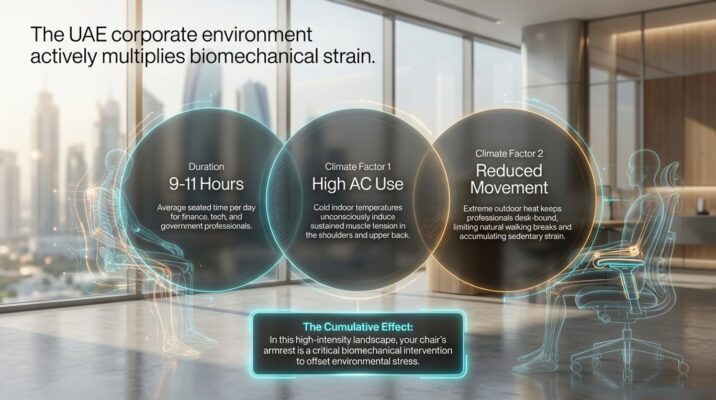
Abu Dhabi’s workforce is characterized by some of the longest average working hours in the GCC region. Government employees, financial services professionals, and oil and gas sector workers frequently log 9 to 11 hours per day, often at fixed workstations with limited opportunity for movement breaks. The combination of extended sedentary periods, often in overcooled office environments (cooler temperatures increase muscle tension), and high-pressure productivity expectations creates conditions where ergonomic chair support is not optional: it is a health imperative.
Dubai’s rapidly expanding tech, media, and e-commerce sectors present a similar picture. Professionals in free zones such as DIFC, Media City, and Silicon Oasis routinely spend 8 to 10 hours at a desk. The city’s reputation as a global business hub means international standards of workplace ergonomics are increasingly expected by multinational employers and expat employees who bring those expectations from Europe and North America.
The Climate Factor: How UAE Heat Affects Ergonomic Needs
An often-overlooked factor in UAE ergonomics is the relationship between outdoor heat and indoor posture. Because the UAE climate is extreme for six months of the year, outdoor movement is limited. Workers who might take a walking break in a more temperate climate stay seated, and desk-time accumulates even further. This increases the cumulative strain on unsupported arms and shoulders dramatically compared with the same professional in, say, London or Toronto.
Additionally, aggressive air conditioning in UAE offices creates muscular tension as the body responds to cold. This tension concentrates in the shoulder and upper back, areas that are directly affected by armrest quality. A 4D armrest that correctly positions the shoulders in a relaxed, lowered state actively counteracts this cold-induced tension.
Regulatory and Wellness Trends in the UAE
The UAE government’s focus on employee wellness, as reflected in initiatives from the Ministry of Human Resources and Emiratization and the Abu Dhabi Department of Health, is increasing awareness of ergonomic workplace standards. Increasingly, HR departments and office fit-out consultants are specifying ergonomic chairs with 4D armrests as part of workspace compliance and employee welfare programmed. Leading providers of office furniture in the UAE, including specialists in office furniture Dubai and Abu Dhabi procurement, report a measurable shift in client specifications toward premium adjustable seating.

5. Ergonomic Deep Dive: How Armrest Adjustability Affects Your Body
The Shoulder-Armrest Connection
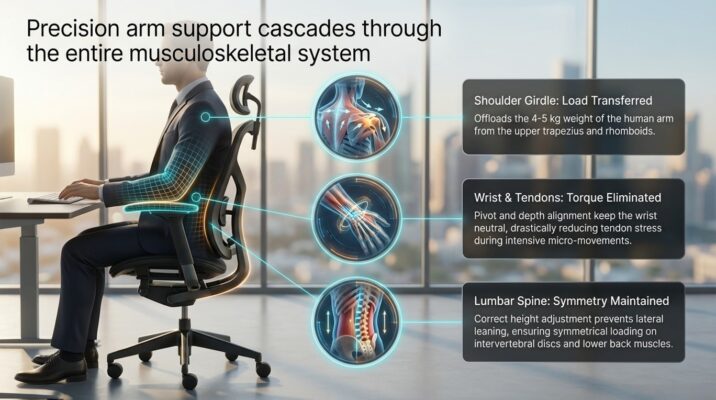
The primary biomechanical function of an armrest is to offload the weight of the forearm from the shoulder girdle. The human arm weighs approximately 4 to 5 kg, and when unsupported, the muscles of the upper trapezius, rotator cuff, and rhomboids must sustain that weight continuously. Over an 8-hour workday, these muscles accumulate fatigue that manifests as the characteristic end-of-day shoulder ache familiar to millions of desk workers.
A correctly positioned armrest reduces this loading significantly. Studies in occupational health have demonstrated that proper arm support can reduce upper trapezius muscle activity by 25 to 35 percent. However, the keyword is “correctly positioned.” An armrest that is even slightly too high, too wide, or angled incorrectly can increase shoulder tension rather than reduce it, essentially acting as a ramp that pushes the shoulder upward into an elevated and strained position. This is precisely why 4D adjustability, which allows fine-tuning of all four parameters, is superior to the binary options offered by a 2D system.
Wrist Alignment and Carpal Tunnel Risk
For keyboard and mouse users, the wrist is the joint under most continuous mechanical stress. Ulnar deviation (bending the wrist outward toward the little finger) and radial deviation (bending inward toward the thumb) are both risk factors for repetitive strain injuries, including carpal tunnel syndrome and de Quervain’s tenosynovitis. The pivot function of a 4D armrest directly addresses this by allowing the arm pad to rotate inward to match the natural supination angle of the forearm during keyboard use, keeping the wrist in a neutral, aligned position throughout the working day.
The depth (fore-aft) adjustment further supports wrist neutrality by ensuring that the forearm is supported right up to the point where it reaches the keyboard, eliminating the unsupported span that forces the wrist to flex downward or upward to reach the keys.
Lumbar and Spinal Implications
There is a less obvious but critically important relationship between armrest quality and lower back health. When armrests are set incorrectly, particularly when they are too high, users tend to shift their body weight laterally, causing asymmetric loading on the spine and intervertebral discs. Over time, this contributes to lumbar muscle imbalances and disc degeneration. Correct armrest positioning, which 4D systems make possible with far greater precision, supports symmetrical seated posture and reduces the likelihood of this spinal loading pattern.
6. Real-World Use Cases: Who Should Choose What?
The Abu Dhabi Corporate Office
A senior financial analyst at an Abu Dhabi investment firm works a consistent 9-hour day across dual monitors with intensive spreadsheet and reporting tasks. For this user, 4D armrests are unambiguously the correct choice. The ability to pivot the arm pads inward to match keyboard angle, combined with depth adjustment to accommodate the keyboard drawer configuration, means shoulders remain relaxed across the full working day. The height adjustment accommodates posture changes between focused work and reclined reflection or video calls.
The Dubai Home Office
A freelance digital marketer in Dubai’s Jumeirah district works from a repurposed dining table that sits 5cm higher than a standard office desk. Their monitor is on a riser. This setup, typical of the improvised home office environments that proliferated post-pandemic, would be a nightmare for a 2D armrest: the extra desk height means the armrests would need to be raised beyond the standard range, and the non-standard depth of the table’s work surface requires fore-aft adjustment. A 4D armrest on a chair with sufficient height range is the only ergonomic solution that actually works.
The Gaming and Creative Setup
Esports professionals and creative directors in the UAE gaming and media industries present a unique ergonomic profile: they alternate between intense, forward-leaning active phases and more relaxed reclined postures during review or communication. 4D armrests support both modes; 2D armrests support neither optimally. The pivot function is especially critical for gaming peripherals, where mouse pads are large and lateral arm movement is frequent.
The Conference Room and Boardroom
Here, finally, is a legitimate use case for 2D armrests. Boardroom seating in UAE corporate environments is typically occupied for 1 to 3 hours per session, not 8+ hours continuously. The ergonomic demands are lower, and the priority often shifts to aesthetics, material quality, and brand impression. Premium 2D armrests with leather padding and polished aluminum bases serve this environment well, and the cost saving over 4D mechanisms can be directed toward higher-quality upholstery or frame materials.
The Executive Desk Chair
C-suite and senior government officials in the UAE often have customized seating arrangements with dedicated executive chairs. The good news is that the premium executive office chair segment has largely migrated to 4D armrests as standard. When procuring executive office furniture for Abu Dhabi government entities or corporate headquarters, specifying 4D armrests is now considered best practice and is aligned with international corporate wellness standards.
7. Buyer’s Decision Guide: Choosing the Right Armrest Type for Your Needs
Step 1: Assess Your Daily Seated Hours
If you sit for fewer than 5 hours a day, quality 2D armrests may suffice, provided the height adjustment covers your range. If you regularly sit for 6 or more hours, 4D armrests should be considered a health investment rather than a luxury.
Step 2: Evaluate Your Primary Task Type
Heavy keyboard and mouse users, particularly those in finance, technology, design, and government administrative roles, derive the greatest benefit from the pivot and depth functions of 4D armrests. If your work involves predominantly reading, phone calls, or physical task management rather than keyboard input, the value differential narrows.
Step 3: Consider Your Desk Configuration
Non-standard desk heights, keyboard trays, corner desks, and standing desk conversions all create environments where a fixed-depth armrest fails. If your workstation deviates from the standard 720-750mm desk height common in UAE office furniture specifications, invest in 4D.
Step 4: Factor in Your Body Geometry
Taller users (above 185cm) and shorter users (below 160cm) are both underserved by chairs designed for the median body. 4D armrests provide the additional range of adjustment that compensates for this. UAE offices employ a highly diverse international workforce, and individual ergonomic needs vary enormously across nationalities and body types.
Step 5: Calculate Long-Term ROI
The cost differential between a good 2D armrest chair and a good 4D armrest chair typically ranges from AED 800 to AED 2,000 in the UAE market. Measured against the productivity losses associated with repetitive strain injuries (an average of 8 to 14 sick days per affected employee per year, according to occupational health data) and the cost of physiotherapy treatment (AED 200 to AED 450 per session in Abu Dhabi), the return on investment for 4D seating is typically realized within 6 to 12 months for a full-time desk worker.
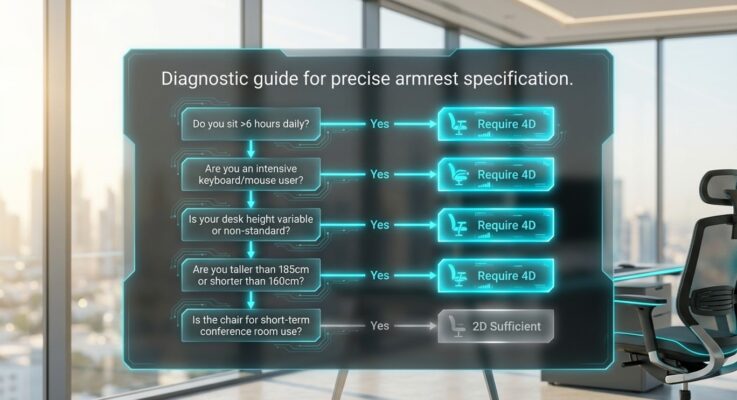
Quick Decision Checklist
- Do I sit more than 6 hours daily? → Choose 4D
- Do I use a keyboard and mouse intensively? → Choose 4D
- Is my desk height non-standard or variable? → Choose 4D
- Am I shorter than 160cm or taller than 185cm? → Choose 4D
- Is this for a conference or meeting room? → 2D may suffice
- Is budget the primary constraint? → Start with quality 2D, upgrade when possible
- Am I furnishing a corporate office for 10+ staff? → Strongly consider 4D for health ROI
8. Integrating Armrest Choice into Your Complete Desk Ergonomics Setup
The UAE Ergonomic Workspace Standard
Armrests do not operate in isolation. Their effectiveness is fully realized only when the surrounding desk ergonomics UAE configuration is also correct. The ideal ergonomic setup for an Abu Dhabi or Dubai office worker includes a monitor positioned so the top of the screen is at or slightly below eye level at approximately 50-70cm viewing distance, a keyboard positioned so the elbows form a 90-110 degree angle, a chair seat height allowing feet to rest flat on the floor or a footrest, and lumbar support aligned with the natural curve of the lower back.
Within this setup, 4D armrests serve as the final calibration layer, fine-tuning the position of the forearms to eliminate residual tension after the major ergonomic parameters have been set. This is why ergonomic assessments in UAE corporate offices increasingly specify armrest type as a discrete procurement criterion alongside lumbar support type, seat pan depth, and headrest adjustability.
Pairing Armrests with Desk Height Adjustment
The growing popularity of height-adjustable standing desks in UAE office furniture specifications creates an additional argument for 4D armrests. When a user transitions from sitting to standing at a desk, they often use a high stool or perch seating. But even in pure sitting configurations, motorized desks that are frequently adjusted by multiple users in hot-desk environments mean that the desk height relative to the chair changes frequently. A 4D armrest’s height and depth adjustability ensures continuous forearm support regardless of desk position changes.
Armrests and Monitor Configuration
Multiple monitor setups, now standard in many Abu Dhabi financial and technology offices, change the lateral reach dynamics at a workstation. Users frequently rotate or reach sideways to engage with a secondary screen. The width and pivot functions of 4D armrests allow the forearm to be supported even during these lateral movements, which significantly reduces the rotational strain on the shoulder and elbow that otherwise accumulates across hundreds of daily monitor switches.

Frequently Asked Questions (FAQ)
2D armrests adjust in two directions: height (up and down) and width (in and out). 4D armrests adjust in four directions: height, width, depth (forward and backward slide), and pivot (rotation of the arm pad). 4D armrests provide significantly greater ergonomic customization for long working hours.
Yes, for professionals who sit more than 6 hours per day. The additional cost, typically AED 800 to AED 2,000 over a comparable 2D chair, is recouped through reduced physiotherapy costs, lower rates of repetitive strain injury, and measurable improvements in daily comfort and productivity.
The pivot or rotation function allows the arm pad surface to rotate inward or outward, typically 30 to 45 degrees. This matches the natural inward angle of the forearm during keyboard and mouse use, keeping the wrist in a neutral position and reducing the risk of carpal tunnel syndrome and other repetitive strain injuries.
Yes. Correctly adjusted 4D armrests offload the weight of the forearm from the upper trapezius and shoulder muscles, reducing muscle activity in those areas by 25 to 35 percent according to occupational health research. This directly reduces shoulder fatigue and chronic pain in desk workers.
Yes. Premium ergonomic office chairs with 4D armrests are available from specialist office furniture suppliers in Abu Dhabi and Dubai, including OfficeMaster.ae, which offers a curated range of ergonomic seating solutions tailored to the UAE corporate and home office market.
The best office chair for long hours in Abu Dhabi should include 4D adjustable armrests, adjustable lumbar support, a seat pan depth adjustment, breathable mesh or ventilated upholstery suitable for UAE climate, and a tilt mechanism with recline tension control. Leading brands in the UAE ergonomic chair market include Officemaster, and locally available equivalents.
Start by setting the armrest height so your forearms rest parallel to the floor with your shoulders relaxed downward. Then adjust the width so your elbows are directly below your shoulders. Slide the depth forward or backward until the arm pad supports your forearm within 3 to 5 cm of your wrist without contacting it. Finally, pivot the pad inward until it matches the natural angle of your forearm as it approaches the keyboard.
Properly adjusted 4D armrests significantly reduce the risk factors for carpal tunnel syndrome by keeping the wrist in a neutral position and eliminating the need to hover the forearm unsupported over the keyboard. They are not a medical treatment for existing carpal tunnel syndrome but are an important preventive ergonomic measure.
The ideal armrest height positions your forearms parallel to the floor, with your elbows at approximately a 90 to 110 degree angle, your shoulders relaxed downward, and your upper arms hanging vertically from the shoulder joint. This height varies significantly between individuals based on torso length and chair seat height.
4D armrests are primarily designed for seated use. At a standing desk, armrests are not typically used. However, when transitioning between sitting and standing at a height-adjustable desk, the depth and height adjustment of 4D armrests allows them to be quickly reconfigured to match different desk positions during seated intervals.
Yes, 3D armrests, which typically offer height, width, and depth adjustment but not pivot, are a solid mid-range option. They address most ergonomic issues for keyboard users except for wrist rotation alignment. For users who do not perform intensive mouse work or use ergonomically angled keyboards, 3D armrests deliver most of the benefit of 4D at a lower price point.
Ideally, you should readjust your armrests every time you significantly change your desk configuration, switch tasks (e.g., from typing to reading to video calls), or notice shoulder, wrist, or neck discomfort. For users with a fixed workstation and consistent task type, a single correct adjustment may remain optimal indefinitely.
Abu Dhabi government procurement specifications increasingly align with international ergonomic standards such as EN 1335 and BIFMA. For staff in desk-based roles working 8 or more hours daily, 4D armrests are recommended. For support and administrative roles with lighter desk use, quality 2D or 3D armrests meet the standard.
Yes. The extended height and width adjustment range of 4D armrests is particularly beneficial for individuals outside the average height range, including shorter adults under 160cm. The ability to lower armrests further than a 2D system allows and to narrow them more precisely makes 4D chairs significantly more inclusive.
OfficeMaster.ae offers a comprehensive range of ergonomic office chairs with 4D armrests, available for delivery and installation across Abu Dhabi, Dubai, and the wider UAE. Our team provides in-person ergonomic consultations and custom corporate procurement solutions for businesses of all sizes.
Make the Right Armrest Investment for Your UAE Working Life
The question of 4D armrests vs 2D armrests is, at its core, a question about how seriously you take your body’s long-term wellbeing in a world that demands increasingly long hours of desk-based work. For most professionals in Abu Dhabi and Dubai, the answer is clear: 4D armrests deliver meaningfully better ergonomic outcomes, and the investment is justified by the scale of daily seated time that characterizes UAE working culture.
2D armrests remain a legitimate choice for light-use seating, conference rooms, and budget-constrained environments where desk time is moderate. But for the knowledge worker spending 7, 8, or 9 hours at a fixed workstation, they represent an ergonomic compromise that accumulates a health cost over time.
The ideal approach for UAE employers is to conduct a workstation audit and categories roles by daily seated hours, task type, and workstation variability. Roles falling into the high-hours, high-keyboard-intensity category should receive chairs with 4D armrests as a standard provision, not an upgrade. This is not a luxury decision; it is a workforce health strategy with a measurable return.
At OfficeMaster.ae, we are committed to bringing world-class ergonomic office furniture to professionals across Abu Dhabi and Dubai. Whether you are fitting out a corporate headquarters, designing a government office space, or investing in your personal home office setup, our specialists are ready to help you identify the right chair, the right armrest configuration, and the right complete ergonomic setup for your unique working life in the UAE.
Explore our full range of ergonomic chairs, adjustable desks, and office furniture Dubai collections at OfficeMaster.ae, or contact our Abu Dhabi showroom for a personalized ergonomic consultation.