


Blog
The Complete Guide to Acoustic Office Furniture in Dubai: Costs, Data, and the Science of a Quieter Floor
Sep
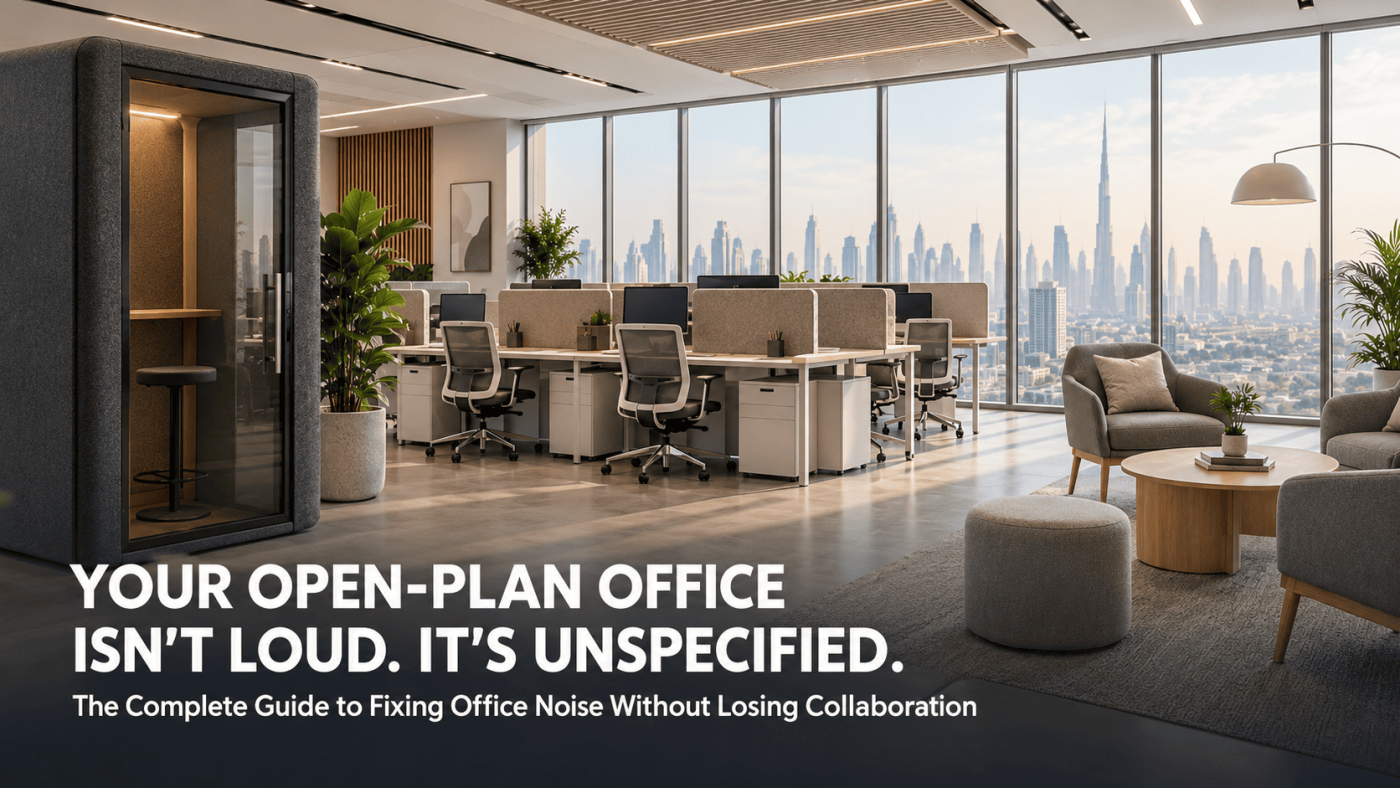
The Noise Problem Hiding Inside Every Open-Plan Office
Every open-plan office in Dubai was designed around the same promise: more collaboration, more density, lower cost per employee. What rarely makes it into the original fit-out brief is the tradeoff that comes with that density — sound has nowhere to go. Conversations, calls, keyboard clatter, and HVAC hum accumulate across a shared floor plate, and by mid-afternoon most employees have stopped noticing how loud it’s become. They’ve just stopped concentrating.
We’ve covered the real estate side of this equation before — how Grade-A office rents in Dubai’s business districts have made every square foot more expensive, and why a well-designed reception and workspace functions as a sales tool. Acoustic design sits underneath both of those conversations. An office that saved money on square footage but loses productivity to noise hasn’t actually reduced its costs — it’s just relocated them from the balance sheet to the org chart.
This guide walks through the complete picture: what causes office noise, what actually reduces it, what it costs, and how to specify it correctly for a Dubai floor plate — whether you’re sourcing office furniture in Dubai for a new fit-out or retrofitting an existing floor.
Before buying anything, walk your floor at 11 a.m. and again at 3 p.m. with a simple decibel meter app. Most facilities teams are surprised to find sustained levels well past the threshold where focused work becomes measurably harder. You cannot fix what you haven’t measured.
Understanding Office Noise: Three Problems, Not One
Acoustic engineers generally separate workplace sound into three distinct categories, and each requires a different furniture response.
| Noise Type | What It Is | Typical Source | Best Furniture Response |
|---|---|---|---|
| Reverberation | Sound bouncing off hard, flat surfaces | Glass partitions, concrete ceilings, laminate desks | Acoustic panels, soft seating, ceiling baffles |
| Speech Transmission | Conversation carrying across open space | Desk clusters, phone calls, meeting spillover | Booths and pods, desk-mounted screens |
| Impact Noise | Physical contact sound | Footsteps, chair movement, dropped objects | Carpet tiles, resilient flooring, felt-based panels |
Office Noise Categories — Cause and Furniture-Based Response
Most offices only address one of these three — usually reverberation, via a handful of decorative wall panels — and then wonder why the floor still feels loud. A genuinely effective acoustic plan treats all three as separate line items.
What the Furniture Industry Measures: NRC and Why It Matters
When you’re comparing acoustic products, the specification to look for is the Noise Reduction Coefficient (NRC) — a standard rating from 0 (perfectly reflective) to 1 (perfectly absorptive) that tells you how much sound energy a material absorbs rather than bounces back into the room. A hard laminate desk surface sits close to 0.05. A well-upholstered acoustic panel typically sits between 0.70 and 0.95. This single number is the fastest way to compare acoustic furniture products against each other, and it’s worth asking for on any quote you receive.
The Four-Part Acoustic Toolkit
Booths and Pods
For calls and heads-down work, removing a person from the shared floor entirely outperforms any amount of surrounding absorption. This is typically the highest-impact single purchase for any floor with more than 15–20 desks. Explore our Booths and Pods range.
Panels and Dividers
Freestanding or desk-mounted panels absorb sound at the point of generation — between adjacent workstations, along busy corridors, or around meeting clusters. They require no construction work, which makes them the fastest and most budget-friendly retrofit option. Browse Panels and Dividers.
Acoustic Whiteboards
Collaboration zones are consistently the loudest part of any floor, and a standard whiteboard does nothing to control that. An acoustic whiteboard functions as a writing surface and a sound-absorbing panel simultaneously — a practical specification for huddle rooms and training areas. See our Acoustic Whiteboards.
Soft Seating
Upholstered lounge furniture absorbs dramatically more sound than any hard-surfaced alternative, which is why the best-performing floors weave soft seating zones through the plan rather than confining everything to desks. View our Soft Seating collection.
Don’t treat acoustic furniture as decoration to add after the layout is finalized. Specify it at the same stage you specify desks and chairs. Retrofitting acoustic elements into a completed layout almost always means compromising on placement — and placement is most of what determines whether a panel actually works.
Architectural acoustic treatment — ceiling baffles, raised flooring — is expensive to install and effectively permanent. Furniture-based acoustic treatment is modular: it can be repositioned, added to, or scaled down as your headcount and layout change. For any organization that expects to reconfigure its floor within 2–3 years — which, in Dubai’s leasing market, is most organizations — furniture-based acoustic solutions carry a real flexibility advantage that architecture cannot match.
Noise and posture are more connected than most facilities managers assume. When employees can’t find a quiet spot to think, they compensate with poor physical habits — hunching toward screens, cupping ears during calls, leaning away from neighbors. A workstation specification that only accounts for chair height and desk depth is solving half the problem. Related reading: The Ergonomic Gap Between Lumbar Support and Real Spine Curves and The Ergonomics of Elbow Floating vs Armrest Support.
Retrofit vs. Architectural Treatment: A Practical Comparison
| Factor | Architectural Treatment | Furniture-Based Solutions |
|---|---|---|
| Typical lead time | 4–8 weeks, requires contractor coordination | 1–3 weeks with a local manufacturer |
| Disruption to occupied space | High — often requires vacating the area | Low — installed around existing operations |
| Flexibility if layout changes | None — fixed once installed | High — panels and pods can be relocated |
| Upfront cost per zone | Generally higher | Generally lower, scalable zone by zone |
| Best suited to | New-build fit-outs, base-build specification | Existing offices, phased upgrades, leased space |
Furniture-Based Acoustic Treatment vs. Architectural Construction
For most existing Dubai offices — leased space where structural changes require landlord approval — furniture-based acoustic solutions are the realistic starting point, with architectural treatment reserved for new-build fit-outs where it can be specified from day one.
Where to Place Acoustic Furniture: A Zone-by-Zone Starting Point
- Map your noise zones first. Walk the floor at midday and note where conversation clusters — usually near meeting pods, the pantry, and any bank of height-adjustable desks where people tend to stand and talk.
- Prioritize call-heavy roles. Sales, recruitment, and client-facing teams generate the most disruptive noise and see the fastest return from a dedicated booth or pod.
- Treat meeting and training rooms as their own zone. These need panels or acoustic whiteboards on shared walls, not just soft seating scattered nearby.
- Match absorption to density. More desks per square meter means proportionally more absorptive surface area is needed — a common oversight in fast-growing companies scaling up their floor plan.
- Reassess layout before adding treatment. Sometimes the fix is rearranging furniture, not adding more of it. Our piece on Simple Changes in Furniture Layout That Improve Daily Comfort is a useful starting point before you spend on acoustic products.
Acoustics for Hybrid Meetings: The Requirement Nobody Budgeted For
Most acoustic planning still assumes every meeting participant is in the room. That assumption stopped holding a few years ago. In a hybrid meeting, poor room acoustics don’t just bother the people physically present — they degrade the call for everyone dialing in, and remote participants have no way to compensate the way an in-room attendee can by leaning in or asking someone to repeat themselves.
Video conferencing microphones pick up reverberation far more aggressively than the human ear does, which is why a meeting room that feels perfectly fine in person can sound cavernous and echo-prone on a recorded call. This is a second, distinct reason — separate from in-room comfort — to treat meeting rooms as a priority acoustic zone rather than an afterthought.
- Wall-mounted panels behind the camera position reduce the echo picked up by the room’s microphone array, which is usually the single biggest driver of poor call audio quality.
- Acoustic whiteboards on the wall opposite the screen double as both a collaboration surface and treatment for the room’s most reflective flat surface.
- Soft seating or upholstered chairs in smaller huddle rooms absorb far more of the mid-range frequencies that make voices sound “boomy” on a call than hard meeting chairs do.
For any organization running a significant share of meetings as hybrid, treating this as a video-quality issue — not just a comfort issue — tends to get budget approved faster, since it ties directly to client-facing call quality rather than a softer wellness argument.
Case Study Scenarios: How This Plays Out in Practice
Scenario 1: A 40-Seat Sales Floor in Business Bay
A sales organization with 40 desks in an open layout reports constant complaints about call quality and concentration. Without any construction work, the floor adds four acoustic booths near the entrance for outbound calls, desk-mounted panels along the two busiest rows, and replaces the break-out area’s hard bench seating with upholstered soft seating. The reconfiguration is completed over a single weekend with no disruption to Monday operations, because furniture-based treatment doesn’t require the floor to be vacated.
Scenario 2: A Boutique Law Firm Fit-Out in DIFC
A law firm relocating into a new DIFC suite specifies acoustic panels and an acoustic whiteboard into two client-facing meeting rooms from the initial design stage, alongside standard boardroom tables. Because acoustic treatment is planned alongside furniture rather than added afterward, panel placement is built into the joinery design rather than mounted as an obvious retrofit — preserving the polished appearance clients expect while still controlling confidentiality-sensitive conversation carry.
Scenario 3: A Coworking Operator Scaling Across Two Floors
A coworking operator needs consistent acoustic performance across two floors with different tenant mixes. Rather than a one-time architectural build, they standardize on a modular kit — a fixed ratio of pods, panels, and soft seating per square meter — that can be rebalanced as tenant density shifts month to month. This is only practical with furniture-based solutions, since architectural treatment can’t be moved between floors as occupancy changes.
What to Buy First: A Starter Package by Office Size
Facilities teams often ask the same question in a different form: not “what’s available” but “what should we actually order first.” The table below is a practical starting allocation — a baseline to adjust once you’ve mapped your own noise zones, not a rigid formula.
| Office Size | Booths / Pods | Panels & Dividers | Acoustic Whiteboards | Soft Seating Zones |
|---|---|---|---|---|
| Small (up to 20 desks) | 1–2 single-person booths | Around the busiest desk cluster | 1, in the main meeting room | 1 small breakout corner |
| Medium (20–60 desks) | 3–4 booths, mix of 1 & 2-person | Along every high-traffic row | 2–3, in meeting and huddle rooms | 1 zone per floor |
| Large (60+ desks) | 6+ booths, scaled to headcount | Full perimeter of every desk cluster | In every meeting and training room | Multiple zones, distributed by floor |
A directional starting allocation — refine against your own noise-zone mapping before ordering.
A Simple Procurement Framework for Facilities and HR Teams
Acoustic upgrades are easy to postpone indefinitely because they rarely have a single obvious owner — not quite an HR budget line, not quite a facilities capex item. A short, structured process avoids that stall:
- Audit first, buy second. Use the noise-zone walk-through described earlier before requesting any quotes. A budget built around guesswork is the most common reason acoustic projects get scaled back or cancelled midway.
- Rank your zones by disruption, not by visibility. The loudest area isn’t always the one leadership notices — ask the people who sit there daily.
- Phase the rollout across a fiscal year. Because furniture-based treatment is modular, there’s no need to solve every zone in a single order; starting with the worst zone and expanding is both financially and operationally easier to approve.
- Re-measure after installation. A simple before-and-after decibel reading, kept on file, is the easiest way to justify the next phase of budget to finance or leadership.
Sound Masking vs. Sound Absorption: Do You Need Both?
These two approaches solve noise in opposite ways, and confusing them leads to a lot of wasted budget. Sound absorption — everything covered so far in this guide — physically reduces the amount of sound energy bouncing around a room using panels, booths, and soft materials. Sound masking is a different technology entirely: small ceiling- or desk-mounted speakers emit a low, unobtrusive background hum (similar to airflow noise) that raises the ambient sound floor just enough to make nearby speech less intelligible and less distracting.
The two are complementary, not competing. Absorption reduces the total amount of noise in a room; masking reduces how distracting the noise that remains actually is. A large open floor with persistent low-level speech distraction — even after panels and booths are installed — is the scenario where adding sound masking on top of furniture-based absorption makes sense. For most small and mid-sized Dubai offices, furniture-based absorption alone resolves the bulk of the complaint before masking technology needs to enter the conversation.
Common Mistakes When Specifying Acoustic Furniture
- Buying panels before mapping noise zones. Panels installed in the wrong location — a quiet corner instead of the busiest row — deliver a fraction of the expected improvement.
- Treating only the walls. Ceilings and floors are just as reflective as walls in most Dubai fit-outs with concrete slabs and hard flooring, but they’re frequently left untreated because they’re less visually obvious.
- Ignoring meeting rooms until last. Meeting and huddle rooms typically generate the loudest, most disruptive noise on a floor, yet acoustic budgets are often spent entirely on open-desk areas first.
- Choosing panels on fabric color alone. A visually appealing panel with a low NRC rating looks the part but does very little acoustically — always ask for the rating, not just the swatch.
- Assuming one round of treatment is permanent. As headcount grows or the layout shifts, noise zones move with it. Acoustic furniture should be reassessed on the same cycle as any other layout review, not treated as a one-time purchase.
Related Reading
- Maximizing Commercial Floor Space with Modular Workstation Clusters
- Real Estate Agency Office Setup: Furniture as a Sales Tool
- The Ergonomic Gap Between Lumbar Support and Real Spine Curves
- The Ergonomics of Elbow Floating vs Armrest Support
- Simple Changes in Furniture Layout That Improve Daily Comfort
- Height-Adjustable Desks: A UAE Buyer’s Guide
- Why a UAE Furniture Manufacturer Means Fewer Delays
- Why “Made in Dubai” Is a Strategic Advantage for B2B Procurement
Locally Manufactured for Faster, Lower-Risk Delivery
Acoustic elements are typically finalized late in a fit-out — often only once the desking layout is locked — which makes lead time the deciding factor in whether they get specified at all. This is one of the practical advantages of sourcing from a UAE-based manufacturer rather than importing: acoustic panels, pods, and soft seating can be produced and delivered in a matter of weeks, without the customs clearance and ocean-freight timelines that an imported order carries. It’s the same logic behind why “Made in Dubai” has become a strategic advantage for B2B procurement more broadly — timeline risk, not just unit price, is now a first-order procurement concern.
For most open-plan floors, booths or pods deliver the most noticeable improvement per dirham spent, because they solve the loudest and most disruptive noise source — voice — directly at the point of generation, rather than trying to absorb it after the fact. If your acoustic budget only stretches to one product category this year, start there.
Frequently Asked Questions
It depends on the combination used and the room’s existing surfaces, but the general pattern holds: a room with predominantly hard, reflective surfaces sees the largest improvement from adding high-NRC panels and soft seating, since there’s more reverberant sound to absorb in the first place. A room that’s already carpeted with soft furnishings will see a smaller marginal gain from additional panels.
For a full new-build fit-out with complex requirements (broadcast studios, clinical spaces, high-security meeting rooms), an acoustic consultant is worth the investment. For a typical open-plan office or existing floor retrofit, a furniture supplier experienced in acoustic products can usually specify an effective solution directly, based on a walk-through and noise-zone mapping.
Both. The same enclosed, absorptive environment that isolates a phone call also removes ambient distraction for any task requiring sustained concentration — this is why many organizations see booths used as much for deep-focus work as for calls.
Yes — this is one of the core advantages of furniture-based treatment over architectural construction. Freestanding and desk-mounted panels can be relocated as teams and layouts change, with no construction work required.
Yes, specifically for impact noise — footsteps, chair movement, and dropped objects. Hard flooring reflects and amplifies this category of sound; carpet tiles absorb it at the source. It’s a frequently underrated part of an acoustic plan because it’s rarely thought of as an “acoustic product.”
An acoustic whiteboard combines both functions into a single wall-mounted unit, which is usually more space-efficient and cost-effective for a meeting or huddle room than specifying a whiteboard and a separate absorptive panel side by side.
For most open-plan floors, booths or pods deliver the most noticeable improvement per dirham spent, because they solve the loudest and most disruptive noise source — voice — directly at the point of generation, rather than trying to absorb it after the fact.
Modern acoustic furniture is available in a full range of finishes, fabrics, and forms — from minimalist felt panels to upholstered pods that read as design pieces in their own right. Acoustic performance and aesthetic quality are no longer a trade-off.
For a straightforward retrofit — panels, a handful of pods, and soft seating — a local manufacturer can typically design, produce, and install within a few weeks, compared with the months required for imported acoustic furniture subject to shipping and customs.
Ideally alongside it, at the same design stage. Acoustic zoning affects where desk clusters, meeting pods, and breakout areas are placed, so treating it as a separate, later decision usually means compromising on placement.
Most fabric-wrapped acoustic panels only need periodic vacuuming with a soft brush attachment to prevent dust buildup, which can slightly reduce absorption over time. Spot-cleaning with a mild fabric cleaner handles the occasional mark. Unlike carpet or upholstery in high-traffic zones, wall-mounted panels see far less wear, so maintenance is minimal compared to other office soft furnishings.
Yes, often more noticeably than it helps in-person comfort. Video conferencing microphones amplify room echo and reverberation far more than the human ear notices it, so a meeting room with hard, reflective surfaces frequently sounds far worse to remote participants than it feels to people sitting in it. Panels behind the camera position and an acoustic whiteboard opposite the screen are the two highest-impact additions for hybrid room audio.
In most organizations it sits with facilities or workplace experience teams, since it’s a physical fit-out change, but the business case is often strongest when framed jointly: facilities owns the installation and space planning, while HR or L&D can point to the wellbeing and focus benefits when justifying budget. Framing the request around a specific pain point — call quality, a documented complaint pattern, or hybrid meeting audio — tends to move faster than a general wellness pitch.
Sound absorption — achieved with panels, booths, and soft furnishings — physically reduces the total noise energy in a room. Sound masking uses small speakers to add a low background hum that makes remaining speech less intelligible and distracting, without reducing the actual noise level. Most offices should start with absorption through furniture, and only consider adding masking technology if distraction persists on a large open floor after furniture-based treatment is in place.
Buying panels or booths before mapping where the actual noise is coming from. Acoustic products placed in the wrong zone — a quiet corner instead of the busiest desk row or the loudest meeting room — deliver only a fraction of their potential improvement, which is why a short noise-zone walkthrough should always come before a purchase order.
Bringing It Together
Open-plan offices aren’t inherently noisy — they’re offices that haven’t been acoustically specified yet. Booths for focus work, panels where desks cluster, acoustic whiteboards in collaboration zones, carpet tiles underfoot, and soft seating woven through breakout areas together solve the problem without sacrificing the openness that made the layout attractive in the first place.
If you’re planning a fit-out or reviewing an existing floor, our team can walk your space, map your noise zones, and recommend an acoustic plan alongside your desking and seating layout.
About OfficeMaster.ae
OfficeMaster.ae is a premier supplier of commercial office furniture in Dubai, UAE, serving corporate, governmental, educational, and hospitality clients across the region. Learn more about our local manufacturing capabilities or get in touch to plan your acoustic upgrade.
Visit Us Today!
— OfficeMaster.ae | Premium Office Furniture UAE —
