


Blog
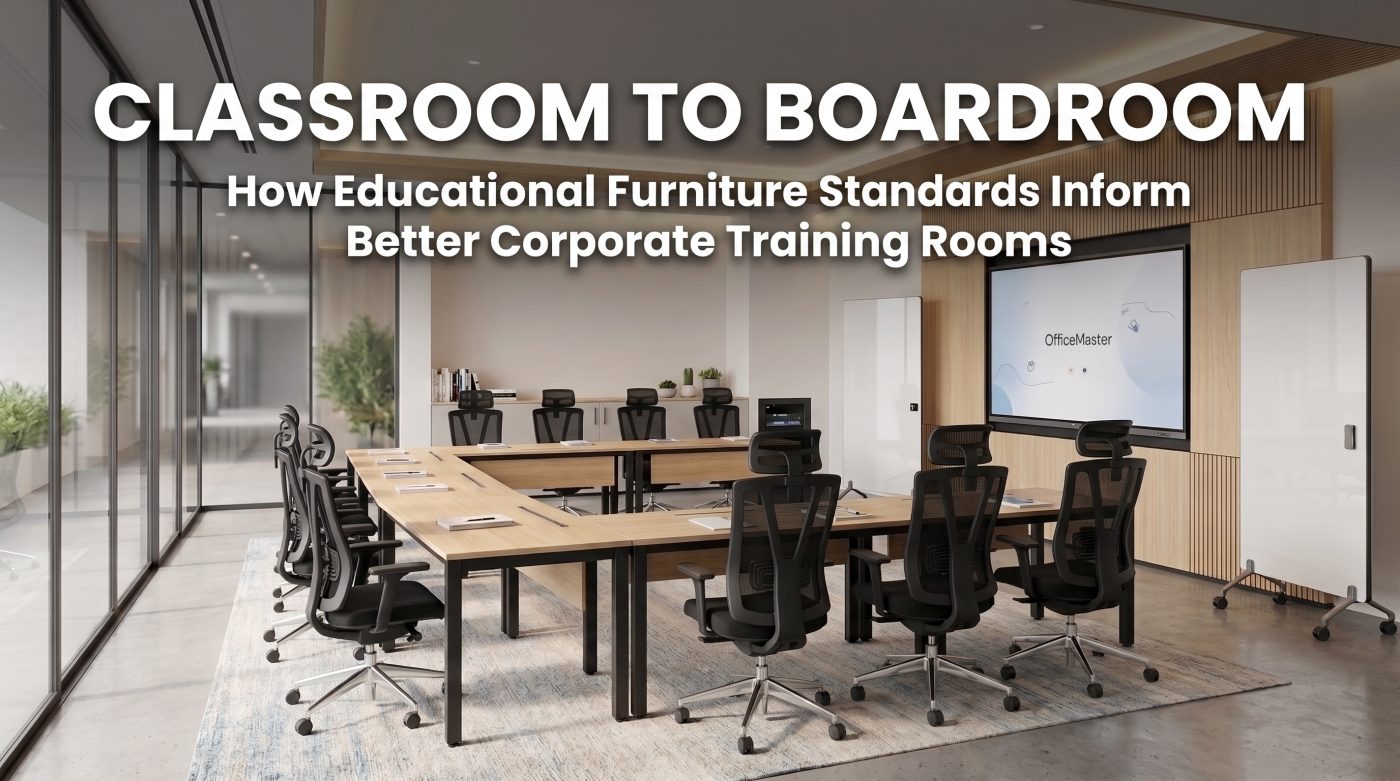
CLASSROOM TO BOARDROOM How Educational Furniture Standards Inform Better Corporate Training Rooms
Jul
Why the Classroom Holds the Answer to Your Training Room Problem
Picture this: a corporate training session in Dubai is underway. Forty professionals from a global logistics firm are seated in a conference room that was, until an hour ago, arranged for a board meeting. The chairs are executive, the table is fixed and heavy mahogany, and the room layout has not changed in three years. Within twenty minutes, backs are aching. By the ninety-minute mark, three participants have quietly shifted to standing near the walls. By the time the breakout session is announced, the facilitator realizes there is no way to re-arrange the furniture without disrupting half the floor.
Now picture a well-designed modern classroom a university lecture hall or a progressive K-12 facility. The tables flip up and wheel into storage in thirty seconds. The chairs stack neatly against the wall. The room transforms from a lecture-style setup to collaborative pods in under five minutes. The ergonomic seating accommodates a seven-year-old and a seventeen-year-old with equal comfort. Every surface is built to survive 200 students per day, 180 days per year.
The irony is stark: organizations investing millions in Learning & Development (L&D) programs across the UAE are placing their trainers and trainees in furniture environments less thoughtfully engineered than a primary school in Sharjah. This blog dismantles that gap strategically and structurally and shows how OfficeMaster.ae brings “school-tough” durability and “boardroom-level” aesthetics together in one cohesive product line.
Whether you are sourcing office furniture in Dubai for a new training center, upgrading a multi-use conference space in Abu Dhabi, or planning an L&D hub fit for a 21st-century workforce, this guide gives you the engineering intelligence to buy smarter, last longer, and perform better.
The Engineering Gap — Classroom Demands vs. Corporate Reality
Before we look at solutions, it is important to quantify the problem. The engineering specifications behind educational furniture and standard corporate meeting room furniture are not just different they exist in separate leagues.
The High-Traffic Stress Test
A typical school chair endures contact with 25 to 35 students per day across six or more class periods. Over an academic year of approximately 180 days, that is upwards of 6,300 use-cycles on a single chair. Add the natural exuberance of young users tipping, rocking, dragging, stacking and you understand why educational furniture is engineered to a higher structural specification than most office furniture.
By contrast, the average corporate meeting room chair in the UAE is designed for roughly 4 to 8 hours of daily use by adults in largely sedentary conditions. The engineering load assumptions are simply not comparable. When that same chair is placed in a corporate training room used by 30 people in back-to-back sessions, stacked and unstacked daily, rolled across hard floors, and adjusted by users of wildly different body types — it typically fails within 18 to 24 months.
| Specification | Education-Grade Furniture | Standard Meeting Room Furniture |
|---|---|---|
| Daily Use Cycles | 30–35 users × 6 sessions | 5–8 hours per day |
| Annual Cycle Count | 5,000 – 6,300+ | 1,500 – 2,000 |
| Weight Capacity (chair) | Up to 135 kg (tested) | 100 – 110 kg (typical) |
| Stacking Capacity | 8–12 chairs high | 2–4 chairs (if any) |
| Floor Contact | Glides + casters (tested) | Glides only (standard) |
| Surface Durability (tables) | High-pressure laminate, impact-rated | Melamine / veneer (standard) |
| Frame Standard | BIFMA / EN 1729 (education) | BIFMA x5.1 (general office) |
| Expected Lifespan | 10–15 years | 5–8 years |
| Mobility Design | Flip-top, caster-ready | Fixed or manual fold |
Engineering Specifications — Educational vs. Standard Corporate Furniture
The implications for UAE-based L&D managers are direct: if your training room runs two or three sessions per day, five days a week, your furniture is under educational-grade load and it should be engineered accordingly. The global educational furniture market was valued at USD 15 billion in 2024 and continues growing precisely because institutions have recognized that furniture is not a passive accessory it is a performance environment.
Pillar 1: Unmatched Durability — Building for the Long Game
Durability in furniture is not simply about choosing thick steel or heavy wood. It is a systems-level engineering decision that considers weight distribution, joint stress, surface abrasion, and finish resilience under high-volume, multi-user conditions. Educational furniture engineers have spent decades solving exactly these problems and the corporate training room sector is only beginning to understand why those solutions matter here too.
What “Education-Grade” Durability Actually Means
In the global furniture industry, the BIFMA (Business and Institutional Furniture Manufacturers Association) sets the baseline standards for testing and certification. For educational environments, additional protocols exist including EN 1729 in Europe and BS 5459 in the UK — that govern dimensions, load testing, stability, and durability under repeated use by populations of varying age and body weight.
When a chair meets educational-grade specifications, it has typically passed:
- Drop tests simulating a user falling into the seat from a standing position
- Repeated load tests at 1.5× the rated capacity for thousands of cycles
- Tipping stability tests at defined angles to prevent forward and backward falls
- Surface hardness and scratch-resistance tests for all exposed finishes
- Stacking integrity tests to simulate vertical load from multiple stacked units
When sourcing training room chairs in Dubai, always ask your supplier for the BIFMA test certification documentation. Many budget suppliers claim “commercial grade” without independent third-party verification. The difference between a BIFMA-certified chair at AED 350 and a non-certified chair at AED 200 is not just AED 150—it is typically 5 to 7 years of additional service life, translating to a total cost of ownership that is 40% lower over a decade.
Frame Materials: The Steel Advantage
Classroom chairs have long favored powder-coated steel frames for a simple reason: steel is structurally honest. Under repeated stress, it flexes predictably and signals fatigue before catastrophic failure. Competing materials particularly polypropylene all-plastic frames may look equally robust but are prone to sudden, brittle failure under torsional stress, especially in high-temperature environments like the UAE where interior temperatures can fluctuate dramatically with air conditioning cycling.
Education-grade steel frames in the UAE market typically use 16-gauge to 18-gauge tubular steel with MIG-welded joints. The welds not the bolts are the critical structural element. Furniture made with bolt-together steel frames (common in low-cost import market segments) experience joint loosening within one to two years of heavy use, creating wobble, noise, and ultimately a safety hazard.
Surface Resilience: Beyond the Aesthetic
Table surfaces in educational environments are built to survive marker stains, accidental impacts, liquid spills from water bottles and coffee mugs, and the general mechanical abuse of laptops being slid across surfaces multiple times daily. The specification that matters here is the use of high-pressure laminate (HPL), which is manufactured under extreme heat and pressure to create a surface that is dramatically harder, more scratch-resistant, and more stain-resistant than standard melamine wrap commonly used on budget office furniture.
For corporate training rooms in the UAE, this matters enormously. A whiteboard marker accidentally set down on a laminate-wrapped table leaves a permanent stain within minutes in a warm environment. An HPL surface can be cleaned without trace. Over a three-year period, this difference alone justifies the premium investment.
The global school furniture market reached USD 1.98 billion in the US alone in 2024, driven by institutions recognizing that furniture is a long-term capital investment, not a consumable budget line. Corporate procurement teams in the UAE are now adopting the same 10-year total-cost-of-ownership framework previously reserved only for building infrastructure and AV technology. OfficeMaster.ae applies this same institutional-grade engineering philosophy to its corporate training room collections—combining education-level structural testing with executive-level aesthetic finishes.
Stacking Standards: The Overlooked Hero of Training Room ROI
One of the most underestimated differentiators between classroom furniture and standard office furniture is the stacking specification. The ability to vertically stack 8 to 12 chairs — with each unit locking securely into the one below — is a design feature born entirely from educational environments where room reconfiguration happens multiple times daily.
In the corporate world, the practical value is equally significant: a training room that can transform into a town hall, a workshop space, or a social event venue without requiring additional furniture or contractor assistance is a genuine asset multiplier. When chairs stack to a height of 8 units on a dolly, one person can clear 40 chairs from a room in under three minutes. That operational efficiency compounds across every day the room is used for multiple purposes.
Pillar 2: Hypermobility — The Multi-Use ROI Multiplier
The concept of mobility in furniture design is not new, but the strategic depth of its ROI implications in the corporate training context is frequently undervalued. “Hypermobility” — as we define it at OfficeMaster.ae — refers to a complete mobility ecosystem: flip-top tables, lockable caster systems, nesting and stacking capabilities, and modular interconnection features that allow a single room to serve multiple configurations without physical strain or specialist assistance.
Flip-Top Tables: The Swiss Army Knife of Training Room Furniture
The flip-top table — also known as a tilt-top or pivot-top table — was pioneered in educational environments for a straightforward reason: classrooms have limited storage space and must reconfigure frequently across very different pedagogical modes. A flip-top table allows the tabletop to rotate 90 degrees to a vertical position, making the table’s footprint dramatically smaller and enabling nest-storage where dozens of tables occupy the space of just a few fixed units.
In the corporate training room context, the flip-top table is the primary enabler of multi-use room ROI. Consider a 60 sqm training room in a Dubai business bay office:
| Room Configuration | Seating Capacity | Setup Time (flip-top tables) | ROI per Session |
|---|---|---|---|
| Classroom / lecture rows | 28 – 32 pax | 8 – 12 minutes | Full utilization |
| U-Shape / discussion | 16 – 20 pax | 10 – 14 minutes | Facilitation optimized |
| Collaborative pods (4-person) | 20 – 24 pax | 12 – 15 minutes | Team problem-solving |
| Herringbone / workshop | 24 – 28 pax | 10 – 12 minutes | Presentation + activity |
| Theater style (tables stored) | 45 – 55 pax | 6 – 8 minutes | Town hall / keynote |
| Boardroom layout | 18 – 22 pax | 12 – 16 minutes | Executive session |
Configuration Versatility of a Flip-Top Table-Equipped 60 sqm Training Room
The financial implication is direct: a room equipped with flip-top tables and stackable education-grade chairs can serve six distinct corporate use cases in a single day. A room equipped with fixed tables and standard office chairs serves, at best, two. When corporate real estate in Dubai Business Bay or DIFC averages AED 250 to AED 400 per sqm per month, the ability to extract six functions from one room versus two is a space-efficiency premium that pays for the furniture upgrade in under six months in most scenarios.
Caster Wheel Technology: Engineering for Human Reality
Not all casters are equal, and in the training room context, the quality of the caster system directly determines both the mobility experience and the longevity of both the furniture and the floor surface. Educational furniture engineers have developed caster specifications that the corporate market is now adopting:
- Dual-wheel casters with 50mm diameter rollers that distribute weight across a wider contact area, reducing point-load damage to polished concrete, marble, and hardwood flooring common in UAE commercial interiors
- Locking mechanisms that engage with a single foot-press, enabling immediate stability without bending down or reaching under the table
- Floor-type specific wheel compounds — harder polyurethane for hard floors, softer compounds for carpet — that prevent scuffing and reduce rolling resistance
- Weight-rated casters appropriate for the table’s full loaded weight plus an additional 30% safety margin for stacked items, equipment, or asymmetric loads
In UAE commercial interiors with Italian marble or polished porcelain flooring, specify “soft-roll” casters with a polyurethane compound Shore A hardness of 65–75. Harder casters (Shore A 85+) commonly found on budget import tables can micro-scratch premium flooring surfaces within weeks, creating both aesthetic and liability issues. OfficeMaster.ae offers floor-type consultation as part of our training room package, matching the caster specification to your specific floor material before installation.
Nesting and Ganging: The Space Intelligence Layer
Beyond individual table mobility, the ability for tables to nest together in storage and gang together in use represents an advanced layer of spatial intelligence that educational furniture designers have perfected over decades. Nesting allows flip-top tables to interlock in a vertical stack on a dolly, reducing the storage footprint of 20 tables to the equivalent space of 2 fixed tables. Ganging the ability to hook adjacent tables together with connecting clips creates a seamless unified surface from multiple individual units, eliminating the misalignment gaps that plague improvised table configurations.
For corporate training rooms in the UAE where floor space is a premium commodity, the combination of flip-top mechanism, quality casters, nesting storage, and ganging connectivity represents a complete hypermobility system. It is the architectural flexibility equivalent of a hotel ballroom scaled and priced for the corporate training context.
Pillar 3: Inclusive Ergonomics — Furniture That Fits Every Body, Every Session
Ergonomics is among the most frequently cited purchasing criteria for office furniture, and among the most frequently misunderstood. In the corporate context, “ergonomic” has become a marketing adjective applied to almost any chair with a lumbar bump and adjustable height. True ergonomic design particularly in training room contexts where users are sedentary for extended periods and represent a diverse range of body types, ages, and physical conditions requires a substantially more rigorous engineering approach.
Educational furniture designers have been solving inclusive ergonomic challenges longer than the corporate sector. Classrooms must accommodate students ranging from petite 10-year-olds to large-framed 18-year-olds in the same room, using the same furniture, across six-hour school days. The ergonomic solutions developed for that context translate directly and powerfully to the corporate training room.
The Body Diversity Problem
Consider the diversity of a typical corporate training cohort in Dubai: attendees may range from a 52 kg South Asian executive assistant to a 130 kg European operations director. Seat heights that work for a 165 cm individual create dangling feet and spinal stress for a 155 cm user and inadequate thigh clearance for someone 185 cm tall. Lumbar support positioned for an average spine profile provides zero support for users whose torso proportions differ from that average.
A standard corporate training chair sized and configured for one average user profile delivers varying degrees of discomfort for everyone who deviates from that average. In a training session lasting four or more hours, discomfort is not merely an inconvenience: research published in the International Journal of Environmental Research and Public Health has demonstrated a direct correlation between physical discomfort and reduced cognitive engagement, shortened attention spans, and diminished information retention.
Educational furniture designers use the concept of “adjustability range” rather than “one-size” design. Chairs meeting EN 1729 standards offer seat height adjustability across a minimum 150mm range, enabling genuine fit for the 5th to 95th percentile of the adult population. This 150mm adjustability range—standard in education-grade furniture is absent in over 60% of standard corporate meeting room chairs available in the UAE market. If your training chair’s seat height is fixed or adjustable by less than 80mm, you are delivering a compromised ergonomic experience to a majority of your training attendees.
Height-Adjustable Tables: Standing, Sitting, Thriving
The integration of height-adjustable tables into training room design represents the single highest-ROI ergonomic investment available to corporate L&D teams today. Educational institutions recognized this first height-adjustable desks have become standard features in modern classrooms precisely because research consistently demonstrates that posture variation (alternating between sitting and standing throughout a session) reduces physical fatigue by 30 to 40% compared to sustained seated positions.
In 2025, educational furniture design placed unprecedented emphasis on creating truly inclusive learning environments, with height-adjustable desks accommodating users of different heights and those using wheelchairs. For corporate training rooms hosting multi-day programs, workshops with participants who have specific mobility needs, or sessions spanning more than three hours, this is not a luxury specification it is a basic duty-of-care requirement.
OfficeMaster.ae offers training table solutions with motorized height-adjustment ranges from 680mm to 1,200mm comfortably covering seated and standing positions for the full range of adult body dimensions in both individual and ganging-compatible configurations. The same table that supports a comfortable seated workshop session in the morning can transition to a standing collaborative ideation session after lunch without any tools, specialist knowledge, or physical effort.
Writing Tablets and Arm-Integrated Solutions
One ergonomic feature that educational furniture has championed with particular sophistication is the integrated writing tablet a pivoting arm-mounted surface that provides a personal work area without requiring a full table configuration. In the corporate training room context, writing tablet chairs enable theatre-style or tiered seating configurations that dramatically increase room capacity while still providing each attendee a functional work surface for note-taking, laptop use, or tablet operation.
OfficeMaster.ae training chairs feature writing tablets in both right-handed and left-handed configurations a detail that standard corporate furniture suppliers frequently overlook along with under-seat basket storage for bags and personal items, keeping the floor clear of trip hazards and contributing to a more professional training environment aesthetic.
| Ergonomic Feature | Education-Grade Standard | Standard Corporate Chair | Training Room Impact |
|---|---|---|---|
| Seat Height Range | 380 – 530mm (adj.) | 420 – 450mm (fixed/limited) | Fits 5th–95th percentile vs. 40th–60th |
| Lumbar Support | Dynamic / adjustable | Fixed profile | Sustained comfort 4+ hrs vs. fatigue by hr 2 |
| Seat Depth | Adjustable or multi-size options | Fixed single depth | Prevents pressure behind knees |
| Armrests | 4D adjustable | Fixed height | Reduces shoulder elevation fatigue |
| Backrest Flex | Synchronized tilt mechanism | Fixed or basic tilt | Spinal movement reduces disc compression |
| Weight Capacity | 130 – 160 kg tested | 100 – 110 kg typical | Inclusive of larger body types |
| Writing Tablet | Left & right hand options | Rarely available | Inclusive for left-handed users (~12%) |
| Floor Mobility | Glides + optional casters | Fixed glides | Easy repositioning for group work |
Ergonomic Specification Comparison — Education-Grade vs. Standard Corporate Training Chair
OfficeMaster.ae: The Bridge from School-Tough to Boardroom-Beautiful
The strategic insight behind OfficeMaster.ae training room collection is deceptively simple: the engineering standards of educational furniture and the aesthetic requirements of corporate environments are not in conflict. They are complementary — and combining them produces the ideal training room furniture solution for UAE businesses operating in the region’s increasingly sophisticated commercial landscape.
Dubai’s corporate identity is built on a standard of environmental excellence that few global cities match. Boardrooms in DIFC, training centers in Dubai Internet City, and L&D facilities in Abu Dhabi Global Market all project a brand image through their physical environment. The furniture cannot look institutional. It must communicate investment, professionalism, and design intelligence. But it also must survive the engineering reality of heavy daily use.
The OfficeMaster Training Room Product Philosophy
Every product in OfficeMaster.ae training room collection is evaluated against a dual standard: “Would this survive a busy school?” and “Would this impress a boardroom?” Only furniture that answers both questions affirmatively enters the collection. This dual-filter approach eliminates the two most common failure modes in corporate training room procurement:
- Aesthetically impressive furniture that fails structurally within two years of intensive use
- Structurally robust furniture that looks institutional and undermines the professional brand environment
Finish Options: Where School-Tough Meets Boardroom-Level Aesthetics
OfficeMaster.ae offers its education-grade structural frames in a curated palette of corporate-appropriate powder-coat finishes: matte black, anthracite grey, champagne, and executive white — all compliant with standard corporate interior design schemes across the UAE. The HPL table surfaces are available in woodgrain, stone, solid color, and custom-matched options to coordinate with existing interior design specifications.
The result is a training table or chair that, at first glance, appears to be a premium corporate furniture piece designed for executive environments — and, on structural examination, carries the engineering DNA of furniture built for 6,000 use cycles per year. OfficeMaster.ae delivers the performance profile of a classroom in the visual language of a boardroom.
Complete Training Room Solutions: The OfficeMaster Offering
| Product Category | Key Features | Education-Grade Spec | Corporate Aesthetic |
|---|---|---|---|
| Flip-Top Training Tables | HPL surface, powder-coat steel frame, dual-lock casters, nesting dolly compatible | BIFMA X5.5 cycle tested | Woodgrain & stone finishes |
| Stackable Training Chairs | 8-high stacking, poly or upholstered seat, glide + caster options | EN 1729 load tested | Full upholstery options |
| Writing Tablet Chairs | L&R hand tablets, basket storage, adjustable height | Education specification | Mesh or fabric back, 4 colourways |
| Height-Adjustable Tables | 680–1200mm motorised, ganging clips, cable management | Education ergonomic standard | Slim profile, premium laminate |
| Table Dollies & Trolleys | Flip-top table transport, rubber-wheel protected | Institutional storage spec | Branded options available |
| Nesting Conference Chairs | Interlock nesting, arms folding, stackable | Heavy-duty casters | Leather + mesh options |
OfficeMaster.ae Corporate Training Room Product Portfolio
The Smart Procurement Framework: What to Specify and Why
For UAE corporate procurement managers, facility directors, and L&D leaders, selecting training room furniture without a structured specification framework leads to the most common and costly mistakes: optimizing for upfront unit cost, ignoring total cost of ownership, and underspecifying mobility and ergonomic requirements. The following framework adapted from institutional procurement best practices provides a practical specification checklist:
Step 1: Define Your Room Use Profile
Before selecting a single product, document how your training room will actually be used. Key questions:
- How many sessions per day, averaged across the year?
- What is the maximum and minimum attendee count per session?
- How many different configurations will the room be used in?
- Will sessions regularly exceed three hours in duration?
- Are any users likely to have specific physical requirements (wheelchair access, bariatric seating, left-handed writing tablet)?
Step 2: Calculate Your True Use-Cycle Load
Multiply your daily session count by your average attendee count. A room running three sessions of 25 people per day generates 75 chair use-cycles daily. Over a 250-working-day year, that is 18,750 cycles — comparable to a mid-size educational institution. This calculation immediately clarifies whether standard corporate furniture specifications are adequate or whether education-grade engineering is warranted.
Step 3: Specify the Three Non-Negotiables
- BIFMA certification: Demand documentation, not claims
- Seat height adjustability minimum 150mm range for inclusive fit
- Flip-top tables with locking dual-wheel casters rated for your floor type
Step 4: Calculate Total Cost of Ownership
Compare furniture options not on unit price, but on a 10-year total cost of ownership framework that accounts for:
- Initial purchase price
- Estimated replacement frequency based on use-cycle load vs. product specification
- Maintenance and repair costs
- Room configuration labor cost savings enabled by mobility features
- Productivity value of improved ergonomic comfort (measurable in session quality metrics)
UAE corporate training rooms typically see a full furniture replacement cycle of 5–7 years with standard office furniture under heavy use. Education-grade furniture in the same environment routinely serves 12–15 years without structural failure. On a 100-chair, 20-table training room, standard furniture at AED 350 per chair and AED 900 per table costs AED 53,000 and requires replacement at year 6, resulting in AED 106,000 over 12 years. Education-grade furniture at AED 550 per chair and AED 1,400 per table costs AED 83,000 and requires no replacement over the same period—delivering a total saving of AED 23,000, in addition to the operational benefit of avoiding costly disruptions caused by mid-cycle furniture replacement.
The UAE Training Room Landscape: Why the Timing Has Never Been Better
The UAE commitment to human capital development as a cornerstone of its economic diversification agenda creates a uniquely favorable environment for investment in high-quality training room infrastructure. The UAE National Agenda and various Vision 2031 frameworks have positioned L&D as a strategic national priority translating into significant corporate investment in training facilities across Dubai, Abu Dhabi, Sharjah, and the northern emirates.
Dubai specifically has emerged as a regional hub for multinational L&D operations. Global financial institutions in DIFC, technology firms in Dubai Internet City, healthcare organizations in Dubai Healthcare City, and government entities across the emirate are all expanding their internal training capacity. The demand for corporate training room furniture in Dubai that meets both international engineering standards and the aesthetic expectations of a global-standard business city has never been higher.
Simultaneously, the UAE high-density commercial real estate market creates intense pressure on every square meter. A training room that can function as a boardroom in the morning, a workshop space at noon, and a town hall venue in the evening is not a luxury it is a financial necessity. The hypermobility features of education-grade training furniture directly address this real estate efficiency imperative.
The global educational furniture market is projected to reach USD 7.24 billion by 2030, growing at a CAGR of 5.23%. This growth reflects a global recognition that furniture is a strategic infrastructure investment, not a commodity expense. In the UAE, this recognition is accelerating. L&D budgets in corporate organizations have grown by an estimated 18–22% over the past three years, with an increasing share being allocated to the physical learning environment including furniture rather than exclusively to content and digital platforms. OfficeMaster.ae is positioned at the intersection of this trend, offering UAE businesses the international engineering intelligence of educational furniture standards combined with the regional aesthetic expectations of the UAE premium commercial interior design culture.
Frequently Asked Questions
Educational furniture is engineered to withstand significantly higher use cycles, heavier structural loads, and more demanding stacking and mobility requirements than standard office furniture. Educational chairs are tested to 5,000+ annual use cycles versus 1,500–2,000 for corporate equivalents, and must meet stricter safety and ergonomic standards including EN 1729 and BIFMA educational specifications. The structural frames, surface laminates, and joint engineering are all rated to a higher performance specification.
Corporate training rooms operate under use conditions similar to educational environments multiple sessions daily, high attendee counts, frequent configuration changes, and diverse user body types. Education-grade furniture is specifically engineered for these conditions, delivering longer service life, lower total cost of ownership, and better ergonomic support for extended training sessions. The investment premium over standard corporate furniture is typically recovered within 4 to 6 years through reduced replacement costs alone.
Flip-top training tables feature a mechanism that allows the tabletop to rotate 90 degrees to a vertical position, dramatically reducing the table’s storage footprint. When stored vertically and loaded onto a nesting dolly, 20 flip-top tables occupy the space of 2 fixed tables. They enable rapid room reconfiguration from classroom to U-shape to theatre-style by a single person in under 15 minutes, making them essential for multi-use training rooms seeking to maximize real estate ROI.
For sessions exceeding 2 hours, specify chairs with a minimum 150mm seat height adjustability range, dynamic lumbar support (not fixed), synchronized backrest tilt mechanism, 4D adjustable armrests, and seat depth adjustment. Ensure the chair is tested to a weight capacity of at least 130 kg. Where your training population includes diverse body types, specify chairs in multiple seat depth sizes or with full adjustability. OfficeMaster.ae training chair range covers these specifications with corporate-appropriate aesthetic finishes.
For UAE commercial interiors with marble, porcelain, or polished concrete flooring the most common surface materials in Dubai and Abu Dhabi commercial buildings specify dual-wheel casters with polyurethane compound in a Shore A hardness of 65 to 75. This compound is soft enough to prevent surface scratching while firm enough to provide smooth, effortless rolling. Casters should feature a foot-activated locking mechanism for immediate stability and a weight rating that includes a 30% safety margin above the table’s maximum loaded weight.
OfficeMaster.ae is a leading office furniture Dubai supplier offering a comprehensive range of corporate training room furniture Dubai furniture including flip-top tables, stackable chairs, height-adjustable training tables, and writing tablet chairs. OfficeMaster.ae serves corporate clients across Dubai, Abu Dhabi, Sharjah, and all UAE emirates, with space planning consultation, product specification support, and installation services available for training room projects of all scales.
BIFMA (Business and Institutional Furniture Manufacturers Association) is the leading independent body that establishes and administers safety and performance standards for commercial furniture. BIFMA certification means that the furniture has been independently tested to meet specific structural, stability, and durability standards under conditions simulating real-world commercial use. For training room furniture, BIFMA X5.1 (seating) and X5.5 (table) certifications provide documented assurance that the products will perform reliably under heavy institutional use.
Education-grade stacking chairs are typically engineered to safely stack 8 to 12 units high without auxiliary support, and up to 16 to 20 units on dedicated stacking trolleys. This compares to standard corporate stacking chairs that typically support 4 to 6 units maximum. The structural engineering behind the stacking interface — including the load transfer points, anti-tip geometry, and surface protection pads — is significantly more sophisticated in education-grade products.
Yes and this is precisely the value proposition that OfficeMaster.ae has built its training collection around. Education-grade training furniture in appropriate premium finishes (executive dark woodgrain, stone grey laminate, upholstered seating in leather or premium fabric) is visually indistinguishable from dedicated boardroom furniture while carrying the structural engineering specification required for training room use. The combination delivers both use cases at a fraction of the cost of maintaining separate dedicated furniture sets for each function.
Education-grade training room furniture used in corporate environments which typically generates 50 to 70% of the use-cycle load of an educational institution — has an expected functional lifespan of 12 to 15 years. Standard corporate conference room furniture used in the same training environment typically requires replacement within 5 to 7 years. This lifespan differential is the primary driver of the total cost of ownership advantage of education-grade furniture specification.
Modern training room table casters are available in specifications for all common UAE commercial floor types: polished marble (soft polyurethane compound), ceramic tile (medium compound), carpet (hard nylon or reinforced polyurethane), hardwood or parquet (soft compound with larger diameter for reduced point loading), and concrete (medium to hard compound). OfficeMaster.ae provides floor-type consultation as part of its training room project service, ensuring the caster specification is matched to the actual installation environment.
Start with your maximum attendee count and add 10% as a buffer for unexpected group size increases. For flip-top tables, allocate 70 to 80 cm of table width per person in classroom configuration. For stacking chairs, order storage dollies at a ratio of one dolly per 10 to 12 chairs to enable rapid reconfiguration. Factor in at least one height-adjustable table position per 8 to 10 standard tables to ensure accessibility compliance. OfficeMaster.ae space planning team provides complimentary layout consultation for training room projects.
Absolutely. Research consistently links physical comfort with cognitive performance. In training contexts where the goal is maximum knowledge transfer and skill acquisition, furniture that accommodates all body types — from the 5th to the 95th percentile of adult anthropometry directly supports learning outcomes. Inclusive ergonomic design is also a progressive workplace policy commitment that signals organizational values around diversity, equity, and inclusion.
The optimal layout depends on the session objective. For knowledge transfer sessions, classroom rows with a clear sightline to the presenter surface optimize attention. For skill development and collaborative learning, pod configurations of four to six participants encourage peer interaction. For hybrid sessions combining presentation and group work, a herringbone layout balances visibility and collaboration. Flip-top tables with casters make it practical to transition between these layouts within the same half-day training program.
OfficeMaster.ae applies educational furniture engineering specifications BIFMA-tested structural frames, HPL surfaces, education-grade stacking and mobility systems to products finished in executive corporate aesthetics: premium powder-coat frames, coordinated woodgrain or stone laminate surfaces, and upholstered seating in leather, mesh, or fabric options suitable for the most demanding UAE corporate environments. The result is training room furniture that performs like institutional equipment and looks like investment-grade office furniture.
The Smartest Upgrade Your Training Room Will Ever Make
The journey from classroom to boardroom is not a departure from educational principles it is an elevation of them. The engineering wisdom accumulated over decades of solving the world’s most demanding furniture challenge (making furniture survive children) turns out to be exactly the wisdom corporate training environments need to stop wasting furniture budgets on underspecified products that fail too soon, serve too few configurations, and compromise the health and cognitive performance of the very people an organization is investing in developing.
The three pillars Unmatched Durability, Hypermobility, and Inclusive Ergonomics are not independent features. They are a unified philosophy of furniture design that treats the physical training environment as a strategic performance tool rather than a background commodity. When your chairs can survive 15,000 use cycles. When your tables reconfigure a room in eight minutes. When your ergonomic specification fits every body in the room with equal precision. Then your training room is working as hard as the people inside it.
OfficeMaster.ae brings this philosophy to every corporate training room furniture Dubai project across the UAE with the product expertise, specification support, and installation experience to make the bridge from classroom standards to boardroom results a straightforward, confident decision.
About OfficeMaster.ae
OfficeMaster.ae is a premier supplier of commercial office furniture in Dubai, UAE, serving corporate, governmental, educational, and hospitality clients across the region. Specializing in ergonomic, modular, and multi-use furniture solutions, OfficeMaster.ae combines international engineering standards with UAE market expertise to deliver workspace environments that perform as well as they look.
Visit Us Today!
— OfficeMaster.ae | Premium Office Furniture UAE —
