

Blog
The Hidden Cost of Poor Ergonomics in UAE Companies
Apr
The Silent Drain on UAE Business Performance
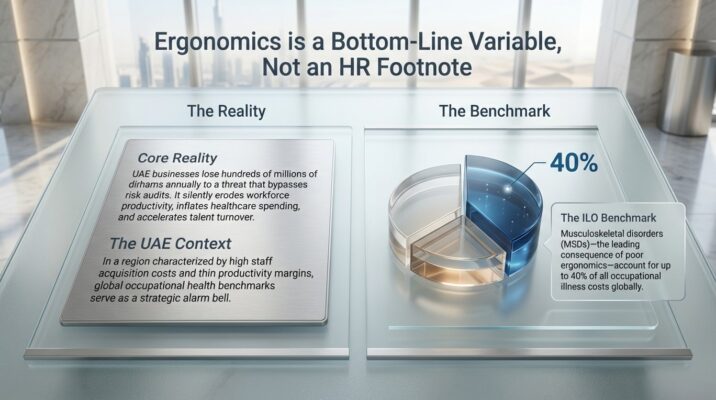
Every year, UAE businesses collectively lose hundreds of millions of dirhams to a threat most leadership teams never see on a balance sheet. It does not show up in quarterly forecasts, it is not flagged in risk audits, and it rarely appears in board presentations. Yet it silently erodes workforce productivity, inflates healthcare spending, accelerates talent turnover, and corrodes employee morale sometimes all at once.
The culprit is poor workplace ergonomics.
In a region where commercial real estate commands premium square-footage rates, where humidity and extreme heat define months of the year, where an overwhelmingly expatriate workforce spends longer hours at desks than the global average, and where a booming construction, tech, and finance sector demands peak cognitive performance the ergonomic quality of the office environment is not a luxury consideration. It is a bottom-line variable.
This in-depth report quantifies the true cost of poor ergonomics for UAE-based organizations, draws on international benchmarks and regional labor statistics, and equips facilities managers, HR directors, and C-suite leaders with the evidence they need to justify investment in quality office furniture and ergonomic workplace design. Whether your business operates from a glass tower in DIFC or a commercial park in Dubai Silicon Oasis, the data in this article is directly relevant to your workforce performance and expenditure.
KEY INSIGHT
Research published by the International Labor Organization (ILO) estimates that musculoskeletal disorders (MSDs) — the leading consequence of poor ergonomics — account for up to 40% of all occupational illness costs globally. For UAE companies operating with thin productivity margins and high staff acquisition costs, this statistic is a strategic alarm bell.
1. Understanding Ergonomics in the UAE Workplace Context
Ergonomics is the science of designing work environments, equipment, and processes to fit the capabilities and limitations of the human body. In practical terms for a UAE office setting, this means selecting the right office furniture — chairs, desks, monitor arms, keyboard trays configuring workstations to prevent repetitive strain, managing lighting and acoustics, and ensuring that the physical demands of sedentary work do not translate into chronic injury or cognitive fatigue.
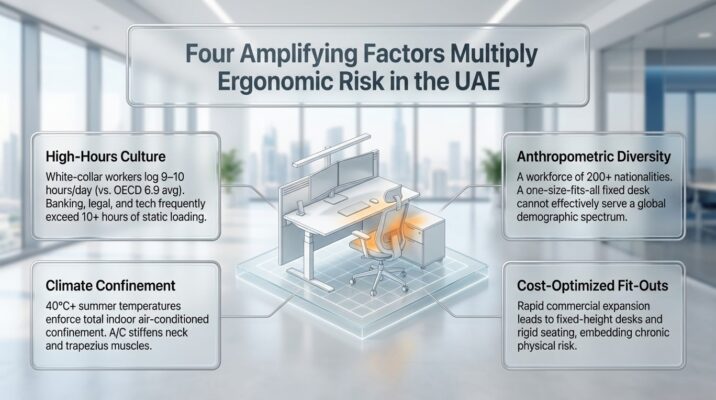
The UAE context adds several amplifying factors that make ergonomic risk particularly acute compared to other global business hubs:
A Predominantly Sedentary, High-Hours Workforce
According to the UAE Ministry of Human Resources and Emiratization (MOHRE), white-collar workers in the UAE regularly log 9 to 10 hours per day at their desks significantly above the OECD average of 6.9 hours. In industries such as banking, legal, media, and technology, screen time frequently exceeds 10 hours. This duration of seated, static posture dramatically amplifies the cumulative load on the spine, shoulders, and wrists.
Climate-Driven Indoor Confinement
Temperatures in the UAE routinely exceed 40°C between June and September, making outdoor mobility during working hours essentially impossible. Employees are confined to air-conditioned interiors for the majority of their waking hours, eliminating the incidental movement that counterbalances sedentary postures. Air conditioning itself introduces secondary ergonomic challenges: cold, dry air stiffens muscles, particularly the neck and trapezius group, while low humidity increases eye strain.
Multicultural Workforce Diversity
The UAE’s workforce comprises over 200 nationalities. Anthropometric variation differences in body dimensions across ethnicities means a single ‘standard’ chair or desk configuration cannot serve an Indian software engineer, a Somali logistics coordinator, and a Dutch financial analyst with equal effectiveness. One-size ergonomics is a myth, and in the UAE it is a demonstrably expensive one.
Rapid Office Expansion and Cost-Optimized Fit-Outs
The UAE’s extraordinary pace of commercial development has led many companies to priorities speed and cost in office fit-outs. The result is a proliferation of fixed-height desks, non-adjustable seating, and monitor placements that violate basic ergonomic guidelines all of which create silent, compounding injury risk for occupants working eight to ten hours daily.
2. The Financial Anatomy of Poor Ergonomics: Direct and Indirect Costs
To accurately quantify the cost of poor ergonomics, we must distinguish between direct costs — expenses that appear on invoices and insurance claims — and indirect costs, which are far larger and more insidious. Research consistently shows that for every AED 1 spent on direct ergonomic-related healthcare, businesses absorb AED 3 to AED 5 in indirect losses.
Direct Cost Category 1: Healthcare and Workers’ Compensation
Musculoskeletal disorders triggered or worsened by poor workplace ergonomics encompass lower back pain, cervical disc herniation, carpal tunnel syndrome, shoulder impingement, and chronic headaches associated with poor monitor positioning. These conditions generate direct costs in the following forms:
- Private health insurance claims for physiotherapy, orthopedic consultations, MRI scans, and prescription medication
- Group medical insurance premium increases following elevated claims history
- Workers’ compensation payouts where UAE Labor Law applies
- Emergency medical care for acute musculoskeletal episodes
A mid-sized UAE company of 200 employees with a mixed-quality seating environment can anticipate annual direct healthcare costs of AED 180,000 to AED 380,000 attributable to musculoskeletal complaints alone — based on per-capita MSD treatment costs benchmarked from the UAE’s private health insurance sector (2022–2024 data).
Direct Cost Category 2: Absenteeism
Absenteeism linked to ergonomic injuries is both measurable and significant. UAE Ministry of Health and Prevention data, supplemented by regional employer health surveys, indicates that ergonomic-related musculoskeletal disorders account for the second highest cause of sick leave in sedentary white-collar environments, behind respiratory illness. Each day of absence carries a fully loaded cost that includes salary continuation, temporary staffing or overtime redistribution, and project delay penalties.
Estimated Annual Absenteeism Cost by Company Size (UAE Context)
| Company Size | Avg. Absent Days/Employee/Year (MSD) | Affected Employees (est. 15%) | Daily Salary Cost (AED) | Total Annual Absenteeism Cost (AED) |
|---|---|---|---|---|
| 50 employees | 4.2 days | 8 | 950 | 31,920 |
| 100 employees | 4.2 days | 15 | 1,100 | 69,300 |
| 250 employees | 4.2 days | 38 | 1,200 | 191,520 |
| 500 employees | 4.2 days | 75 | 1,350 | 425,250 |
| 1,000 employees | 4.2 days | 150 | 1,500 | 945,000 |
Source: OfficeMaster.ae estimates based on MOHRE labor data, UAE private sector salary benchmarks, and ILO MSD prevalence rates (2023–2024).
Indirect Cost Category 1: Presenteeism — The Invisible Epidemic
Presenteeism the phenomenon of employees being physically present but cognitively and physically impaired is the largest and most underestimated dimension of poor ergonomic cost. A worker managing chronic lower back pain, tension headaches from monitor glare, or wrist discomfort from an unsupported keyboard position will not call in sick. They will arrive at their desk, log into their system, and deliver a fraction of their potential output.
Research published in the Journal of Occupational and Environmental Medicine estimates that presenteeism reduces individual productivity by 20 to 35% for employees with active musculoskeletal pain. At AED 1,200 per day for a mid-level knowledge worker, that translates to a presenteeism cost of AED 240 to AED 420 per impaired working day invisible on any timesheet, invisible to management, and never claimed from insurance.
CRITICAL BENCHMARK
A 2023 Cigna Healthcare Middle East Wellness Survey found that 68% of UAE employees reported experiencing physical discomfort related to their workspace in the past 12 months — yet fewer than 14% had formally reported it to their employer. The gap between actual ergonomic suffering and visible workplace injury data is enormous.
Indirect Cost Category 2: Talent Attrition and Recruitment
Chronic physical discomfort is a measurable driver of employee disengagement and voluntary turnover. Employees who associate their workplace with physical pain are significantly more likely to seek employment elsewhere. In the UAE’s hypercompetitive talent market where replacing a senior professional costs between 50% and 200% of their annual salary in recruitment, onboarding, and productivity ramp-up costs ergonomic-driven attrition is a strategic liability.
True Cost of Presenteeism vs. Absenteeism Comparison (Per 100 Employees)
| Cost Type | Estimated Annual Cost (AED) | Visibility to Management | Typical Insurance Coverage |
|---|---|---|---|
| Direct medical claims (MSD) | 120,000 – 240,000 | High | Partial |
| Absenteeism (MSD-related) | 180,000 – 360,000 | Medium | Salary continuation |
| Presenteeism (MSD-related) | 480,000 – 960,000 | Low to None | None |
| Staff turnover (ergonomic-linked) | 200,000 – 600,000 | Low | None |
| Total Estimated Burden | 980,000 – 2,160,000 | — | — |
Estimates derived from Cigna Middle East data, UAE HR benchmarking reports, and SHRM cost-of-turnover methodology adjusted for UAE salary structures.

3. Sector-by-Sector Exposure: Which UAE Industries Bear the Highest Ergonomic Risk?
Ergonomic risk is not uniform across industries. The following analysis identifies the sectors in the UAE where the cost burden of poor ergonomics is most severe, drawing on a combination of international occupational health data and UAE-specific workforce composition.
Financial Services and Banking
Dubai and Abu Dhabi’s financial districts host thousands of analysts, traders, compliance officers, and relationship managers who spend the majority of their working hours in front of multiple monitor screens. Multi-screen setups without proper monitor arm support create a chronic lateral neck rotation pattern. DIFC and ADGM-based firms typically have higher-than-average ergonomic awareness, but rapid headcount scaling during fintech growth phases has outpaced fit-out quality in many organizations.
Technology, Media, and Free Zone Companies
Dubai Internet City, Dubai Media City, Dubai Silicon Oasis, and TECOM collectively house tens of thousands of knowledge workers. The tech sector’s ‘startup culture’ aesthetic — characterized by open-plan layouts, fixed-height benching systems, and an emphasis on aesthetic over ergonomic function — creates exactly the conditions under which musculoskeletal risk accumulates over a 3–5 year employment tenure.
Government and Semi-Government Entities
UAE federal and emirate-level government entities employ hundreds of thousands of UAE nationals and residents in administrative, legal, and operational roles. Government offices frequently operate with aging furniture inventories and standardized procurement — meaning ergonomic deficiencies are systemic rather than individual. The implementation of UAE Vision 2031 and related nationalization (Emiratization) targets makes workforce wellness in government bodies a national competitiveness issue.
Legal, Consulting, and Professional Services
High-billing professional services firms in the UAE demand extreme cognitive output over extended hours. Partners and associates in law firms, consultancies, and accounting practices routinely log 12-hour desk days. The combination of extreme hours, high cognitive load, and often inadequate ergonomic support creates a disproportionate musculoskeletal burden in this sector.
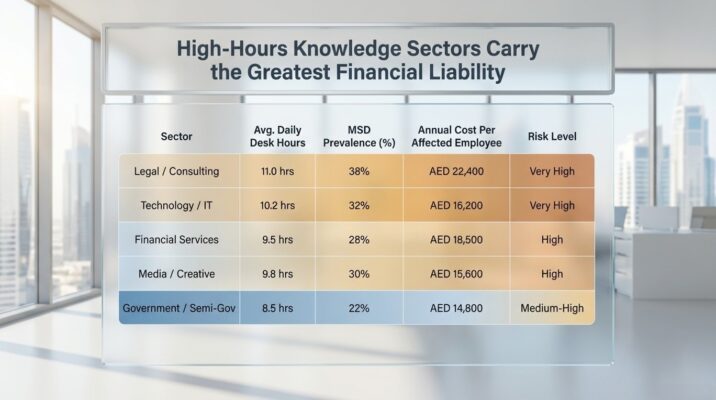
Ergonomic Risk & Cost Exposure by UAE Industry Sector
| Industry Sector | Average Daily Desk Hours | MSD Prevalence (%) | Annual Cost Per Affected Employee (AED) | Overall Risk Level |
|---|---|---|---|---|
| Financial Services | 9.5 hrs. | 28% | 18,500 | High |
| Technology / IT | 10.2 hrs. | 32% | 16,200 | Very High |
| Government / Semi-Gov. | 8.5 hrs. | 22% | 14,800 | Medium-High |
| Legal / Consulting | 11.0 hrs. | 38% | 22,400 | Very High |
| Media / Creative | 9.8 hrs. | 30% | 15,600 | High |
| Healthcare Administration | 8.0 hrs. | 19% | 12,900 | Medium |
| Retail / Real Estate | 8.2 hrs. | 21% | 13,400 | Medium |
| Logistics & Supply Chain | 7.5 hrs. | 17% | 11,200 | Medium-Low |
Source: ILO Ergonomics Sector Reports, Cigna MENA Workforce Health Survey 2023, and OfficeMaster.ae analysis.
4. Ergonomic Injury Catalogue: The Specific Conditions Costing UAE Businesses
Understanding which specific musculoskeletal conditions arise from poor office ergonomics enables targeted intervention. The following are the most prevalent and costly conditions observed in UAE desk-based workers:
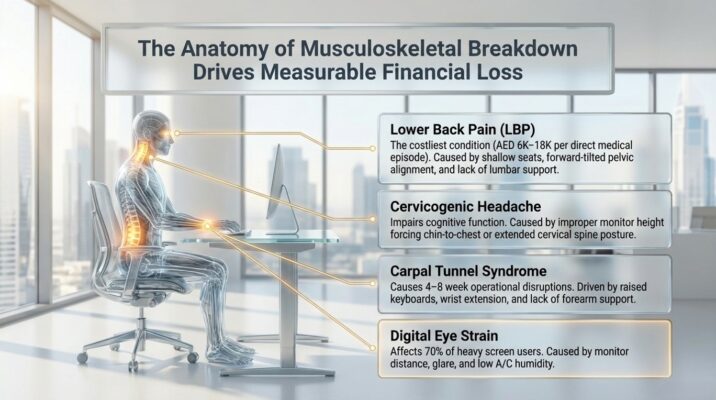
Lower Back Pain (LBP) — The UAE’s Most Costly Workplace Condition
Lower back pain is the single largest contributor to ergonomic-related cost in UAE office environments. Caused by poorly supported lumbar curvature, excessively forward-tilted pelvic alignment from shallow seats, and prolonged static loading of intervertebral discs, LBP in office settings is almost entirely preventable with correctly specified ergonomic seating. Yet it remains endemic. The direct cost of a single episode of work-related LBP requiring physiotherapy, MRI, and specialist consultation in a UAE private hospital typically ranges from AED 6,000 to AED 18,000. In chronic cases requiring surgical intervention, costs can exceed AED 80,000.
Cervicogenic Headache and Neck Pain
Monitor positioning violations screens placed too low (forcing chin-to-chest posture), too high (extending the cervical spine), or off to one side generate sustained muscular tension in the cervical extensors and upper trapezius. This manifests as tension headache and neck pain that impairs cognitive function, reduces reading comprehension speed, and increases error rates in precision work. For a 100-person firm, unaddressed cervicogenic headache presentations can collectively account for thousands of lost productive hours annually.
Carpal Tunnel Syndrome and Repetitive Strain Injury
Wrist extension caused by raised keyboard positions, insufficient forearm support, and mouse placement that requires repeated reach across a desk surface are the primary drivers of carpal tunnel syndrome and related repetitive strain injuries (RSI) in office workers. Advanced cases require corticosteroid injection or surgery, with recovery periods of 4 to 8 weeks during which full keyboard and mouse use is restricted. For roles that are computationally intensive — coding, data analysis, legal drafting this represents a severe operational disruption.
Eye Strain and Digital Vision Syndrome
While not a musculoskeletal injury, digital eye strain (also called Computer Vision Syndrome) affects an estimated 70% of heavy screen users and is directly linked to monitor height, screen brightness calibration, glare exposure, and viewing distance. Symptoms including dry eyes, blurred vision, and frontal headaches reduce reading speed, increase error rates, and accelerate decision fatigue all of which have measurable productivity and quality implications.
5. The ROI of Ergonomic Investment: What the Evidence Tells UAE Decision-Makers
The business case for ergonomic investment is among the best-evidenced propositions in occupational health economics. The question for UAE business leaders is not whether ergonomic improvement delivers return — the evidence is overwhelming that it does. The question is how to calculate that return with enough precision to justify board-level investment approval.
The Washington State Department of Labor Studies
One of the most frequently cited bodies of evidence in ergonomics ROI literature comes from Washington State’s decade-long analysis of ergonomic interventions across 250 companies. The data showed that every USD 1 invested in ergonomic improvement generated between USD 2.40 and USD 10.10 in reduced workers’ compensation costs, lower absenteeism, and higher productivity a median ROI of 4.1x. Adjusted to UAE purchasing power parity and AED-denominated costs, this translates to compelling financial justification for most Dubai and Abu Dhabi-based businesses.
Productivity Gains from Ergonomic Seating and Adjustable Desks
A meta-analysis of 166 studies published in Ergonomics (Taylor & Francis) found that ergonomic interventions specifically the replacement of non-adjustable seating with properly specified task chairs and the introduction of sit-stand desks produced an average productivity improvement of 17.8% in knowledge worker populations. For a UAE professional earning AED 20,000 per month, a 17.8% productivity gain is worth AED 3,560 in recovered productive value every month against a one-time ergonomic chair investment of AED 1,800 to AED 4,500.
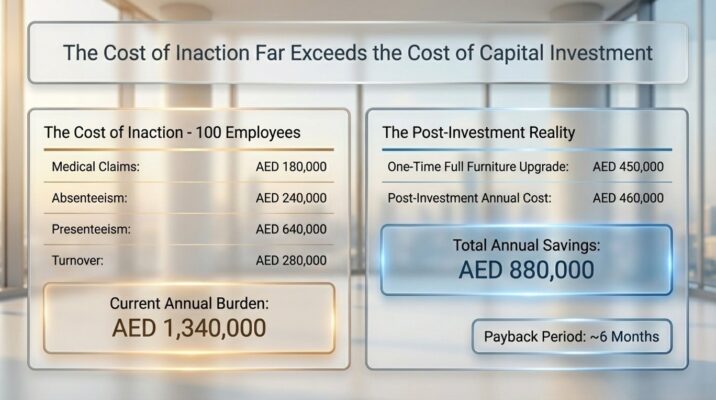
ROI Analysis — Ergonomic Investment vs. Cost of Inaction (100-Person UAE Company)
| Category | Annual Cost of Poor Ergonomics (AED) | Post-Investment Annual Cost (AED) | Annual Saving (AED) |
|---|---|---|---|
| Direct medical claims | 180,000 | 72,000 | 108,000 |
| Absenteeism (MSD days) | 240,000 | 84,000 | 156,000 |
| Presenteeism loss (est. 20%) | 640,000 | 192,000 | 448,000 |
| Turnover (ergonomic-linked) | 280,000 | 112,000 | 168,000 |
| Total Annual Burden / Saving | 1,340,000 | 460,000 | 880,000 |
| One-Time Investment Cost | — | 450,000 | — |
| Payback Period | — | — | ~6 months |
OfficeMaster.ae proprietary ROI model based on international ergonomics ROI literature and UAE-specific salary/healthcare cost data.
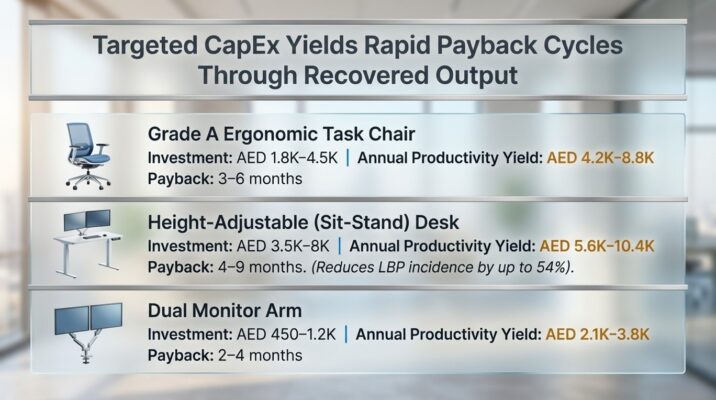
Cost of Ergonomic Office Furniture vs. Conservative Productivity Recovery Estimate
| Equipment Item | Investment per Workstation (AED) | Est. Annual Productivity Recovery per Employee (AED) | Payback Period |
|---|---|---|---|
| Ergonomic task chair (Grade A) | 1,800 – 4,500 | 4,200 – 8,800 | 3 – 6 months |
| Height-adjustable (sit-stand) desk | 3,500 – 8,000 | 5,600 – 10,400 | 4 – 9 months |
| Monitor arm (dual) | 450 – 1,200 | 2,100 – 3,800 | 2 – 4 months |
| Ergonomic keyboard & mouse set | 300 – 750 | 1,400 – 2,600 | 2 – 4 months |
| Laptop riser + external keyboard | 180 – 480 | 1,200 – 2,200 | 2 – 3 months |
| Lumbar support cushion | 120 – 350 | 800 – 1,600 | 1 – 3 months |
| Full workstation ergonomic package | 6,350 – 15,280 | 15,300 – 29,400 | 4 – 8 months |
6. UAE Legal and Regulatory Framework: Compliance Obligations and Employer Liability
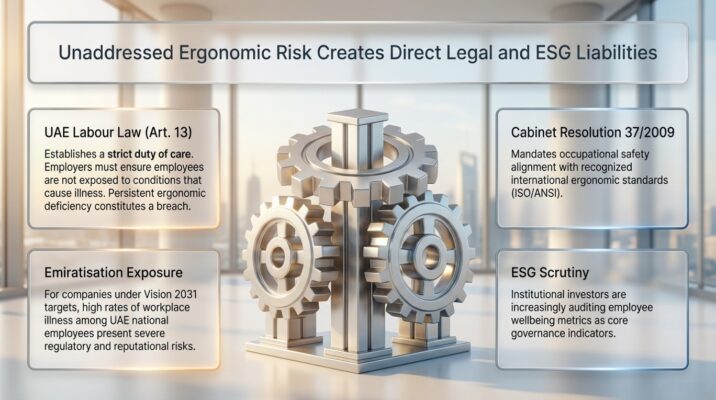
UAE Federal Law No. 33 of 2021 (the New UAE Labor Law) and its implementing Cabinet Resolutions establish an employer’s duty to provide a safe, healthy working environment. While the law’s primary ergonomics provisions focus on physically demanding occupations, the general duty of care extends to office environments — and increasingly, UAE courts and MOHRE dispute panels are recognizing ergonomic injury as a legitimate occupational health claim.
Key compliance considerations for UAE employers include:
- Article 13 of UAE Labor Law: Employers must ensure employees are not exposed to workplace conditions that cause illness or injury. Persistent provision of ergonomically deficient workstations may constitute a breach of this duty.
- UAE Cabinet Resolution No. 37 of 2009: Governs occupational safety standards and requires workplaces to align with recognized international safety guidelines — which include ergonomic standards from ISO and ANSI/HFES.
- Health Insurance Law (Emirates): Mandatory health insurance coverage for employees creates a direct financial incentive for employers to reduce MSD claims through preventive ergonomic investment.
- Emiratization Compliance: For companies under Emiratization targets, high rates of workplace-related illness and injury among UAE national employees represent both a reputational and regulatory risk.
Beyond legal exposure, forward-looking UAE organizations are beginning to treat ergonomic standards as a component of their ESG (Environmental, Social, and Governance) reporting — particularly as regional and global institutional investors increase scrutiny of employee wellbeing metrics.
7. Actionable Ergonomic Improvement Roadmap for UAE Businesses
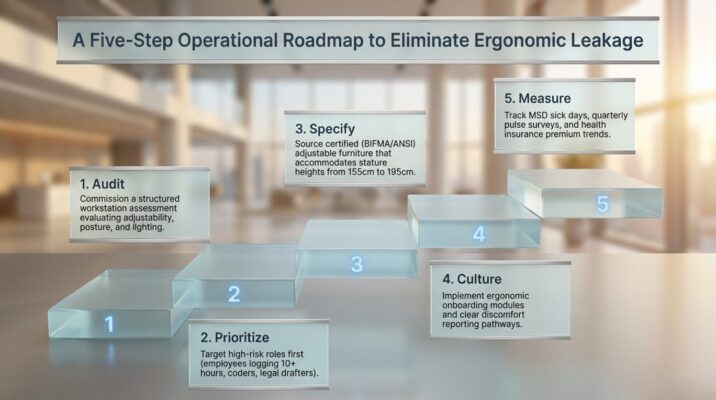
The following step-by-step roadmap is designed to guide UAE organizations from ergonomic risk awareness to measurable improvement, regardless of company size or current fit-out quality.
Step 1: Conduct a Workstation Ergonomic Audit
Before any investment decision is made, commission a structured ergonomic assessment of all workstations. This should evaluate chair adjustability, desk height relative to occupant stature, monitor distance and elevation angle, keyboard and mouse positioning, lighting conditions, and foot support. Many specialist UAE office furniture consultants, including OfficeMaster.ae, offer complimentary workspace consultations as part of a fit-out engagement.
Step 2: Priorities High-Risk Employees and Roles
Not all employees carry equal ergonomic risk. Priorities ergonomic upgrades for employees who: log more than 8 hours daily at a fixed workstation, have reported musculoskeletal discomfort in the past 12 months, are in roles requiring sustained keyboard/mouse use (coding, legal drafting, financial analysis), or have existing conditions that are aggravated by sedentary work.
Step 3: Specify Ergonomic Office Furniture Purposefully
When selecting office furniture for a UAE environment, the following specifications are non-negotiable for ergonomic compliance:
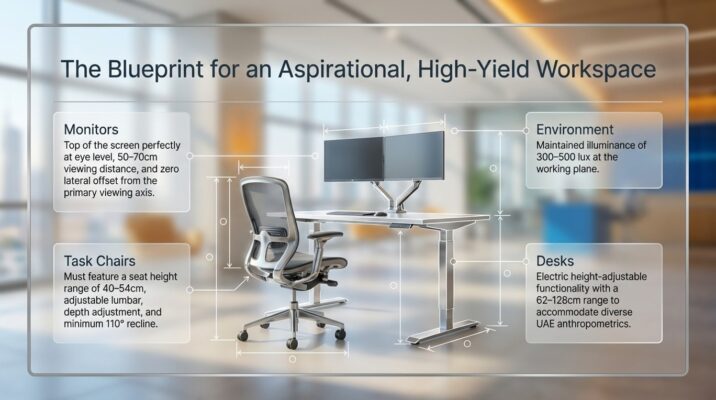
- Task chairs: Seat height range 40–54 cm, adjustable lumbar support, armrests adjustable in height and width, seat depth adjustment, tilt tension control, and backrest recline of at least 110 degrees.
- Desks: Height-adjustable models (electric or manual) providing a range of 62–128 cm are strongly preferred. Fixed-height desks should only be used where sit-stand is budgetarily impossible, and must be paired with height-adjustable chairs and footrests.
- Monitor positioning: Top of screen at or slightly below eye level, viewing distance 50–70 cm, monitor tilt 10–20 degrees, zero lateral offset from the primary viewing axis.
- Lighting: Maintained illuminance of 300–500 lux at the working plane, supplemented with individually controllable task lighting to eliminate shadows and reduce digital eye strain.
If your organization is sourcing office furniture in Dubai or Abu Dhabi, ensure suppliers provide certified ergonomic products — ideally with BIFMA, ANSI/HFES, or equivalent certification — and can demonstrate adjustability ranges that accommodate the full anthropometric diversity of a UAE workforce.
Step 4: Establish an Ongoing Ergonomic Culture
Equipment alone is insufficient. Ergonomic benefit is only realized when employees know how to use adjustable furniture correctly and are encouraged to do so. Implement:
- A brief ergonomic onboarding module for all new hires
- Quarterly reminders encouraging workstation self-assessment
- A clear reporting pathway for musculoskeletal discomfort before it becomes a clinical condition
- Manager training on identifying early signs of ergonomic distress in their teams
Step 5: Measure, Report, and Iterate
Ergonomic investment should be tracked with the same rigor as any other capital expenditure. Key performance indicators to monitor include: MSD-related sick leave days per quarter, physiotherapy claims per 100 employees, employee-reported discomfort scores (measured via quarterly pulse surveys), productivity metrics in roles that received ergonomic upgrades, and health insurance premium trends year-over-year.
Frequently Asked Questions: Ergonomics and UAE Business Costs
The total cost of poor ergonomics for UAE companies — including direct healthcare claims, absenteeism, presenteeism, and talent turnover — typically ranges from AED 9,800 to AED 21,600 per affected employee annually. For a 100-person company where 25–35% of employees experience ergonomic-related discomfort, total annual losses can reach AED 980,000 to AED 2.1 million.
The most prevalent ergonomic conditions in UAE office environments are lower back pain, neck and shoulder pain (cervicogenic pain), carpal tunnel syndrome, tension headaches from poor monitor placement, and digital eye strain. Lower back pain is consistently identified as the single largest driver of MSD-related sick leave and healthcare claims in sedentary work environments.
While UAE Labor Law does not specify ergonomic standards by name, employers have a statutory duty under Federal Law No. 33 of 2021 to provide a safe working environment that does not cause injury or illness. Persistent ergonomic deficiencies that result in employee injury can constitute a breach of this duty. UAE companies subject to international compliance frameworks (e.g., ISO 45001 occupational health and safety) have additional specific ergonomic obligations.
A quality ergonomic workstation for a UAE office — comprising an adjustable task chair, a fixed or sit-stand desk, a monitor arm, and ergonomic input devices — costs between AED 6,350 and AED 15,280 per workstation. Given that the annual cost of poor ergonomics per affected employee can exceed AED 18,000, this represents a payback period of under one year in most documented cases.
Yes. A meta-analysis of 166 studies published in the journal Ergonomics found that ergonomic office furniture interventions produced an average productivity improvement of 17.8% in knowledge workers. For Dubai-based businesses with average white-collar salaries of AED 15,000–25,000 per month, the productive value recovered from ergonomic improvement typically ranges from AED 2,700 to AED 4,450 per employee per month.
Dubai’s extreme summer heat (regularly above 40°C from June–September) confines employees to air-conditioned environments for extended periods, eliminating incidental movement that would otherwise counteract sedentary posture. Air conditioning can also stiffen muscles — particularly in the neck and upper back — while low indoor humidity contributes to digital eye strain. These climate-specific factors increase the cumulative ergonomic risk relative to temperate climates.
Presenteeism refers to employees who are physically present at work but cognitively and physically impaired — typically due to pain or discomfort. It is estimated to cost UAE employers 2 to 4 times more than absenteeism because it is invisible to management and absent from health insurance data. For a 100-person company, presenteeism related to ergonomic discomfort can cost AED 480,000 to AED 960,000 annually.
The documented ROI of ergonomic office furniture investment typically ranges from 2.4x to 10.1x, with a median of approximately 4.1x based on Washington State and European occupational health studies. In a UAE context — factoring in premium healthcare costs, high talent acquisition expenses, and long working hours — the ROI is consistently above 3x when measured over a 24-month period.
A structured ergonomic risk assessment for a UAE office should evaluate: workstation height alignment relative to occupant anthropometrics, chair adjustability and lumbar support, monitor positioning (height, distance, tilt), keyboard and mouse placement, lighting levels and glare sources, break frequency and movement opportunities, and self-reported discomfort scores from employees. Professional ergonomic assessments can be arranged through specialist office furniture consultants in Dubai and Abu Dhabi.
Leading ergonomic chair and desk brands available through premium office furniture Dubai suppliers include Officemaster and regional equivalents. When purchasing, look for documented adjustability ranges that accommodate stature heights from 155 cm to 195 cm — the range needed to serve the UAE’s diverse multinational workforce.
Chronic physical pain — the primary outcome of poor ergonomics — is strongly correlated with reduced mood, elevated anxiety, and symptoms of workplace-related burnout. UAE-based research published through the Dubai Health Authority and the Emirates Medical Association has highlighted the bidirectional relationship between musculoskeletal pain and psychological wellbeing. Employees managing persistent pain are 2.1 times more likely to report disengagement, and 1.7 times more likely to consider resigning within 12 months.
The most frequently observed ergonomic mistakes in UAE offices include: purchasing non-adjustable fixed-height desks for all occupants regardless of stature, selecting task chairs based on aesthetics rather than adjustability, positioning monitors too low (on desk surfaces without risers), failing to provide keyboard trays for desks with non-standard heights, ignoring laptop users (who face extreme neck flexion risks without external monitors), and providing no ergonomic training during onboarding.
Yes — especially given the extreme seated hours logged in UAE office environments. Sit-stand desks break the static loading cycle that accumulates spinal disc pressure, reduce lower back pain incidence by up to 54% (according to a 2018 Cochrane Review meta-analysis), and have been shown to improve afternoon energy levels and focus in knowledge workers. For UAE companies where employees sit for 9 to 11 hours daily, sit-stand desks represent one of the highest-return individual ergonomic investments available.
During Ramadan, UAE Labor Law reduces working hours by 2 hours per day. However, the compressed workday — combined with fasting, altered sleep patterns, and reduced hydration — creates a heightened ergonomic risk environment. Employees are more susceptible to postural fatigue and musculoskeletal discomfort during fasting states. Ergonomically optimized workstations that reduce postural effort are measurably more important during Ramadan than during standard working periods.
OfficeMaster.ae is a leading specialist in ergonomic office furniture for businesses across the UAE, offering a curated range of height-adjustable desks, certified task chairs, monitor arms, and complete workspace ergonomic packages for offices of all sizes. With consultative project services, showroom access, and installation support across Dubai, Abu Dhabi, and the wider UAE, OfficeMaster.ae provides end-to-end ergonomic workspace solutions backed by product expertise and competitive commercial pricing.
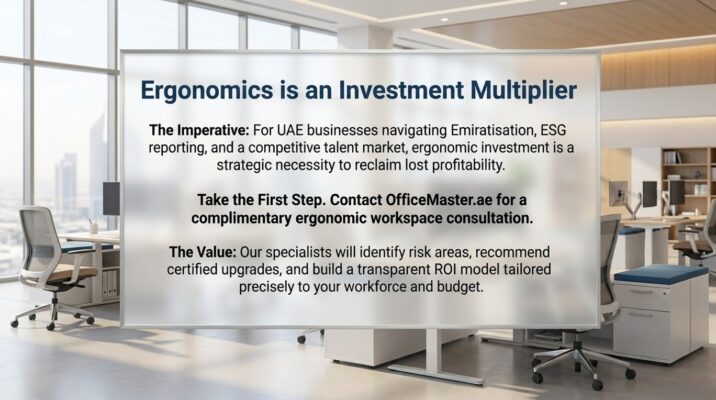
Ergonomics Is Not an Overhead — It Is an Investment Multiplier
The evidence assembled in this report makes a single, unambiguous argument: poor workplace ergonomics is one of the most expensive and most avoidable cost centers in the modern UAE business. It generates direct healthcare expenditure, inflates absenteeism, creates a vast and invisible ocean of presenteeism loss, and quietly accelerates staff turnover in a talent market where replacement costs are punishing.
Conversely, the investment case for high-quality ergonomic office furniture — from certified task chairs and sit-stand desks to monitor positioning systems and ergonomic input devices — is supported by decades of occupational health research, UAE-specific workforce data, and documented ROI multiples that would satisfy any rigorous capital expenditure analysis. A business that invests AED 450,000 in ergonomic workstations for 100 employees can realistically expect to recover that investment in under a year while unlocking persistent productivity gains, reduced insurance costs, and measurable improvements in employee wellbeing and retention.
For UAE businesses navigating Vision 2031 workforce development targets, Emiratization obligations, ESG reporting requirements, and an increasingly competitive talent acquisition environment, ergonomic workplace investment is not a wellness nicety. It is a strategic imperative.
Take the First Step
Contact OfficeMaster.ae today for a complimentary ergonomic workspace consultation. Our specialists will assess your current office environment, identify risk areas, and recommend a tailored ergonomic upgrade plan — with transparent ROI modelling for your specific workforce and budget.