


Blog
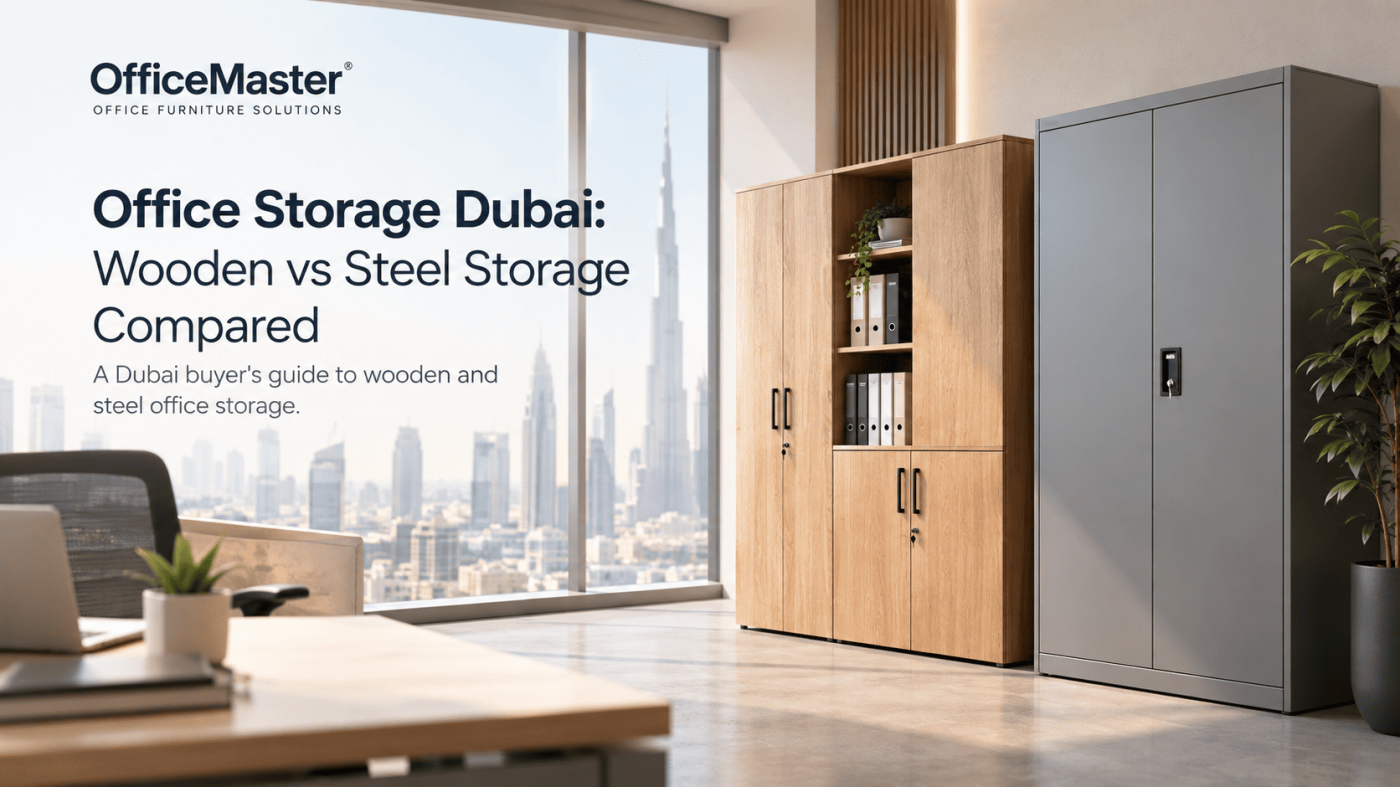
Office Storage Dubai: Wooden vs Steel Storage Compared
Oct
The Furniture Category Nobody Budgets for Until the Office Is Already Full
Storage is almost always an afterthought in an office fit-out budget. Desks, chairs, and the reception area get specified first; storage gets whatever’s left over, often ordered in a rush once filing cabinets and stray boxes have already started colonizing desk corners and the floor beneath meeting tables. By then, the decision is reactive rather than planned — whatever’s in stock, in whatever finish is available, sized to fit whatever gap remains.
That’s a missed opportunity, because storage affects more of an office’s daily function than almost any other furniture category: document compliance, confidentiality, fire safety, and how cluttered or composed a space feels to anyone walking through it. This guide compares the two primary storage materials specified in Dubai offices — wooden and steel — and how to match each to the right zone, rather than defaulting to whichever one the fit-out happens to have left over in the budget.
Measure your actual document and filing volume before ordering storage, not your current storage volume. Most offices under-order because they’re replacing what they had, not accounting for what they’ve accumulated since the last fit-out — storage needs tend to grow faster than headcount in document-heavy industries like law, finance, and real estate.
Wooden vs Steel Storage: A Side-by-Side Comparison
The two materials serve genuinely different purposes, and confusing them usually means paying a premium for a feature the space doesn’t actually need — or missing a compliance requirement that matters more than the finish.
| Factor | Wooden Storage | Steel Storage |
|---|---|---|
| Primary strength | Aesthetic integration with executive and client-facing spaces | Security, fire resistance, load capacity |
| Security rating | Basic locks, not fire-rated | High-security locks, fire-rated options available |
| Load capacity | Moderate — fine for files and stationery | High — suited to heavy archives and equipment |
| Aesthetic flexibility | High — wide range of finishes and veneers | Lower — functional, industrial by default |
| Best suited to | Executive offices, reception, client-visible areas | Back-office archives, server rooms, confidential records |
A directional comparison — most offices specify both, matched to the zone rather than one material throughout.
Wooden Storage: Where Appearance Matters as Much as Function
Wooden storage units — credenzas, sideboards, veneer-finished cabinets — earn their place anywhere storage is visible to clients or senior staff. A matching wooden credenza behind an executive desk or along a boardroom wall reads as furniture, not utility equipment, and can be specified to match the same finish language as the Executive Desks or Boardroom Tables already in the room. Browse our Wooden Storages range.
Steel Storage: Where Security and Capacity Come First
Steel storage is the right choice wherever security, fire resistance, or raw load capacity matters more than how the unit looks. Financial services firms, law practices, and government-adjacent offices frequently have regulatory or internal compliance requirements around document retention and confidentiality that only fire-rated, lockable steel storage can satisfy. It’s also simply more durable under heavy daily use — a steel filing cabinet in a busy back office will outlast a wooden equivalent handling the same volume of use. See our Steel Storages collection.
The most common storage mistake we see isn’t choosing the wrong material — it’s treating storage as a single office-wide decision instead of a zone-by-zone one. A law firm, for example, typically needs fire-rated steel storage for client files in the back office, alongside wooden credenzas in partner offices and reception where the same storage function needs to look like furniture rather than equipment. Specifying one material throughout usually means either overspending on security nobody needs in a reception area, or underspecifying compliance-critical storage in the back office.
Storage and Confidentiality: A Compliance Consideration, Not Just a Furniture One
For client-facing businesses — the kind we covered in our Real Estate Agency Office Setup guide — storage is also where confidentiality commitments are physically enforced. Contracts, client financial details, and identification documents collected during a transaction need to sit somewhere lockable, and in regulated industries, somewhere fire-rated. This is a conversation worth having with your compliance or legal team before furniture is specified, not after a storage unit has already been ordered in the wrong configuration.
Storage by Zone: A Practical Specification Table
| Zone | Recommended Storage | Why |
|---|---|---|
| Executive Offices | Wooden Storage | Matches desk and finish language, client-visible |
| Reception & Boardrooms | Wooden Storage | First-impression area, low security need |
| Back-Office Archives | Steel Storage | High capacity, fire resistance, not client-visible |
| HR & Finance Departments | Steel Storage, lockable | Confidential records, regulatory compliance |
| Open-Plan Desk Clusters | Steel or mixed, lower-profile units | Durability under daily shared use |
How Storage Placement Affects Floor Space and Layout
Storage units are easy to over-order “just in case,” and every extra cabinet is floor space that isn’t being used for desks or collaboration zones — a real cost in a market where commercial floor space is one of the most expensive line items in a Dubai lease. Right-sizing storage to actual document volume, rather than defaulting to a standard unit count per employee, is one of the more overlooked ways to reclaim usable floor area without touching the desking plan at all.
Common Mistakes When Specifying Office Storage
- Ordering storage last. When storage is an afterthought, it’s specified around whatever floor space is left, rather than planned into the layout from the start.
- Using one material for every zone. As covered above, matching material to zone — wood for visible areas, steel for security and capacity — avoids both overspend and compliance gaps.
- Underestimating future document volume. Storage needs tend to grow with the business, especially in document-heavy industries, so sizing storage to current volume alone often means a costly reorder within a few years.
- Overlooking fire rating requirements. Certain regulated industries require fire-rated storage for specific document categories — a detail easy to miss if storage is treated as a purely aesthetic decision.
Coordinating Storage With a Full Fit-Out
Storage capacity is closely tied to the broader layout and joinery decisions made during a fit-out — built-in storage, for instance, is often a joinery decision rather than a furniture one. If your project includes custom millwork or built-in storage as part of a complete interior design scope, our design partner DesignMaster.ae covers this kind of integrated planning, including the joinery and carpentry considerations detailed in their guide to joinery and carpentry in interior design. We recommend involving both furniture and fit-out planning early if built-in storage is part of your brief, since the two are easier to coordinate before either is finalized.
A Glossary of Storage Terms Worth Knowing Before You Buy
Storage specifications come with their own vocabulary, and knowing a few key terms makes it much easier to compare quotes and avoid paying for — or missing — a feature that matters.
| Term | What It Means |
|---|---|
| Fire Rating | A certified duration a storage unit protects its contents from fire, commonly expressed in minutes (e.g. 30, 60, or 120 minutes) |
| Load Rating | The maximum weight a shelf or drawer is rated to carry safely without deforming over time |
| High-Security Lock | A locking mechanism rated beyond a standard cam lock, often with pick- and drill-resistance certification |
| Mobile Shelving | Shelving units mounted on tracks that compress together, maximizing storage density in a fixed footprint |
| Veneer Finish | A thin layer of real wood applied over a core material, giving wooden storage its finish without the cost of solid wood |
Total Cost of Ownership: Wooden vs Steel Storage
As with flooring, the cheaper option upfront isn’t always the cheaper option over the life of the unit. Comparing total cost of ownership rather than purchase price alone gives a more accurate picture.
| Cost Factor | Wooden Storage | Steel Storage |
|---|---|---|
| Relative upfront cost | Moderate to high, depending on finish | Low to moderate |
| Typical lifespan | 10–15 years with care | 15–20+ years, very low wear under normal use |
| Maintenance | Occasional polishing, sensitive to moisture and scratches | Minimal — wipe-clean, resistant to daily wear |
| Compliance cost avoidance | Limited — rarely meets fire-rating requirements | High — avoids costly compliance retrofits later |
Directional comparison — request itemized quotes for your specific project before budgeting.
A Simple Procurement Process for Office Storage
- Audit current document and filing volume. Count what actually exists today across departments, not an estimate from memory.
- Identify compliance and confidentiality requirements. Loop in legal, HR, or compliance teams early to flag any fire-rating or security requirements before units are selected.
- Map storage needs to zones. Decide which areas are client-visible (favoring wood) and which are security- or capacity-critical (favoring steel).
- Specify with growth in mind. Order for projected volume 2–3 years out, not just current volume, particularly in document-heavy departments.
- Coordinate with layout and joinery. Confirm whether any storage is built-in versus freestanding before finalizing the floor plan, since this affects both furniture and fit-out budgets.
Sustainability Considerations in Office Storage
Storage units, particularly steel cabinets, are typically among the longest-lived pieces of furniture in an office, which gives them a naturally lower lifecycle impact than shorter-lived categories. Steel is also widely recyclable at end of life. For wooden storage, sourcing from manufacturers who use responsibly managed timber and low-VOC finishes reduces both the environmental and indoor air quality impact — worth asking about specifically if your organization tracks sustainability credentials as part of procurement.
Storage Requirements by Industry
Compliance and practical storage needs vary significantly by sector, and what’s standard practice in one industry can be entirely unnecessary — or dangerously insufficient — in another.
| Industry | Typical Storage Priority | Recommended Approach |
|---|---|---|
| Legal | Client confidentiality, long-term file retention | Fire-rated, lockable steel storage for all client files |
| Financial Services | Regulatory document retention, audit trails | High-security steel storage, often with access logging |
| Healthcare | Patient confidentiality, medical record retention | Lockable steel storage, restricted access by role |
| Government / Semi-Government | Security clearance, long-term archival | High-security, fire-rated steel, often custom-specified |
| Tech / Startups | Equipment storage, minimal paper documentation | Light steel or mixed storage, low footprint |
| Real Estate / Brokerage | Client documents, presentation-quality front office | Wooden storage front-of-house, steel for back-office files |
Custom vs Off-the-Shelf Storage
Off-the-shelf storage units cover the majority of standard office needs at a lower cost and shorter lead time than custom options. Custom storage becomes worth considering in a few specific scenarios: when a space has unusual dimensions that standard units can’t fit efficiently, when storage needs to match a very particular finish language for a high-end executive or client-facing area, or when a built-in solution is more space-efficient than any freestanding unit available. As a locally based manufacturer, OfficeMaster can produce custom storage configurations without the extended lead times that custom orders from overseas suppliers typically carry — the same local manufacturing advantage detailed in our guide to UAE furniture manufacturing.
Storage Accessories and Organization Systems
The storage unit itself is only part of the picture — how it’s organized internally determines whether it actually stays functional day to day. A few accessories worth specifying alongside the base unit:
- Hanging file frames keep suspension files upright and accessible rather than sliding into a disorganized pile at the back of a drawer.
- Adjustable shelf dividers allow a single shelving unit to accommodate both large binders and smaller stationery without wasted vertical space.
- Labeling systems on drawer fronts and shelf edges make it dramatically faster for any employee — not just the person who organized the unit — to find what they need.
- Lockable drawer inserts allow a single steel unit to combine open general storage with a smaller secured compartment for sensitive items, avoiding the need for an entirely separate locked cabinet in some cases.
A Quick Buying Checklist
- Have you measured actual current document and equipment volume, not just current storage capacity?
- Have compliance, legal, or HR teams confirmed any fire-rating or security requirements?
- Have you mapped which zones are client-visible versus back-office?
- Have you accounted for growth over the next 2–3 years, not just current headcount?
- Have you confirmed lead times, especially for any custom or fire-rated units?
- Have you coordinated with your fit-out or interior design team if any storage is built-in?
Case Study: A Healthcare Clinic’s Storage Specification in Dubai Healthcare City
A multi-specialty clinic in Dubai Healthcare City needed storage for patient records alongside a reception and consultation area that still needed to feel calm and non-clinical for visiting patients. The specification split cleanly by zone: lockable steel storage with restricted role-based access for the records room holding patient files, and wooden storage in the reception and consultation rooms to maintain a warmer, less institutional atmosphere for patients. The approach satisfied the clinic’s patient confidentiality obligations in the back office while keeping the patient-facing areas visually consistent with the rest of the clinic’s calming interior design.
Case Study: A Tech Company’s Open-Plan Storage Rethink in Dubai Internet City
A growing tech company in Dubai Internet City had accumulated mismatched storage units across its open-plan floor as headcount scaled, with no consistent material or finish. A storage audit found the business held very little genuinely confidential paper documentation — most records were digital — but still needed secure storage for laptops, equipment, and occasional contracts. The revised specification replaced the mismatched units with low-profile steel storage integrated into the desk clusters for daily equipment use, plus a single small steel filing cabinet for the handful of physical documents that required it. The result freed up several square meters of floor space previously occupied by underused storage furniture, which was reallocated to additional desking.
Case Study: A Law Firm Storage Specification in DIFC
A mid-sized law firm relocating within DIFC initially planned to furnish the entire office in matching wooden storage for visual consistency with their existing executive furniture. During specification review, the firm’s compliance requirements for client file retention made fire-rated, lockable steel storage non-negotiable for their records room. The final specification kept wooden credenzas in partner offices and the reception area, while the back-office records room was fitted with fire-rated steel filing cabinets — meeting both the firm’s compliance obligations and its client-facing aesthetic standard, at a lower overall cost than an all-wood specification would have required once compliant, fire-rated wooden alternatives were priced.
Related Reading
- The Complete Guide to Acoustic Office Furniture in Dubai
- Office Flooring Guide Dubai: Carpet Tiles vs Parquet vs Vinyl
- Real Estate Agency Office Setup: Furniture as a Sales Tool
- Maximizing Commercial Floor Space with Modular Workstation Clusters
- Why “Made in Dubai” Is a Strategic Advantage for B2B Procurement
- Joinery and Carpentry Difference in Interior Design — DesignMaster.ae
Frequently Asked Questions
Neither is universally better — they serve different purposes. Wooden storage suits client-visible areas like executive offices and reception, where appearance matters most. Steel storage suits back-office, security-sensitive, or high-capacity needs, where fire resistance and load capacity matter more than finish.
Yes, fire-rated steel storage is widely available and is the standard choice for any organization with regulatory or internal compliance requirements around document retention, particularly in finance, legal, and government-adjacent sectors.
Wooden storage can include basic locking mechanisms, but it generally doesn’t match the fire resistance or high-security locking of steel storage. For genuinely confidential or regulated documents, steel storage is the safer specification even if the unit sits in a less visible area.
No — most well-specified offices mix materials by zone, using wooden storage in client-visible areas and steel storage in back-office, security, or high-capacity zones. A single material throughout usually means compromising on either appearance or compliance somewhere in the building.
This varies significantly by industry — a document-heavy business like a law firm or accountancy needs considerably more storage per employee than a tech company operating largely digitally. It’s best to measure actual current document volume and project growth, rather than using a generic per-employee benchmark.
Yes. Over-ordering storage “just in case” uses floor space that could otherwise support desks or collaboration areas. Right-sizing storage to actual document volume, rather than a default unit count, is a practical way to reclaim usable floor area without changing the desking layout.
Built-in storage is worth considering when it’s part of a broader joinery or millwork scope within a fit-out, since it can be designed to match the room’s architecture more seamlessly than freestanding furniture. It’s typically coordinated with an interior design and fit-out team rather than specified as furniture alone.
A fire rating indicates how long a storage unit is certified to protect its contents from fire exposure, typically expressed in minutes — for example, a 60-minute rated cabinet is certified to keep its interior below a damaging temperature for 60 minutes of fire exposure. This is a standard specification to request for any storage holding documents that must survive a fire incident.
Both can be reasonably sustainable choices depending on sourcing. Steel storage tends to have a very long lifespan and is widely recyclable at end of life. Wooden storage sourced from responsibly managed timber with low-VOC finishes also performs well — the better question to ask any supplier is about their specific sourcing and finishing practices rather than assuming one material is inherently greener.
Mobile shelving is a system of shelving units mounted on tracks that compress together when not in use, maximizing storage density within a fixed footprint. It’s typically specified for archive rooms or document-heavy departments where floor space is limited but storage volume is high, rather than for general office storage needs.
With a locally based manufacturer, custom storage configurations can generally be produced in a matter of weeks rather than the months typically required for custom orders shipped from overseas, since there’s no international shipping or customs clearance involved.
Yes. Legal, financial services, healthcare, and government sectors typically require fire-rated, high-security steel storage due to regulatory and confidentiality obligations, while tech companies and startups with mostly digital records generally need far less formal document storage, prioritizing equipment storage instead.
Hanging file frames, adjustable shelf dividers, labeling systems, and lockable drawer inserts all make a significant difference to how usable a storage unit remains over time — without them, even a well-chosen cabinet tends to become disorganized within a few months of daily use.
Bringing It Together
Office storage is easy to treat as an afterthought, but it carries real weight — compliance, confidentiality, and how composed a space feels day to day all run through it. The right specification is rarely one material throughout the office; it’s a deliberate mix, with wood handling the client-visible areas and steel covering the security- and capacity-critical ones.
If you’re planning a fit-out and want storage specified alongside your desking, flooring, and acoustic plan rather than ordered as an afterthought, our team can walk your space and recommend a zone-by-zone approach that works as one coordinated system.
About OfficeMaster.ae
OfficeMaster.ae is a premier supplier and manufacturer of commercial office furniture in Dubai, UAE, serving corporate, governmental, educational, and hospitality clients across the region. Learn more about us or get in touch to plan your next fit-out.
Visit Us Today!
— OfficeMaster.ae | Premium Office Furniture UAE —
