


Blog
Space Optimization vs Employee Health in Dubai Workspaces: The Ultimate Guide for Forward-Thinking Businesses
Apr
1. The Tension at the Heart of Every Dubai Office
Walk into any of Dubai’s iconic business towers the gleaming corridors of DIFC, the sprawling tech campuses of Dubai Internet City, or the meticulously planned headquarters in Business Bay and you’ll find a shared dilemma playing out behind every frosted glass partition: how much space is enough, and at what cost to the people who occupy it?
As commercial real estate in Dubai commands some of the highest per-square-meter rates in the MENA region, business leaders face a relentless pressure to squeeze maximum utility from every floor plate. Hot-desking policies multiply. Open-plan floors replace private offices. Collaborative zones cannibalize quiet areas. Storage vanishes. Partitions come down.
And yet, the cost of getting this balance wrong is not merely aesthetic it is measurably financial. The World Health Organization estimates that depression and anxiety disorders cost the global economy over USD 1 trillion per year in lost productivity. Poorly designed workspaces are a leading environmental driver. In Dubai specifically, where talent retention in competitive sectors like finance, technology, and professional services depends on the quality of workplace experience, the stakes are exceptionally high.
This article explores the real tension between space optimization and employee health in Dubai workplaces and offers businesses a practical, data-backed framework for resolving it. Whether you are fit-ting out a new office, refreshing an existing one, or simply rethinking how your teams work, the insights here are built for the Dubai business environment.
1.1 Understanding the Dubai Workspace Landscape
The Commercial Real Estate Reality
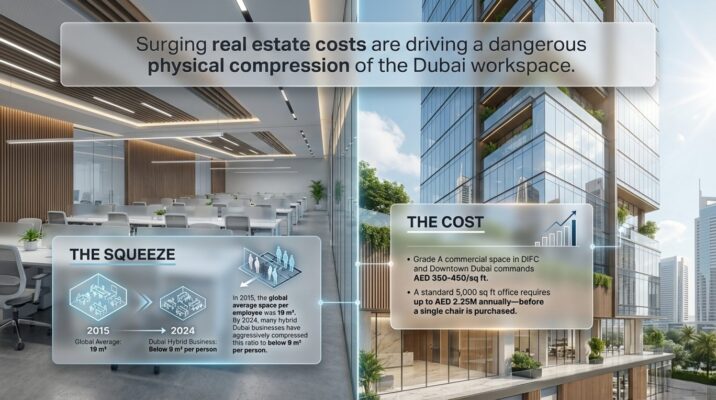
Dubai’s commercial property market is unique. Grade A office space in DIFC and Downtown Dubai regularly exceeds AED 350–450 per sq ft per year. Even in secondary locations like JLT, Media City, and Al Quoz, rates hover between AED 100–200 per sq ft. For a business occupying 5,000 sq ft, that represents an annual commitment of AED 500,000 to AED 2.25 million — before a single chair is purchased.
This economic reality has driven an intense focus on space efficiency ratios the measurement of how much usable workspace ergonomics Dubai is delivered per employee. In 2015, the global average was roughly 19 square meters per person. By 2024, many Dubai businesses had pushed this figure below 9 square meters per person, particularly in sectors adopting hybrid working models.
The Post-Pandemic Workplace Shift in the UAE
The pandemic permanently recalibrated how UAE businesses think about space. A 2023 CBRE Workplace Report found that UAE organizations adopted flexible working policies at a faster rate than the global average, with 71% of companies surveyed implementing some form of hybrid model. This created a paradox: offices became simultaneously more flexible and more dense fewer assigned desks, but those that remain are occupied more intensively.
Dubai’s free zone authorities, including DIFC, DMCC, and Dubai Silicon Oasis, have actively promoted Activity-Based Working (ABW) models in their master-planned environments, enabling businesses to design workplaces around task types rather than fixed headcounts.
2. The Business Case for Employee Health in the Workplace
Before diving into design solutions, it is worth establishing precisely what employee health in the workplace costs when neglected and what it yields when prioritized.
Productivity and Wellness: The Numbers Speak
| Metric | Stat | Source |
|---|---|---|
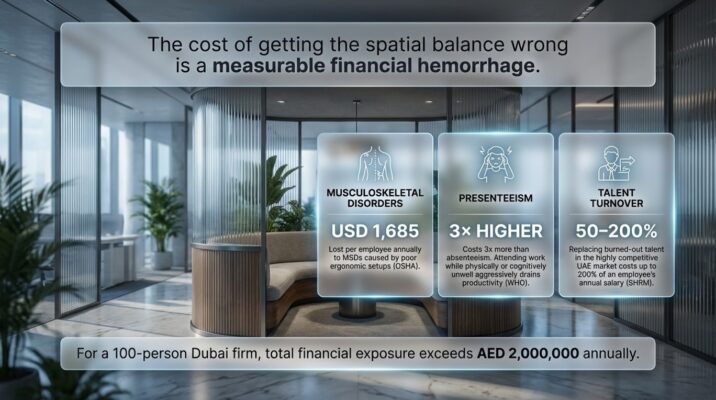
| Lost productivity from musculoskeletal disorders (MSDs) per employee per year | USD 1,685 | OSHA, 2023 |
| Reduction in absenteeism with ergonomic workstations | Up to 25% | Cornell University Ergonomics Lab |
| Productivity gain from optimized lighting and air quality | 11–16% | Leesman Index 2023 |
| Employee turnover cost (knowledge worker, UAE context) | 50–200% of annual salary | SHRM, adapted for UAE |
| Annual cost of presenteeism (attending work while ill) | 3× higher than absenteeism | WHO |
| Reduction in error rates with proper ergonomic setup | 40% | HFES Research Review |
| ROI on wellness programmed in corporate environments | 1:3 to 1:6 | Harvard Business Review |
These figures are not abstract. For a Dubai business with 100 knowledge workers, the annual financial exposure from ergonomic neglect alone — injuries, turnover, absenteeism — can easily exceed AED 2 million.
Key Health Risks in Space-Compressed Dubai Offices
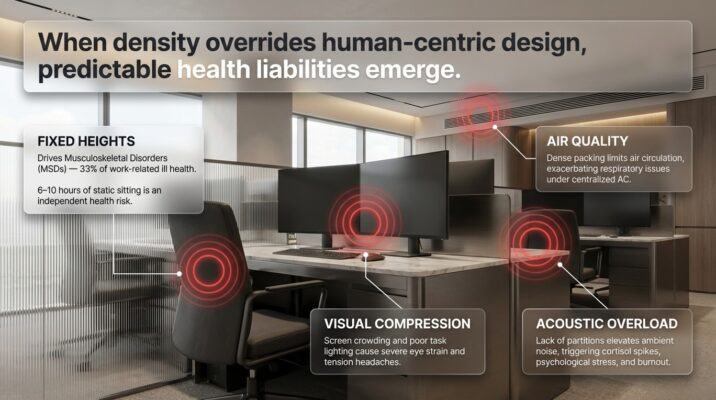
When space optimization overrides health considerations, several predictable health outcomes emerge:
- Musculoskeletal disorders (MSDs): Back pain, neck strain, and repetitive strain injuries (RSIs) from inadequate seating, fixed-height desks, and improper monitor positioning. MSDs account for 33% of all work-related ill-health in developed economies.
- Eye strain and headaches: Insufficient task lighting, glare from untreated glazing, and screens positioned too close due to desk crowding.
- Respiratory issues: Reduced air circulation in densely packed offices, exacerbated by Dubai’s reliance on centralized air conditioning.
- Psychological stress and burnout: Noise pollution, lack of privacy, and insufficient quiet zones all elevate cortisol levels and impair cognitive function.
- Sedentary behavior: Static seated postures for 6–10 hours daily are now classified by the WHO as an independent risk factor, separate from exercise habits.
3. Ergonomic Standards and Space Ratios — What Dubai Offices Should Target
Recommended Ergonomic Desk and Seating Specifications
One of the most reliable investments any Dubai business can make is in properly specified office furniture that meets international ergonomic standards. The following table reflects guidance from ISO 9241, the Chartered Institute of Ergonomics and Human Factors (CIEHF), and BIFMA:
| Specification | Recommended Range | Common Violation |
|---|---|---|
| Desk height (fixed) | 720–750 mm | 680 mm (too low) or >780 mm (too high) |
| Seat height adjustment range | 400–520 mm | Non-adjustable fixed seats |
| Lumbar support height | 165–210 mm from seat | No lumbar support |
| Monitor distance from eyes | 500–700 mm | 350 mm or less in dense layouts |
| Monitor top edge to eye level | At or just below eye level | Top of screen above eye level |
| Keyboard to elbow angle | 90–110 degrees | Wrists bent upward |
| Task lighting lux level | 500–750 lux | Below 300 lux |
| Ambient noise level (focus work) | Below 50 dB | 65–75 dB in open-plan offices |
| Minimum desk surface area | 0.96 m² (1,200 mm × 800 mm) | 900 mm × 600 mm cramped desks |
Office Space Allocation Standards
Understanding space ratios is critical to balancing density with wellbeing. The following benchmarks reflect current best practice for Dubai’s corporate market:
| Space Type | Minimum Recommended per Person | Activity-Based Working Target | Dubai Market Reality (2024) |
|---|---|---|---|
| Primary desk / workstation | 8–10 m² | 6–7 m² (shared) | 5–7 m² |
| Open collaboration zone | 2–3 m² per seat | 1.5–2 m² per seat | 1.5–2 m² |
| Quiet focus room | 4–6 m² per occupant | Pod-based: 2–3 m² | Often absent |
| Meeting rooms (boardroom) | 2.5–3 m² per seat | 2.5 m² | 2–3 m² |
| Break / wellness area | 1.5–2 m² per employee | 1.5 m² | Under 1 m² |
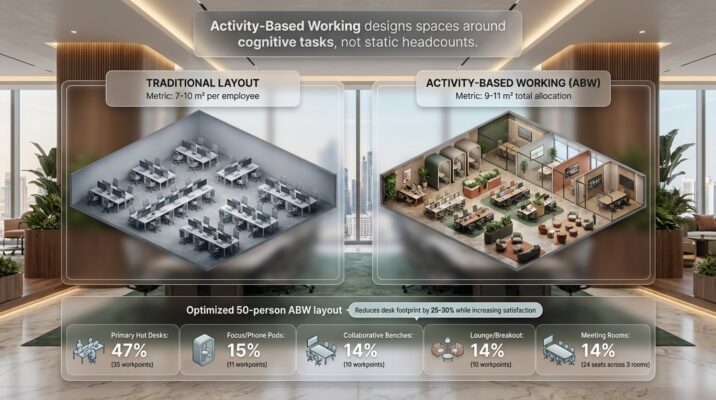
| Total office allocation | 12–15 m² per employee | 9–11 m² | 7–10 m² |
4. Space Optimization Strategies That Protect — Not Sacrifice — Employee Health
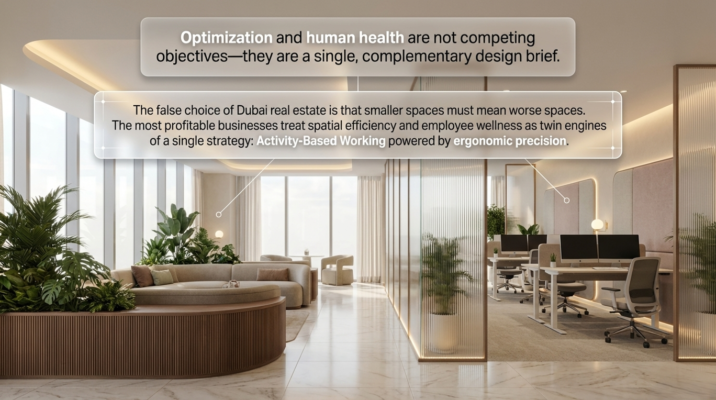
The false dichotomy in most workspace ergonomics Dubai discussions is that space optimization and employee health are competing objectives. In reality, the most effective Dubai offices treat them as complementary design briefs. Here’s how leading businesses are achieving both simultaneously.
4.1 Activity-Based Working (ABW): Design for Tasks, Not Headcounts
Activity-Based Working removes the assignment of fixed desks and replaces them with a palette of workspace types — each calibrated for a specific type of cognitive task. This reduces the total desk count (space efficiency win) while improving the quality of each environment (health and productivity win).
ABW workspace types for Dubai offices:
- Focus stations: Single-occupancy pods or semi-enclosed desks for deep, uninterrupted work. Acoustic panels, task lighting, and height-adjustable surfaces are essential.
- Collaborative benches: Long, open surfaces with integrated power and cable management for team-based or co-working tasks. Ergonomic stools or height-adjustable chairs allow variation in posture.
- Informal meeting zones: Soft seating with low tables for short, spontaneous conversations. Keeps meeting rooms free and reduces corridor crowding.
- Phone and video booths: Acoustic pods for calls and video conferences — the single most-requested addition in post-pandemic Dubai office fit-outs.
- Rejuvenation and wellness areas: Biophilic zones with natural light, plants, and comfortable seating for mental recovery between intensive work periods.
In a well-designed ABW model, a company of 100 employees might require only 70–75 total work points, reducing desk footprint by 25–30% while measurably improving employee satisfaction scores.
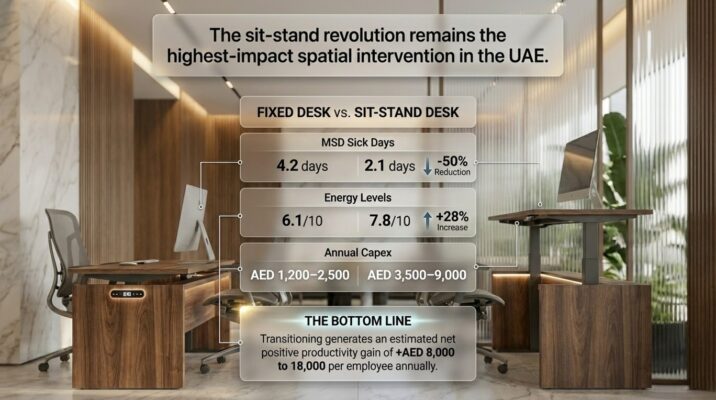
4.2 Height-Adjustable (Sit-Stand) Desks: The Single Highest-Impact Intervention
If there is one piece of office furniture in Dubai that delivers a disproportionate return on investment, it is the height-adjustable or sit-stand desk. Research from the University of Leicester demonstrated that workers using sit-stand desks reported a 32% reduction in upper back and neck pain after just 12 weeks. A 2024 JLL Workplace Health Report found that sit-stand desks rank as the second-highest requested workplace benefit by UAE office workers, behind flexible hours.
Sit-Stand Desk ROI for Dubai Businesses:
| Metric | Fixed Desk | Sit-Stand Desk | Difference |
|---|---|---|---|
| Average annual MSD-related sick days | 4.2 days | 2.1 days | −50% |
| Self-reported energy levels (1–10 scale) | 6.1 | 7.8 | +28% |
| Focus and concentration score | 6.4 | 7.5 | +17% |
| Annual cost per desk (quality commercial grade, AED) | AED 1,200–2,500 | AED 3,500–9,000 | Premium: AED 2,300–6,500 |
| Estimated productivity gain (annual value per employee, AED) | Baseline | +AED 8,000–18,000 | Net positive ROI |
4.3 Acoustic Design: The Overlooked Dimension
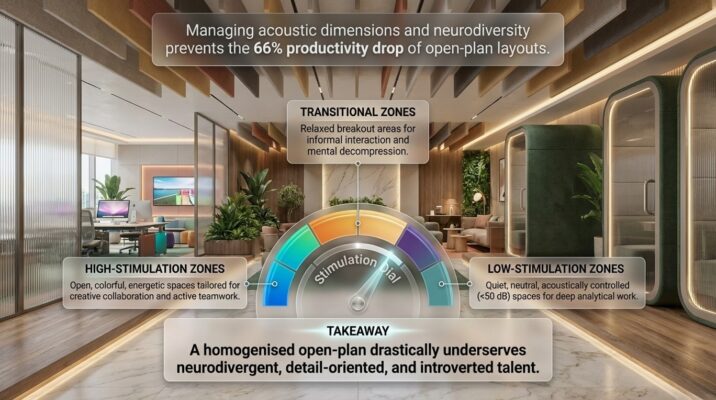
In the rush to open-plan everything, acoustic design is the most commonly sacrificed element of employee health. Yet its impact is quantifiable: a study published in the Journal of Applied Psychology found that workers in open-plan offices experienced a 66% reduction in productivity relative to those in properly acoustically managed environments.
Practical acoustic solutions for space-optimized Dubai offices include:
- Acoustic ceiling panels and baffles: Reduce reverberation without consuming floor space.
- Desk-mounted privacy screens: Provide speech privacy at workstation level without full partitioning.
- Acoustic phone pods: Freestanding, modular, and redeploy able — ideal for lease-flexible Dubai offices.
- Carpet tiles and soft furnishings: Particularly effective in hybrid hard/soft-floored environments.
- White noise systems: Electronically generated ambient sound to mask speech intelligibility in dense areas.
4.4 Biophilic Design: Nature as a Space-Efficient Wellness Tool
Biophilic design — the integration of natural elements into the built environment — delivers measurable wellbeing benefits without demanding large floor areas. Key interventions include:
- Vertical green walls: Transform unused wall surfaces into productivity assets. Studies from the University of Exeter show a 15% increase in productivity and wellbeing in offices with direct nature exposure.
- Desk plants: Low-cost, high-impact; shown to reduce stress by 37% (Journal of Physiological Anthropology).
- Natural light maximization: Glass partitioning, reflective surfaces, and open plan orientations that avoid blocking perimeter glazing.
- Circadian-responsive lighting: Systems that shift color temperature throughout the day to mirror natural light cycles — particularly valuable in Dubai’s heavily air-conditioned and often daylight-limited interior spaces.
4.5 Zoning for Neurodiversity and Cognitive Variation
Not all employees have the same cognitive needs. An effective workspace ergonomics Dubai accounts for neurodiversity — the natural variation in how brains process information — by providing a genuine range of environments:
- High-stimulation zones for creative and collaborative work (open, colorful, energetic)
- Low-stimulation zones for analytical, technical, or focused work (quiet, neutral, controlled)
- Transitional zones for informal interaction, coffee, and decompression
This approach directly combats the homogenized open-plan office, which notoriously underserves introverted, neurodivergent, and detail-oriented workers.
5. Choosing the Right Office Furniture for Dubai’s Climate and Culture
Climate-Specific Considerations
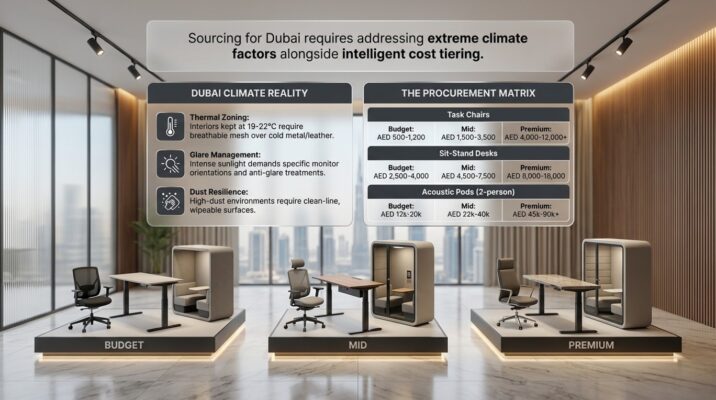
Dubai’s climate creates unique workplace design requirements that are often overlooked in imported Western workspace models:
- Thermal comfort: With indoor temperatures frequently maintained at 19–22°C to counteract outdoor heat, employees — particularly those seated near air conditioning vents — experience cold-related discomfort that affects concentration and physical comfort. Quality office furniture Dubai suppliers factor in thermal zoning when specifying seating materials — avoiding cold metal surfaces and over-relying on leather, instead recommending breathable mesh, fabric, or engineered textiles.
- Glare management: Dubai’s intense sunlight creates significant glare challenges. Monitor positioning, desk orientation relative to glazing, and screen anti-glare treatments must all be specified deliberately.
- Dust and maintenance: In a high-dust environment, furniture with complex crevices or porous upholstery requires more intensive maintenance. Clean-line commercial furniture with wipeable surfaces is a practical advantage.
A Practical Furniture Selection Matrix for Dubai Offices
| Furniture Category | Budget Tier (AED) | Mid-Range Tier (AED) | Premium Tier (AED) | Key Selection Criteria |
|---|---|---|---|---|
| Task Chair | 500–1,200 | 1,500–3,500 | 4,000–12,000+ | Lumbar support, seat depth adjustment, armrest adjustability |
| Fixed-Height Desk (1,200 mm) | 600–1,200 | 1,500–2,800 | 3,000–6,000 | Surface area, cable management, durability rating |
| Sit-Stand Desk (electric) | 2,500–4,000 | 4,500–7,500 | 8,000–18,000 | Height range, memory settings, load capacity, noise level |
| Storage Pedestal | 400–800 | 900–1,600 | 1,800–3,500 | Security, castors, integration with desk system |
| Meeting Chair | 350–900 | 1,000–2,500 | 2,800–7,000 | Stickability, upholstery, armrests, base type |
| Acoustic Pod (2-person) | 12,000–20,000 | 22,000–40,000 | 45,000–90,000+ | Sound attenuation rating (STC/Rw), ventilation, power |
| Lounge/Breakout Seating | 800–2,000 | 2,500–5,000 | 6,000–20,000 | Durability, cleanability, postural support |
| Monitor Arm | 300–600 | 700–1,500 | 1,800–4,000 | Articulation range, weight capacity, desk clamp type |
6. Space Optimization Without Compromise — A Step-by-Step Framework for Dubai Businesses
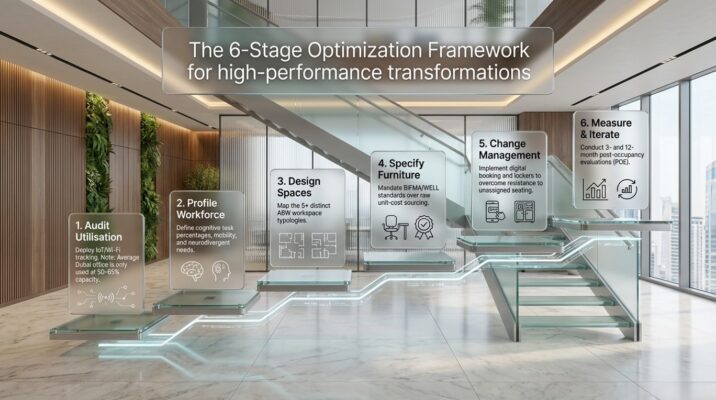
Achieving genuine space efficiency without sacrificing employee health requires a disciplined process. Here is a practical six-stage framework:
Stage 1: Space Audit and Utilization Measurement
Before redesigning anything, measure actual utilization. Workplace analytics tools — from simple sensor networks to AI-driven occupancy platforms — reveal that most Dubai offices are used at only 50–65% of their theoretical capacity on average working days. Understanding your real utilization patterns is the foundation of every efficient, healthy workspace ergonomics Dubai decision.
Tools commonly used in Dubai office audits:
- Badge-based access data analysis
- IoT occupancy sensors (passive infrared or ultrasonic)
- Wi-Fi device tracking (anonymized)
- Employee experience surveys (qualitative layer)
Stage 2: Define Your Workforce Profile
Space and furniture decisions should be driven by an understanding of what your employees actually do, not how many of them there are. Key questions:
- What percentage of work requires deep, focused concentration?
- How much time is spent in meetings or collaborative sessions?
- What proportion of the workforce is mobile, hybrid, or office-based?
- Are there neurodivergent employees or those with physical health conditions requiring specific accommodation?
Stage 3: Design the Palette of Spaces
Map your workforce profile to a range of workspace ergonomics Dubai typologies. Aim for a minimum of five distinct environment types, even in modest-sized offices. A typical distribution for a Dubai professional services firm of 50 people might look like:
| Space Type | No. of Workpoints | % of Total |
|---|---|---|
| Assigned or hot desks (primary workstations) | 35 | 47% |
| Focus/quiet zones | 6 | 8% |
| Collaborative benches | 10 | 14% |
| Meeting rooms (4–8 person) | 3 rooms (24 seats) | 14% |
| Phone/video pods | 5 | 7% |
| Lounge/breakout areas | 10 | 14% |
| Total | ~75 work points | 100% |
 Stage 4: Specify Ergonomic-Grade Furniture
 Stage 4: Specify Ergonomic-Grade Furniture
This is where the investment in quality office furniture pays its greatest dividends. Specifications should be driven by:
- BIFMA G1 ergonomics guidelines for workstations
- ANSI/HFES 100 standards for computer workstations
- WELL Building Standard v2 furniture requirements (increasingly adopted in DIFC and Business Bay Grade A buildings)
- Relevant UAE fire, safety, and materials standards (ESMA)
Work with a reputable office furniture Dubai specialist who can provide BIFMA-certified or equivalent-tested products, rather than sourcing purely on unit cost.
Stage 5: Implement Change Management
The single most common reason ambitious workspace ergonomics Dubai redesigns underperform is insufficient change management. Employees who have assigned desks for years will resist unassigned working unless they understand the benefits, have reliable systems for booking spaces, and trust that their personal storage needs are addressed.
Effective change management for Dubai offices includes:
- Pre-move employee consultation and co-design sessions
- Phased rollout rather than big-bang transition
- Digital booking platforms for desks, rooms, and pods
- Dedicated personal lockers to replace assigned desk storage
- Clear communication from leadership on the rationale for change
Stage 6: Measure, Iterate, and Improve
Post-occupancy evaluation (POE) is standard practice in leading Dubai organizations. Within three and twelve months of any workspace change, measure:
- Space utilization rates (against pre-change baseline)
- Employee satisfaction and wellbeing scores (Leesman Index or equivalent)
- Absenteeism and presenteeism data
- IT and facilities help desk ticket volume (a proxy for environmental issues)
- Business productivity indicators where measurable
7. Emerging Trends Shaping Dubai’s Workspace Future
7.1 The WELL Building Standard — Rising Fast in the UAE
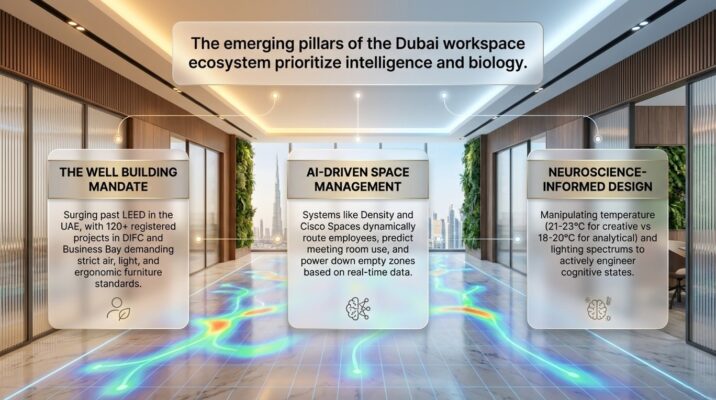
The WELL Building Standard, developed by the International WELL Building Institute (IWBI), is increasingly being adopted by Dubai’s Grade A office developments. WELL certification addresses air, water, nourishment, light, movement, thermal comfort, sound, materials, mind, and community comprehensively addressing the employee health dimensions that traditional green building certifications (like Estidama or LEED) do not fully cover.
By 2024, the UAE had over 120 WELL-registered projects, with Dubai accounting for the majority. For businesses in DIFC, Business Bay, and Dubai Hills Business Park, specifying furniture and fitout to WELL v2 requirements is increasingly a tenant requirement, not merely an aspiration.
7.2 AI-Driven Space Management
Platforms like Density, Cisco Spaces, and Robin are being deployed in Dubai’s largest corporate offices to dynamically manage workspace allocation. These systems use real-time occupancy data to:
- Route employees to available work points
- Predict and pre-configure meeting rooms
- Identify persistently underused zones for redesign
- Generate energy savings by powering down unoccupied areas
7.3 Neuroscience-Informed Design
The emerging field of organizational neuroscience is influencing how Dubai’s leading employers think about workspace. Insights include:
- Restorative environments with natural views and quiet spaces are critical for cognitive recovery after intense focus work
- Temperature variation (zones between 21–23°C vs 18–20°C) can be used deliberately to support different cognitive states — warmer for creative work, cooler for analytical tasks
- Lighting spectrum management (3000K warm for relaxation zones, 5000–6000K cool white for task areas) directly influences alertness and accuracy
7.4 Flexible and Modular Furniture Systems
Fixed furniture layouts are increasingly incompatible with Dubai’s fast-moving business environment, where office populations fluctuate with project cycles, team restructuring, and hybrid working patterns. Modular furniture systems — reconfigurable benches, demountable partitions, mobile storage — allow businesses to reorganize their spaces without the capital cost and disruption of a full fit-out.
Leading international furniture manufacturers serving the Dubai market have responded with furniture ranges specifically designed for rapid reconfiguration, with tool-free assembly, standardized modules, and compatible storage ecosystems.
8. Cost-Benefit Analysis — Investing in Healthy Workspaces in Dubai
Many businesses approach workspace ergonomics Dubai investment through a pure capital expenditure lens — how much does the furniture cost? The financially sophisticated approach accounts for total cost of ownership over a five-to-seven-year lease cycle, including the indirect financial benefits of a healthier, more productive workforce.
Five-Year Total Workspace Investment Comparison
(Based on 50-person professional services office in Dubai, ~450 m²)
| Category | Low-Investment Approach | Ergonomic-Optimised Approach | Difference |
|---|---|---|---|
| Initial furniture capex (AED) | 250,000 | 550,000 | +300,000 |
| Annual MSD-related sick days (days × 50 staff) | 210 | 105 | −105 days |
| Annual cost of absenteeism @ AED 800/day avg (AED) | 168,000 | 84,000 | −84,000/yr |
| Annual turnover costs (estimated, AED) | 360,000 | 180,000 | −180,000/yr |
| Productivity gain from ergonomic/biophilic environment | Baseline | +8% | ~AED 400,000/yr |
| Net five-year financial benefit | Baseline | ~AED +2.62M | ROI: 873% |
Note: Productivity gain is calculated on average AED 100,000 per employee annual cost base × 8% × 50 employees = AED 400,000/yr × 5 years = AED 2M. Absenteeism and turnover savings add AED 1.32M over five years. Total gain AED 3.32M minus additional capex AED 300K = net AED 3.02M.
The numbers are unambiguous. For Dubai businesses competing for talent and operating in a high-cost real estate environment, ergonomic workspace investment is not a discretionary benefit — it is a financial imperative.
9. Practical Checklist for Dubai Businesses
Use this checklist when planning or refreshing your Dubai office workspace:
Space Planning Checklist
- Conducted an occupancy utilization audit before redesigning
- Defined workforce profiles by task type and working pattern
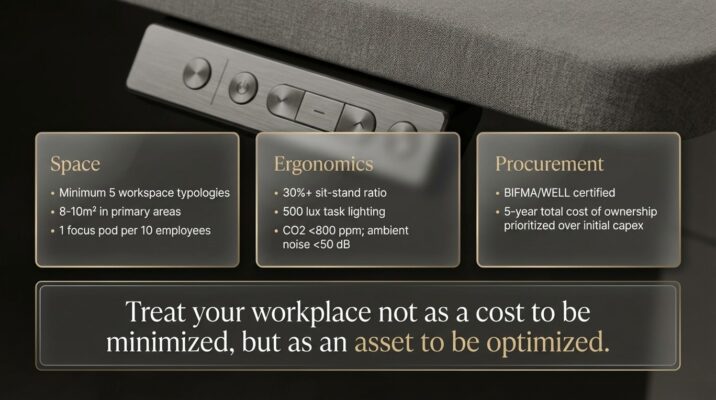
- Achieved minimum 5 distinct workspace typologies
- Maintained at least 8–10 m² per work point in primary desk areas
- Ensured at minimum 1 quiet focus space per 10 employees
- Incorporated designated video/phone call booths
- Provided secure personal storage (locker) per employee in hot-desk environments
Ergonomics and Health Checklist
- All task chairs are height-adjustable with lumbar support and armrests
- Minimum 30% of desks are height-adjustable (sit-stand)
- Monitor arms or height-adjustable monitor risers on all fixed desks
- Task lighting at minimum 500 lux at workstation surface
- Ambient noise below 50 dB in focus areas (measured)
- Air quality monitoring in place (CO₂ levels below 800 ppm)
- Natural light accessible to at least 75% of workstations
- Biophilic elements (plants, natural textures, views) in primary work areas
- Breakout and wellness zones of at least 1.5 m² per employee provided
Procurement and Specification Checklist
- Furniture specified to BIFMA or equivalent ergonomic standards
- UAE-specific climate factors considered (thermal comfort, glare)
- Supplier able to provide post-sale adjustment training for employees
- Modular or reconfigurable elements incorporated for future flexibility
- Five-year total cost of ownership calculated, not just upfront capex
FAQs: Space Optimization and Employee Health in Dubai Workspaces
International standards recommend 8–10 m² per employee for conventional assigned desk environments. In activity-based working (ABW) configurations with shared desks and diverse space types, 9–11 m² total allocation remains best practice. Many Dubai offices currently operate at 5–7 m² per person, which creates measurable health and productivity risks when combined with poor furniture and acoustic design.
Hot-desking itself is not inherently harmful — but poorly implemented hot-desking is. When employees share non-adjustable furniture, lack secure personal storage, and cannot find suitable quiet spaces, health outcomes decline. Well-designed hot-desk environments with height-adjustable furniture, personal lockers, acoustic diversity, and reliable desk booking systems produce equal or better wellbeing outcomes than assigned desk arrangements.
For small Dubai offices where space efficiency is critical, priorities: ergonomic task chairs with full adjustment capabilities, height-adjustable desks (even a single electric sit-stand desk per team), wall-mounted storage to free floor space, and at least one acoustic screen or pod for private calls. Compact but compliant is the goal — a well-specified 6 m² workstation outperforms a poorly specified 10 m² one.
Ergonomic chairs address the root cause of musculoskeletal disorders — the largest single category of work-related ill-health — by maintaining the spine’s natural lumbar curve, reducing sustained pressure on intervertebral discs, and enabling frequent postural micro-adjustments. Research consistently shows 20–50% reductions in back and neck pain among employees switching from standard to ergonomic seating, directly translating to fewer sick days.
Activity-Based Working (ABW) is a workplace model in which employees are not assigned fixed desks but instead select from a variety of environment types based on the task they are performing. It is highly suitable for Dubai businesses with mobile workforces, hybrid working policies, and growth ambitions — because it reduces desk density while improving workplace experience. The key success factors are: genuine management commitment, a diverse enough palette of spaces, reliable technology for booking and wayfinding, and strong change management.
Extensive research says yes. The Leesman Index — the world’s largest workplace experience database with over 800,000 employee responses — consistently shows that high-performing workplaces deliver 18–30% higher productivity scores than average workplaces. Factors with the greatest impact include: acoustic quality, ergonomic furniture, access to natural light, thermal comfort, and availability of focus spaces. In Dubai specifically, where indoor environments are artificial by necessity, these factors are even more decisive.
Look for BIFMA (Business and Institutional Furniture Manufacturers Association) certification on task chairs and desks, which validates ergonomic performance and durability. For broader building performance, WELL v2 and LEED certifications indicate that the environment has been designed with human health and sustainability as primary criteria. UAE-specific standards from ESMA (Emirates Authority for Standardization and Metrology) apply to materials safety and fire compliance.
For a mid-range commercial fit-out in Dubai (excluding base build), budget AED 1,500–3,500 per m² for space planning, furniture, and installation. For a 500 m² office, this represents AED 750,000 to AED 1.75 million. Specifically for ergonomic-grade task seating, allocate AED 1,500–3,500 per chair; for electric sit-stand desks, AED 4,500–8,000 per unit. These figures exclude landlord works, IT infrastructure, and specialist acoustic or biophilic elements, which will add 20–40% to total project cost.
Designing Dubai Workspaces That Win on Both Fronts
The dichotomy between space optimization and employee health is, ultimately, a false choice and one that Dubai’s most successful businesses have already moved past. The evidence is clear: workspace ergonomics Dubai designed with genuine care for human health and cognitive performance deliver superior space efficiency, not inferior. Employees who work in well-designed environments are present more often, leave less frequently, perform more effectively, and generate measurable financial returns that dwarf the investment in quality furniture and considered design.
Dubai sits at a unique intersection: one of the world’s most dynamic business environments, where talent competition is intense, real estate costs are high, and the ambition to build world-class corporate environments is genuine. The businesses that will win the next decade are those that refuse to accept the premise that smaller must mean worse and instead invest in the space planning expertise, ergonomic office furniture, and evidence-based design thinking that transforms every square meter into a genuine competitive advantage.
If your business is ready to take that next step, the journey begins with a single, well-informed decision: to treat your workplace not as a cost to be minimized, but as an asset to be optimized for your people, and through them, for your organization.
