Blog
Round vs. Rectangular: Which Coffee Table Shape Fits Your Office Layout?
Apr
Why Coffee Table Shape Is a Serious Business Decision
Walk into any thoughtfully designed corporate office, executive lounge, or collaborative workspace in Dubai, and one thing becomes immediately clear the coffee table is not an afterthought. It is the architectural anchor of every reception area, breakout zone, client lounge, and informal meeting nook. Yet one critical decision divides office designers into two camps: should you choose a round coffee table or a rectangular one?
This question seems deceptively simple. In reality, it touches on spatial psychology, human ergonomics, brand identity, traffic flow, functionality, and the invisible language of furniture how shapes communicate authority, warmth, collaboration, and creativity before a single word is spoken. Choosing the wrong shape can make a generous room feel cramped, a collaborative area feel hierarchical, or a premium lounge feel chaotic.
At OfficeMaster.ae, we have helped hundreds of businesses across Dubai, Abu Dhabi, and the UAE configure their office furniture to deliver both aesthetic brilliance and operational efficiency. In this comprehensive guide, we break down every dimension of the round vs. rectangular coffee table debate so you can make the smartest choice for your unique office layout.
1. Understanding the Role of a Coffee Table in the Modern Office
Before diving into shapes, it helps to understand how the coffee table has evolved in commercial interiors. Once a purely residential accessory, the coffee table has become a cornerstone of modern workplace design — especially as offices shift toward hybrid, activity-based, and hospitality-inspired layouts.
In today’s progressive workspaces, coffee tables serve multiple functions simultaneously. In reception areas, they communicate brand values and set the tone for client experience. In breakout zones, they facilitate informal collaboration and spontaneous creativity. In executive lounges, they reinforce prestige and create a context for high-trust conversations. In open-plan offices, they define zones and break up the monotony of workstations.
The shape of the coffee table directly affects how people position themselves around it, how conversations flow, how accessible the surface is, and how the surrounding space feels. This is not a minor stylistic choice — it is a spatial strategy.
💡 Pro Tip: When selecting a coffee table for an office, always begin with the function — what primary activity will happen around this table? The answer should drive your shape selection before any aesthetic decision is made.
2. The Psychology of Shape: What Round and Rectangular Tables Communicate
2.1 Round Tables: The Language of Equality and Openness
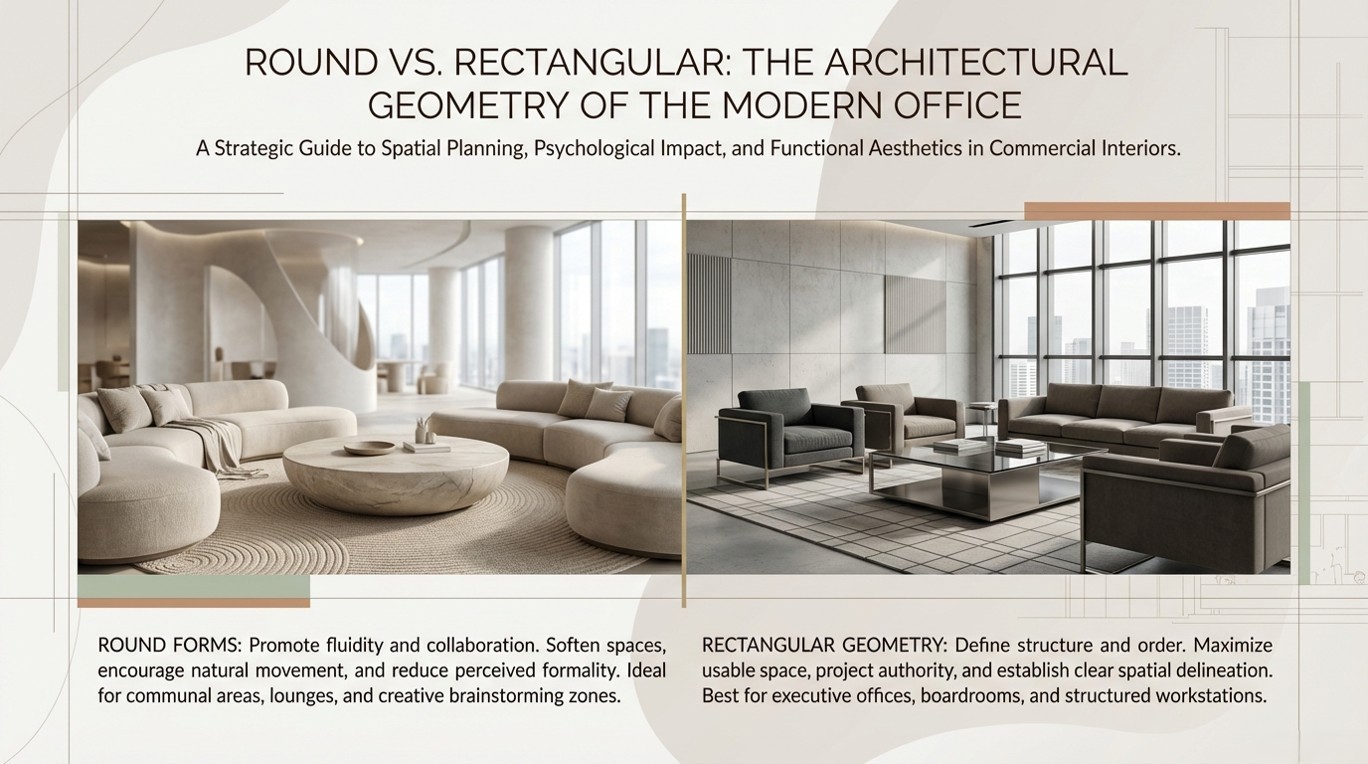
The circle is one of the most psychologically powerful shapes in human culture. From the Arthurian legend of the round table designed so no seat was superior to the circular boardrooms of modern tech campuses, the round shape communicates equality, openness, and inclusivity. In an office context, a round coffee table sends a clear, subconscious message: everyone seated around this table is equally important.
This has profound implications for certain workplace cultures. Companies that prize collaboration, creative brainstorming, cross-functional teamwork, or open communication will find that round coffee tables reinforce those values at a spatial level. There is no head of the table, no dominant corner, no power seat just a shared center around which ideas can circulate freely.
Research in environmental psychology consistently shows that curved furniture shapes reduce feelings of threat, increase perceived warmth, and encourage people to linger longer. For client-facing lounges or HR zones where comfort and trust are paramount, the round table creates an almost subconscious sense of safety.
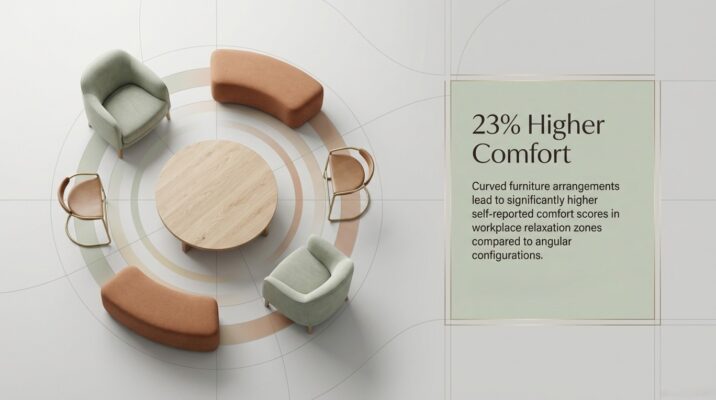
🔍 Key Insight: A University of Queensland study found that curved furniture arrangements led to 23% higher self-reported comfort scores in workplace relaxation zones compared to angular configurations, suggesting that round tables may contribute to better recovery and creativity in breakout spaces.
2.2 Rectangular Tables: The Language of Direction and Clarity
The rectangle, by contrast, carries a different energy. It is the shape of direction, focus, and structure. Rectangular coffee tables imply linearity there is a clear orientation, a defined length, and an implicit hierarchy of seating positions (the ends vs. the sides). This is not inherently negative; many professional environments benefit from this structural clarity.
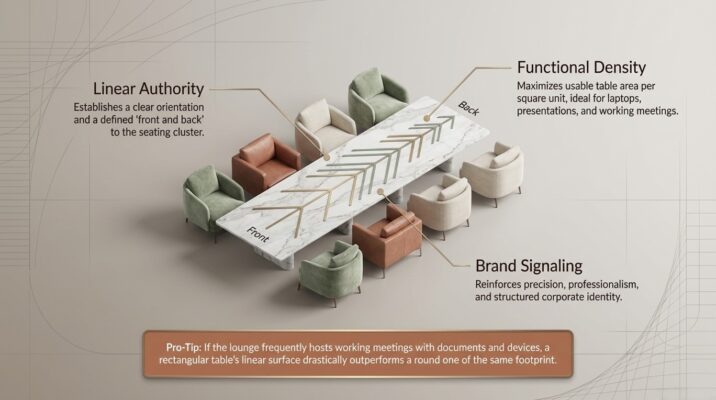
In executive waiting areas, formal client reception rooms, or any setting where the brand identity leans toward precision, professionalism, and authority, a rectangular coffee table reinforces those values. It visually anchors a sofa arrangement, provides a clear ‘front and back’ to a seating cluster, and signals orderliness.
Rectangular surfaces also offer significantly more usable table area per square unit of floor space than round tables. This practical advantage makes them the preferred choice for offices where the coffee table needs to hold laptops, presentation materials, coffee trays, brochures, and other items simultaneously.
💡 Pro Tip: If your office frequently uses the lounge area for working meetings — where clients or team members might have laptops, documents, or coffee simultaneously — a rectangular table’s linear surface is far more functional than a round one of similar footprint.
3. Space Planning: Matching Table Shape to Room Geometry
One of the most practical and frequently overlooked criteria in the round vs. rectangular decision is the geometry of the room itself. The shape of your office space, seating arrangement, and traffic flow patterns should all influence which table shape you select.
3.1 Square and Compact Rooms
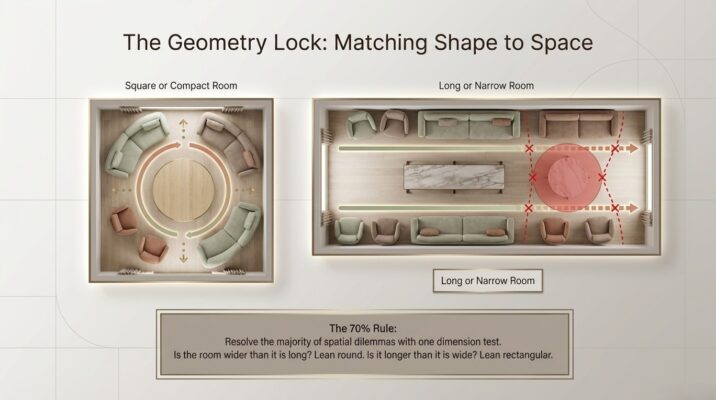
In a square room or a compact lounge nook, a round coffee table is almost always the superior choice. Square rooms lack a natural dominant axis, which means a rectangular table can look awkward and directionally ambiguous. A round table, however, mirrors the balanced geometry of the space and feels intentional. It also allows people to move around it more freely, which is critical in tight quarters where a rectangular table’s corners can create collision points.
Round tables also leave more open floor space around their perimeter compared to rectangular tables of equivalent surface area, because there are no corners projecting into circulation paths. In a compact reception area or a small executive waiting room, this translates into a noticeably more open, breathable atmosphere.
3.2 Long, Narrow, or Rectangular Rooms
In elongated spaces the kind found in many Dubai corporate offices with open-plan lounge corridors or reception stretches — a rectangular coffee table is the natural partner. It mirrors the room’s geometry, reinforces the visual flow along the room’s length, and helps frame the sofa arrangement with clarity.
Placing a round table in a narrow rectangular room can create a spatial mismatch that feels haphazard. The circle’s equal radii cut into the walking space more aggressively when the room offers limited width, and the shape can feel awkward in relation to the linear walls flanking it.
💡 Pro Tip: Use the room’s longest dimension as your guide. If the space is wider than it is long, lean toward round. If longer than wide, lean toward rectangular. This simple rule of thumb resolves about 70% of shape selection dilemmas.
3.3 Open-Plan and Zoned Office Layouts
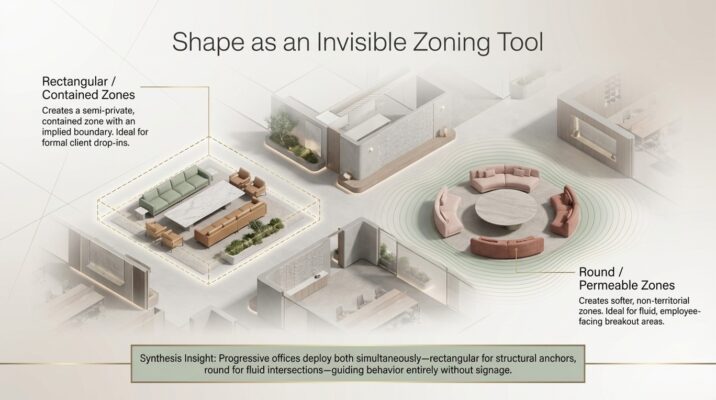
In open-plan offices where the coffee table is being used to define a lounge or collaboration zone within a larger floor plate, shape choice becomes a zoning tool. Rectangular tables with a sofa arrangement create a clear, contained zone with an implied boundary. Round tables create softer, more permeable zones that feel less territorial which is ideal for spontaneous, drop-in collaboration areas.
Many progressive UAE companies are now using a combination of both: rectangular tables for semi-private client zones and round tables for the more fluid, employee-facing breakout areas. This typological contrast also helps staff intuitively understand the intended use of each zone without signage.
4. Comprehensive Comparison: Round vs. Rectangular Coffee Tables for Office
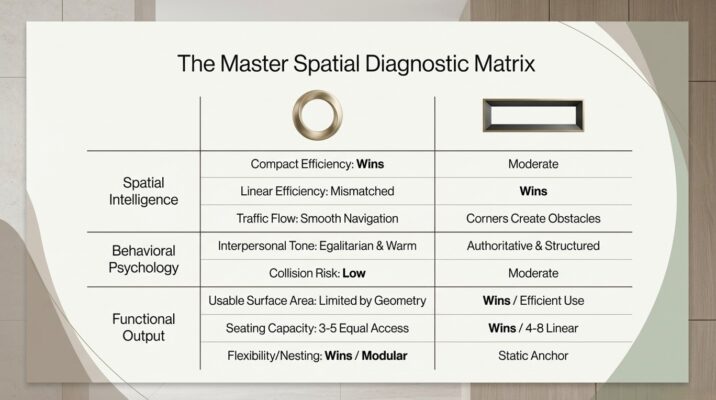
| Criteria | Round Coffee Table | Rectangular Coffee Table |
|---|---|---|
| Space Efficiency (compact rooms) | Excellent — no corners, fluid clearance | Moderate — corners may restrict movement |
| Space Efficiency (long rooms) | Can feel mismatched | Excellent — mirrors room geometry |
| Seating Capacity | 3–5 people (equal access) | 4–8 people (more linear arrangement) |
| Surface Area for Items | Limited by circular geometry | High — efficient linear surface use |
| Traffic Flow Impact | Low impact — smooth navigation | Moderate — corners create obstacles |
| Psychological Tone | Collaborative, warm, egalitarian | Authoritative, structured, professional |
| Suitability: Reception Area | Good for relaxed brands | Ideal for formal/corporate brands |
| Suitability: Breakout Zone | Excellent | Good |
| Suitability: Executive Lounge | Good (modern approach) | Excellent (traditional approach) |
| Suitability: Client Waiting | Good (approachable brand) | Excellent (formal brand) |
| Style Versatility | High — suits modern/Scandi/organic | High — suits modern/classic/industrial |
| Child-Safety / Injury Risk | Low (no sharp corners) | Moderate (corner risk in busy offices) |
| Storage Integration | Difficult — limited edge options | Easy — drawers, shelves possible |
| Price Range (Dubai) | AED 350 – AED 4,500+ | AED 400 – AED 6,000+ |
| Maintenance Ease | Easy (no corner joints) | Easy (straight edge cleaning) |
5. Ergonomics and Accessibility: Who Sits Where, and How Comfortably
Office furniture design must account for the physical experience of every person who uses it. From an ergonomic standpoint, round and rectangular coffee tables create meaningfully different user experiences.
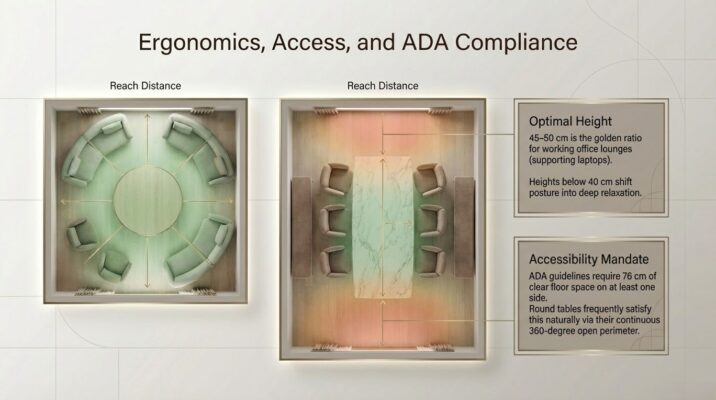
A round coffee table ensures equidistant access for everyone seated around it. Every person is the same distance from the table’s edge, which means no one has to lean awkwardly or stretch across to reach items. This is especially important in formal client meetings where body language matters — no one wants to lean over a table edge during a pitch.
Rectangular tables, however, create variable access distances. People seated at the sides have easy access to the central surface, while those at the ends may find themselves stretching. For large groupings with six or more people, this can create minor but persistent ergonomic inconveniences.
Height is equally important regardless of shape. The standard coffee table height in office environments ranges from 40 cm to 50 cm. Tables below 40 cm feel lounge-oriented and casual; tables above 50 cm start to feel like low dining tables. For office furniture Dubai environments where guests may be conducting working meetings from lounge seating, a height of 45–50 cm is typically optimal, allowing comfortable laptop use and easy item placement.
🔍 Key Insight: The Americans with Disabilities Act (ADA) guidelines — widely referenced even in UAE design standards — recommend ensuring clear floor space of at least 76 cm on at least one accessible side of any lounge table. Round tables often naturally satisfy this requirement because of their 360-degree perimeter openness.
6. Material and Finish Considerations for Office Coffee Tables
The shape debate cannot be entirely separated from the material conversation, because different shapes tend to look better and perform better in different materials. Understanding these relationships helps you make a holistic selection rather than evaluating shape and material in isolation.
6.1 Glass
Glass-top coffee tables in either shape create a sense of visual lightness and openness. In compact office spaces, glass tops reduce visual clutter because the eye travels through rather than stops at the surface. Round glass tables are particularly elegant in modern reception areas, giving a jewel-like quality to the lounge zone. Rectangular glass tables are popular in executive areas for their clean, precise aesthetic — though they require diligent maintenance in high-traffic environments.
6.2 Wood and Wood Veneers
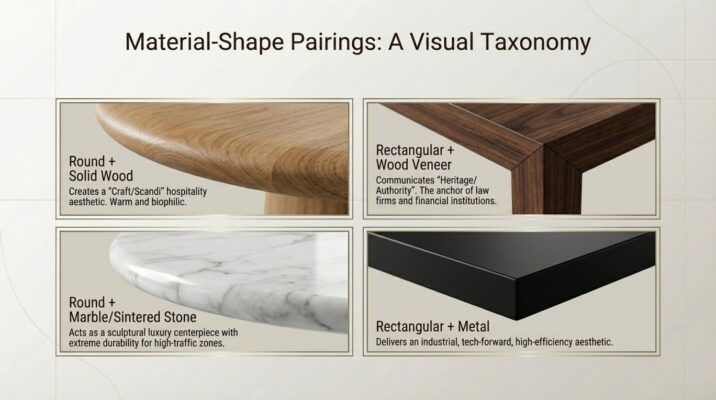
Solid wood or high-quality wood veneer surfaces bring warmth, craft, and natural texture to an office environment. This material works beautifully in both shapes but delivers different effects. Round wooden tables evoke Scandinavian or mid-century modern design sensibilities, while rectangular wooden tables communicate heritage, craft, and tradition often preferred in law firms, financial institutions, and consultancies seeking a grounded, trustworthy aesthetic.
6.3 Marble and Stone
Marble and sintered stone surfaces have seen a dramatic rise in UAE office interiors over the past five years. Marble-topped coffee tables signal luxury, permanence, and sophistication. In round form, a marble table creates a sculptural centerpiece; rectangular marble tables anchor a lounge with gravitas. Both benefit from high-quality bases in brushed brass, matte black steel, or natural oak to complete the premium look.
6.4 Metal
Metal coffee tables particularly those with perforated steel, powder-coated frames, or brushed aluminum surfaces are popular in industrial-style, tech, and creative offices. Rectangular metal tables complement loft-inspired, open-plan offices, while round metal tables suit minimalist or contemporary spaces. Metal is highly durable and requires minimal maintenance, making it practical for high-traffic office environments.
| Material | Best Shape Pairing | Office Style Fit | Maintenance Level |
|---|---|---|---|
| Glass | Both (round preferred small spaces) | Modern, Contemporary | High (fingerprints/smudges) |
| Wood Veneer | Both (rectangular for formal) | Classic, Scandi, Biophilic | Low-Medium |
| Solid Wood | Round (craft aesthetic) | Traditional, Hospitality | Medium |
| Marble/Stone | Both (statement piece) | Luxury, Executive, Premium | Medium |
| Sintered Stone | Both | Modern Luxury, Minimalist | Low |
| Metal (powder-coat) | Rectangular | Industrial, Tech, Creative | Very Low |
| Acrylic/Perspex | Round | Contemporary, Boutique | Medium |
💡 Pro Tip: In Dubai’s climate, always check that metal-framed coffee tables are powder-coated or treated against humidity-related corrosion. Outdoor-rated finishes are worth the premium even for indoor furniture in high-humidity seasons.
7. Specific Office Area Recommendations
7.1 Reception and Waiting Areas
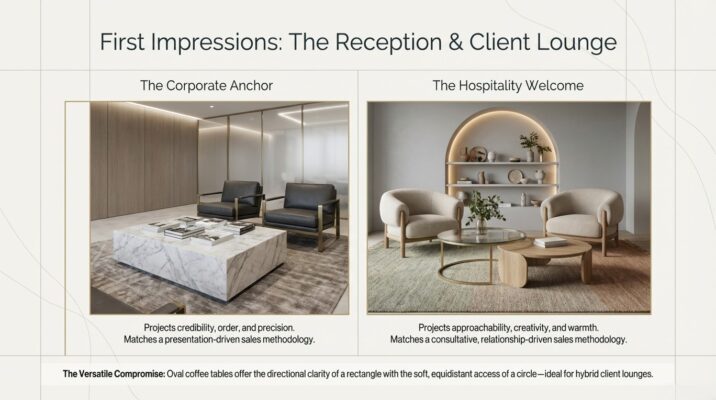
The reception area is the first physical experience of your brand. For formal corporate brands law firms, banks, government entities, professional services a rectangular coffee table in a premium material (marble, dark wood, or glass) anchored by a structured sofa arrangement creates an immediate impression of credibility and order.
For hospitality-driven brands boutique agencies, fashion companies, tech startups, or wellness brands a round coffee table creates a warmer, more inviting first impression that signals approachability. Pair with a curved sofa or armchairs to reinforce the soft, welcoming aesthetic.
At OfficeMaster.ae, we stock a curated range of reception-grade coffee tables in both configurations, with options across every budget tier for the UAE market. Our office furniture Dubai collections include locally adapted designs suited to the specific scale and climate of UAE commercial interiors.
7.2 Executive Lounges and Private Offices
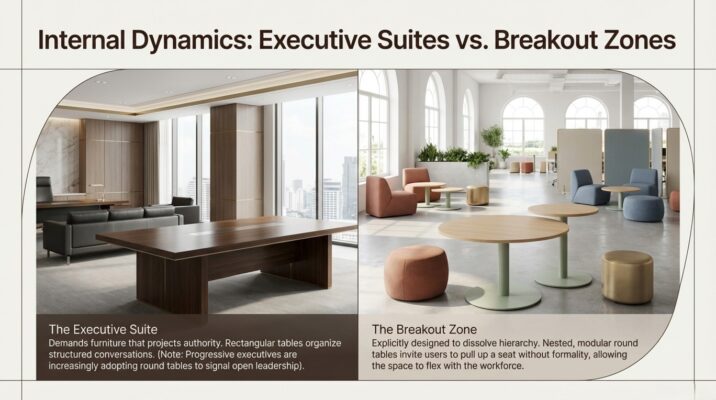
Executive lounges demand furniture that projects authority without feeling cold. The rectangular coffee table is a natural fit here especially in premium materials like marble, walnut, or glass with a brass or polished chrome base. The clear orientation of a rectangular table suits the structured nature of executive conversations.
However, contemporary executives increasingly favor round tables in their private lounges as a signal of progressive leadership philosophy the absence of hierarchy reinforced by a piece of furniture. Both choices can be made to work beautifully; the determining factor should be the executive’s own brand identity and communication style.
7.3 Breakout and Collaboration Zones
This is the domain of the round coffee table. Breakout zones are explicitly designed to dissolve hierarchy and encourage free-flowing conversation, cross-functional exchange, and creative problem-solving. A round coffee table surrounded by soft seating or mobile chairs creates exactly the right physical environment for this everyone is equally positioned, and the space invites people to pull up a seat without formality.
For larger breakout areas, consider nesting multiple round tables at varying heights to create a dynamic, flexible zone rather than a single static arrangement. This flexibility is especially valued in agile and hybrid working environments.
7.4 Client Meeting Rooms with Lounge Configurations
Where client meetings happen in a lounge rather than a formal conference room, the coffee table shape becomes critically important. A rectangular table provides a clear shared workspace ideal for spreading out proposals, documents, or devices. A round table creates a more conversational, informal atmosphere that can reduce the client’s defensive posture and increase openness.
Consider your typical client interaction style. If you lead with presentations and data, choose rectangular. If your approach is consultative and relationship-driven, choose round. The furniture should reinforce your sales methodology.
💡 Pro Tip: For versatility in client meeting lounges, consider oval coffee tables — they split the difference between round and rectangular, offering the directional clarity of the rectangle with the softened edges and equal access of the round table. OfficeMaster.ae offers oval options across multiple finish families.
8. Dubai-Specific Design Considerations
Designing office furniture layouts in Dubai requires awareness of some unique local factors that influence coffee table selection beyond universal design principles.
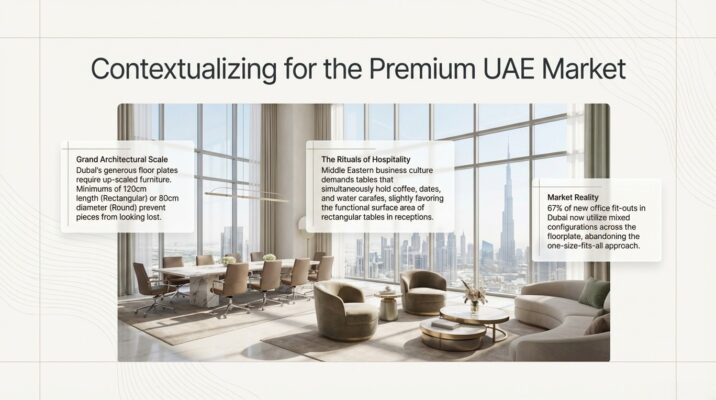
First, office scale: Dubai commercial spaces frequently feature generous floor plates, double-height ceilings, and grand proportions. This means coffee tables often need to be scaled up relative to typical European or North American standards. An undersized coffee table in a large Dubai reception hall will look lost and unintentional. Rectangular tables with a substantial length 120 cm or more or round tables with a diameter of 80 cm or greater are typically appropriate for the scale of UAE commercial spaces.
Second, cultural hospitality norms: In UAE business culture, the act of hospitality offering coffee, dates, and refreshments to guests is deeply meaningful. Coffee tables in reception and waiting areas should be sized to comfortably accommodate a hospitality tray, cups, a water carafe, and small snacks simultaneously. This functional requirement slightly favors rectangular tables for formal reception areas where hospitality rituals are prominent.
Third, aesthetic influences: Contemporary Dubai office design often blends modernist international aesthetics with Middle Eastern design elements geometric patterns, rich textures, warm metallics, and natural stone. Both round and rectangular tables can be selected to complement this aesthetic, but the detail level quality of joinery, material authenticity, finish consistency matters enormously in the discerning UAE market.
🔍 Key Insight: According to commercial interior design surveys across GCC markets, over 67% of new office fit-outs in Dubai use mixed coffee table configurations — combining round tables in collaboration zones with rectangular tables in formal areas — reflecting a sophisticated, function-led approach to workspace design.
9. Size Guidelines and Proportion Rules
Whatever shape you select, getting the proportions right relative to your sofa, seating arrangement, and room is critical. Furniture that is poorly proportioned even if the right shape will undermine the entire space.
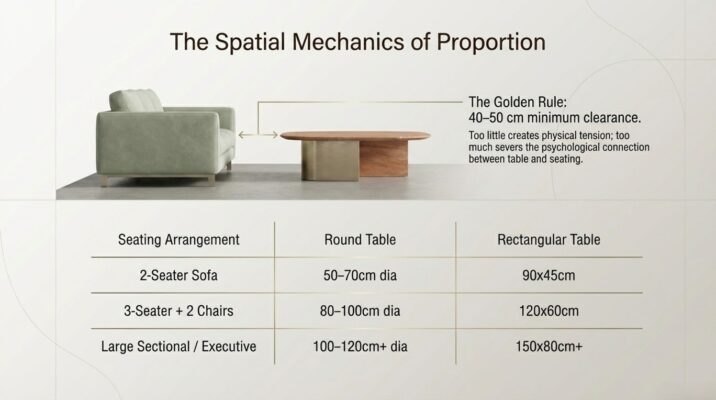
| Seating Arrangement | Recommended Round Table Diameter | Recommended Rectangular Table Size | Clearance Required |
|---|---|---|---|
| 2-seater sofa only | 50–70 cm | 90–100 cm (L) × 45–55 cm (W) | 40 cm minimum all sides |
| 2-seater sofa + 1 chair | 60–80 cm | 100–120 cm (L) × 50–60 cm (W) | 45 cm minimum all sides |
| 3-seater sofa + 2 chairs | 80–100 cm | 120–140 cm (L) × 55–65 cm (W) | 45–50 cm all sides |
| Large sectional or 4+ seats | 100–120 cm | 140–160 cm (L) × 60–75 cm (W) | 50–60 cm all sides |
| Executive suite (large room) | 90–130 cm | 150–200 cm (L) × 70–90 cm (W) | 60 cm+ all sides |
The clearance distance the gap between the table edge and the sofa or chairs — is a frequently underestimated factor. Too little clearance creates a cramped, uncomfortable experience; too much breaks the visual connection between the table and the seating. The 40–50 cm rule is a reliable starting point for most office environments.
10. Budget Considerations and Value Tiers
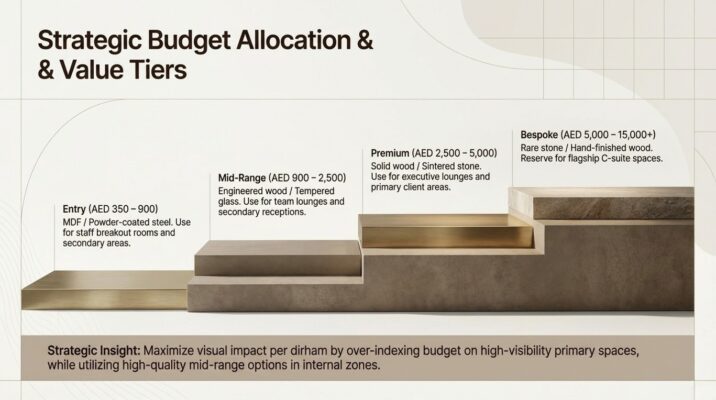
Office coffee tables in Dubai are available across a wide price spectrum, from budget-friendly options under AED 500 to bespoke statement pieces exceeding AED 10,000. Understanding the value tiers helps you match your investment to the visibility and usage of the space.
| Tier | Price Range (AED) | Material Quality | Best For |
|---|---|---|---|
| Entry | 350 – 900 | MDF, basic laminates, powder-coated steel | Staff breakout rooms, secondary areas |
| Mid-Range | 900 – 2,500 | Engineered wood, tempered glass, quality metals | Reception areas, team lounges |
| Premium | 2,500 – 5,000 | Solid wood, marble, sintered stone, brass | Executive lounges, client areas |
| Luxury / Bespoke | 5,000 – 15,000+ | Rare stone, hand-finished wood, designer brands | Flagship reception, C-suite spaces |
At OfficeMaster.ae, we offer competitive pricing across all tiers with the advantage of direct supply partnerships across Europe and Asia. Our clients across Dubai and the wider UAE consistently find that our mid-range office furniture Dubai collections deliver premium aesthetics at accessible price points — making it possible to create impressive commercial interiors without overextending the fit-out budget.
💡 Pro Tip: When budgeting for office coffee tables, allocate more of the budget to high-visibility spaces like the main reception, and use mid-range options in secondary breakout areas. This strategic distribution maximizes visual impact per dirham spent.
11. Trends Shaping Office Coffee Table Design in 2025–2026
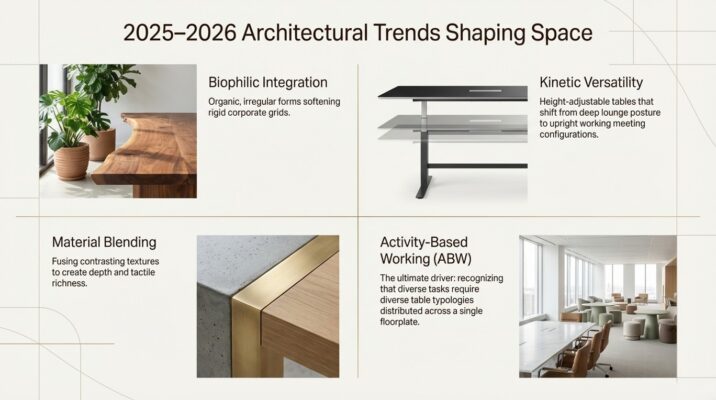
The office furniture market is evolving rapidly as workplaces adapt to hybrid work models, wellness priorities, and shifting generational preferences. Here are the key trends influencing coffee table design in commercial interiors right now:
- Biophilic design integration: Coffee tables featuring live-edge wood, stone surfaces with natural movement, and organic irregular forms are growing in popularity as offices seek to bring natural elements indoors.
- Height-adjustable and flexible coffee tables: Sit-stand coffee tables and height-adjustable options allow the same furniture piece to transition between casual lounging (low position) and working meeting configurations (raised position), adding valuable versatility.
- Mixed material combinations: Tables combining two or more materials — stone with brass, wood with glass, concrete with steel — are trending strongly, reflecting the material richness that UAE design audiences expect.
- Nested and modular configurations: Rather than a single static table, nested sets of round tables at varying heights allow flexible, reconfigurable arrangements that suit the dynamic nature of modern office use.
- Sustainable materials: FSC-certified woods, recycled metal, and low-emission sintered stone are increasingly specified by companies with ESG commitments, particularly in UAE where sustainability is a growing corporate priority.
- Bold color: Coffee tables in dark forest green, terracotta, deep navy, and warm chocolate are replacing the dominant all-white and grey palettes of the 2010s, adding character and warmth to office interiors.
🔍 Key Insight: The shift toward activity-based working (ABW) in UAE corporate offices is the single biggest driver of coffee table diversification. ABW environments require multiple table typologies — formal, informal, collaborative, solitary — distributed across the floorplate, replacing the one-size-fits-all approach of traditional office design.
12. Decision Framework: A Step-by-Step Guide to Choosing Your Shape
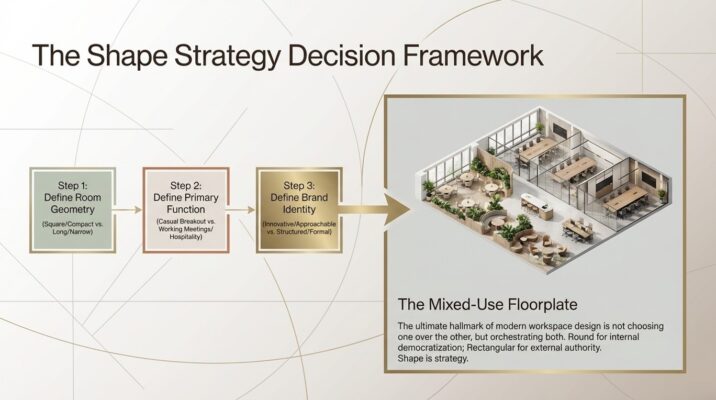
Use this systematic framework to confidently determine whether round or rectangular best serves your specific office environment:
- Define the primary function of the space: working meetings, client hospitality, casual breakout, or waiting? Working meetings and hospitality lean rectangular; casual and collaborative lean round.
- Measure the room’s proportions: is it square/compact or long/narrow? Square favors round; rectangular rooms favor rectangular tables.
- Identify your sofa or seating configuration: a symmetric U-shape or corner arrangement pairs beautifully with a round table; a linear sofa-opposite-chairs configuration pairs best with rectangular.
- Consider your brand personality: innovative, collaborative, and approachable brands should lean round; authoritative, structured, and formal brands should lean rectangular.
- Evaluate traffic flow: heavy foot traffic areas benefit from round tables’ lack of protruding corners; lower-traffic formal zones can accommodate rectangular tables without issue.
- Set your budget and quality tier: use the table above to match your investment to the visibility of the space.
- Consider future flexibility: if the space is likely to change use frequently, round tables (especially in nested or modular configurations) offer greater adaptability.
Frequently Asked Questions (FAQ)
For a standard reception with a 3-seater sofa and two side chairs, a rectangular table measuring 120–140 cm long by 55–65 cm wide, or a round table of 80–100 cm diameter, is ideal. Always maintain 40–50 cm clearance between the table edge and the nearest seating.
Yes, absolutely. While rectangular tables are more traditionally associated with formal settings, round tables in premium materials like marble or dark wood with a metal base project sophistication and modernity. The key is the material and finish quality, not just the shape.
In a compact space, always priorities a round table. The absence of corners means better traffic flow, fewer collision risks, and a more spacious feel. A round table of 60–70 cm diameter works well in tight reception nooks.
For high-traffic areas, sintered stone (like Dekton or Lapitec) is the most practical option — it is scratch-resistant, stain-resistant, heat-resistant, and requires minimal maintenance. Powder-coated metal frames add structural durability.
Yes. Progressive executives increasingly choose round tables for their private lounges as a deliberate signal of an open, collaborative leadership style. In premium materials, round tables look equally sophisticated in executive settings.
The standard range is 40–50 cm. For office environments where people may use the table for working (laptops, documents), a height of 45–50 cm is preferable. For purely relaxation-oriented breakout areas, 38–42 cm creates a more casual, comfortable feel.
Not necessarily by floor area, but by effective spatial impact, yes. Rectangular tables have corners that project into circulation paths. A round table of equal surface area feels less space-invasive because its perimeter is continuous and corner-free.
In office interiors, the coffee table should primarily relate to the surrounding lounge furniture — the sofas, chairs, and any side tables. It does not need to match the desks unless the overall design concept is strongly unified across all zones.
A 70 cm round table comfortably serves 3–4 people. A 100 cm round table serves 4–5. A 120 cm rectangular table serves 4–6 depending on sofa configuration. A 160 cm rectangular table can serve up to 6–8 in a lounge arrangement.
Oval coffee tables are the most versatile choice for dual-use environments. They combine the linear clarity of rectangular tables with the softened edges and equal-access quality of round tables. Height-adjustable coffee tables also offer versatility by transitioning between lounge and working heights.
For biophilic office interiors, organic irregular forms — free-form tables that loosely echo natural shapes — are increasingly popular. Among conventional shapes, round tables with natural wood or stone surfaces align most naturally with biophilic design principles.
Ensure at least 90 cm clear circulation paths around all furniture groupings for emergency egress. Coffee tables with protruding corners should have a minimum 60 cm clearance on at least one accessible side. Round tables naturally satisfy most accessibility clearance requirements.
Yes. OfficeMaster.ae provides delivery and installation services across Dubai, Abu Dhabi, Sharjah, and the wider UAE. Our team also offers office space planning consultations to help determine the optimal furniture configuration for your specific layout.
In commercial interiors, ‘cocktail table’ and ‘coffee table’ are often used interchangeably. However, cocktail tables may be slightly higher (50–60 cm) and designed for standing-adjacent use, while coffee tables are typically lower (38–50 cm) and paired with lounge seating. In office design, the coffee table height range is more functional.
OfficeMaster.ae curates collections from quality European, Turkish, and Asian manufacturers with a focus on commercial-grade durability and contemporary design. Our range spans every budget tier, from value-focused options to premium designer-quality pieces tailored to the UAE market.
Shape Is Strategy
The question of round vs. rectangular coffee tables for your office layout is far richer than it first appears. Shape is not merely an aesthetic preference it is a strategic communication tool, a spatial planning instrument, and a direct contributor to the functional performance of your workspace.
Round coffee tables democratize space, soften authority, improve traffic flow, and create warmth. Rectangular tables anchor arrangements, maximize surface functionality, reinforce brand authority, and align with room geometries. Both shapes have environments where they shine, and the most sophisticated office designs often leverage both purposefully deployed across different zones to serve different functions.
At OfficeMaster.ae, we believe that every piece of office furniture should earn its place in your space. Our team of commercial interior specialists is available to help you navigate these decisions from shape selection to material specification, sizing, budget planning, and installation across Dubai and the UAE.
Explore our full collection of office coffee tables in round, rectangular, oval, and bespoke configurations at OfficeMaster.ae, and let your office furniture work as hard and as intelligently as the people it serves.