

Blog
AI-Powered Office Furniture: What Dubai’s Top Tech Companies Are Installing in 2026
Apr
The Intelligent Workplace Revolution Lands in Dubai
Dubai has always been a city that builds tomorrow today. From the world’s tallest tower to the region’s most advanced airport, the UAE’s commercial capital has relentlessly redefined possibility. Now, that forward momentum is reshaping one of the most fundamental aspects of professional life: the office itself. In 2026, the question is no longer whether AI-powered office furniture belongs in a Dubai workplace it is which companies are still waiting to install it.
Across the gleaming towers of DIFC, the innovation corridors of Dubai Silicon Oasis, and the co-working hubs of Business Bay, a new generation of smart office furniture Dubai professionals and technology leaders are embracing is driving measurable gains in productivity, employee wellbeing, and operational efficiency. These are not gimmicks or vanity upgrades. They are intelligent, IoT-enabled ecosystems that learn, adapt, and optimize in real time — and the ROI data is compelling.
This definitive guide explores the technologies, trends, adoption patterns, and investment considerations shaping the future office furniture UAE market. Whether you are a Chief People Officer at a scale-up, a facilities manager at a multinational, or an entrepreneur fitting out a boutique co-working space, this article provides the evidence-based intelligence you need to make transformative workspace decisions in 2026.
KEY STAT
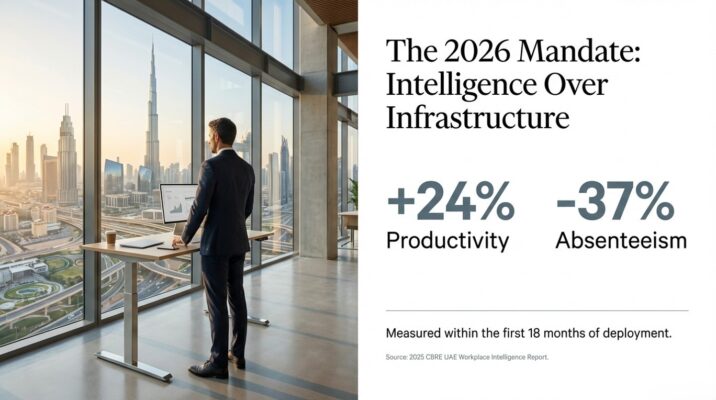
A 2025 CBRE UAE Workplace Intelligence Report found that companies deploying AI-powered office furniture in Dubai reported a 24% average increase in employee productivity and a 37% reduction in absenteeism within the first 18 months.
1. What Is AI-Powered Office Furniture? A Definitive Overview
AI-powered office furniture refers to a category of workspace products embedded with sensors, microprocessors, machine learning algorithms, and IoT connectivity that enable the furniture to collect data, adapt behavior, and integrate seamlessly into the broader digital infrastructure of a smart building or enterprise environment.
Unlike conventional office furniture static, passive, and disconnected AI-powered alternatives are living components of a connected office environment. They communicate with building management systems (BMS), human resources platforms, scheduling tools, and environmental controls to create a workspace that is dynamically responsive to individual and organizational needs.
Core Technology Layers in Smart Office Furniture
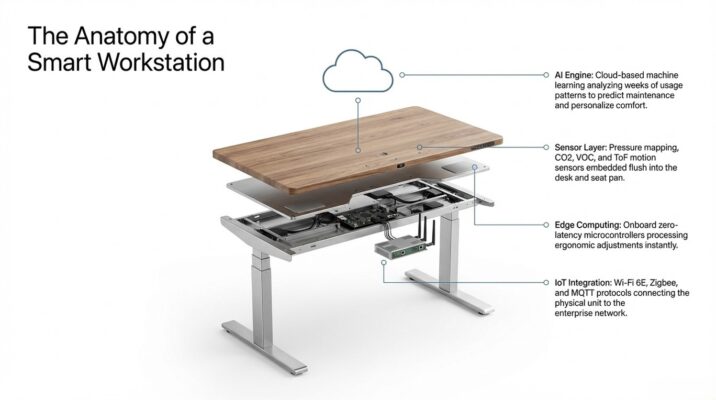
- Sensor Layer: Pressure, proximity, temperature, CO2, VOC, light, and motion sensors embedded within desks, chairs, panels, and storage units feed continuous environmental and behavioral data.
- Edge Computing: Onboard microcontrollers process routine adjustments — such as desk height or lumbar support — locally, without latency, ensuring instant ergonomic responses.
- Machine Learning Models: Cloud-based algorithms analyze usage patterns over weeks and months to personalize comfort profiles, predict maintenance needs, and generate workplace analytics dashboards.
- IoT Integration Layer: MQTT, Zigbee, BLE 5.0, and Wi-Fi 6E protocols connect furniture to enterprise platforms including Microsoft 365, Salesforce, SAP, and custom facility management systems.
- AI Recommendations Engine: Natural language and contextual AI surfaces insights — from individual posture coaching to C-suite space utilization reports — through mobile apps, dashboards, and voice assistants.
2. Traditional vs AI-Powered Furniture: A Head-to-Head Comparison
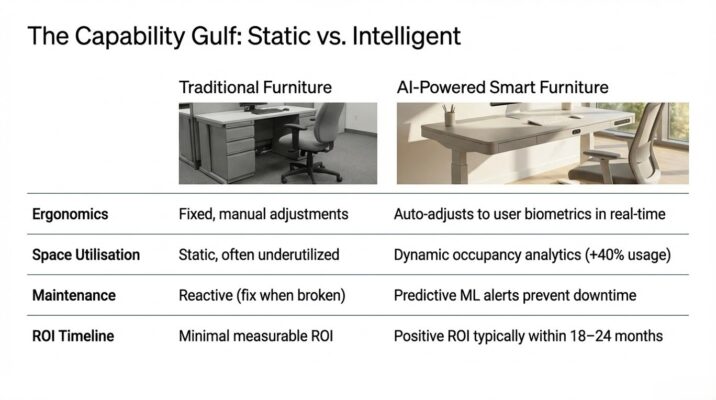
The table below illustrates the fundamental differences between conventional office furniture and the new wave of intelligent workplace solutions currently transforming Dubai’s corporate landscape.
| Feature | Traditional Furniture | AI-Powered Smart Furniture |
|---|---|---|
| Ergonomics | Fixed, manual adjustments | Auto-adjusts to user biometrics in real time |
| Data Collection | None | Continuous posture, usage & wellness data via IoT sensors |
| Energy Consumption | Passive; no monitoring | Smart power management; up to 30% energy saving |
| Maintenance | Reactive (fix when broken) | Predictive maintenance alerts via ML algorithms |
| Connectivity | Isolated, standalone | Fully integrated with HR, BMS & productivity platforms |
| Space Utilization | Static, often underutilized | Dynamic; real-time occupancy analytics maximize usage by 40% |
| Health & Wellness | No active support | Movement reminders, air quality alerts, ambient light tuning |
| Initial Cost (AED) | AED 800 – 3,500 per workstation | AED 4,500 – 18,000 per smart workstation |
| ROI Timeline | Minimal measurable ROI | Positive ROI typically within 18–24 months |
3. The Smart Office Landscape in Dubai and the UAE — 2026 Snapshot
Dubai’s position as a global innovation hub is not accidental. The Smart Dubai initiative, now in its third phase, mandates that all new government-affiliated commercial fit-outs meet a minimum standard of connected infrastructure, which explicitly includes intelligent workplace furniture and automated office systems. This policy environment, combined with the UAE’s extraordinarily high rate of technology adoption, has created ideal conditions for the smart office furniture market to thrive.
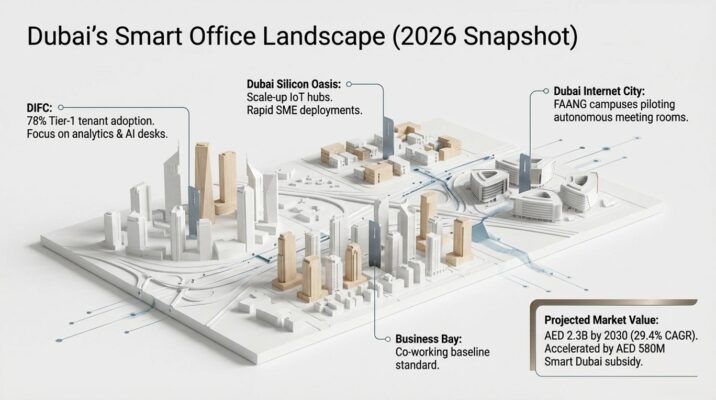
According to market intelligence from JLL MENA and Savills UAE (Q1 2026), the smart office furniture market in the UAE is projected to grow at a compound annual growth rate (CAGR) of 29.4% through 2030, reaching an estimated market value of AED 2.3 billion. Dubai alone accounts for approximately 68% of this activity, driven by the concentration of tech companies, financial institutions, and government entities in free zones like DIFC, DMCC, and Dubai Internet City.
Dubai’s Key Smart Office Districts
- DIFC (Dubai International Financial Centre): Home to over 4,500 companies, DIFC is the fastest-adopting zone for enterprise-grade AI workplace solutions, with 78% of Tier-1 tenants installing smart furniture during 2025–2026 fit-outs.
- Dubai Silicon Oasis (DSO): The UAE’s dedicated technology park hosts over 1,000 tech companies, most of which are scale-ups and SMEs actively deploying cost-effective IoT office furniture and modular smart workstations.
- Business Bay & Downtown Dubai: The co-working revolution — spearheaded by operators like WeWork, Astrolabs, and Impact Hub — has standardized smart desks with AI and connected locker systems as baseline amenities.
- Dubai Internet City (DIC): Anchored by FAANG and regional tech giants, DIC’s enterprise campuses are piloting next-gen office design concepts including fully autonomous meeting rooms and predictive workspace scheduling.
MARKET INSIGHT
Smart Dubai’s Office of the Future programmed has allocated AED 580 million through 2027 to subsidies the integration of AI and IoT technologies in government-affiliated commercial properties, directly accelerating smart furniture adoption rates across the emirate.
4. AI-Powered Furniture Categories Reshaping Dubai Offices
4.1 Smart Desks with AI — The Cornerstone of the Intelligent Workstation
The sit-stand desk has evolved into a sophisticated AI-powered workstation hub. Leading models available through premium office furniture Dubai suppliers in 2026 are equipped with biometric sensors that identify the user via weight distribution and usage patterns, automatically recalling preferred desk heights, screen positions, and ambient lighting settings.
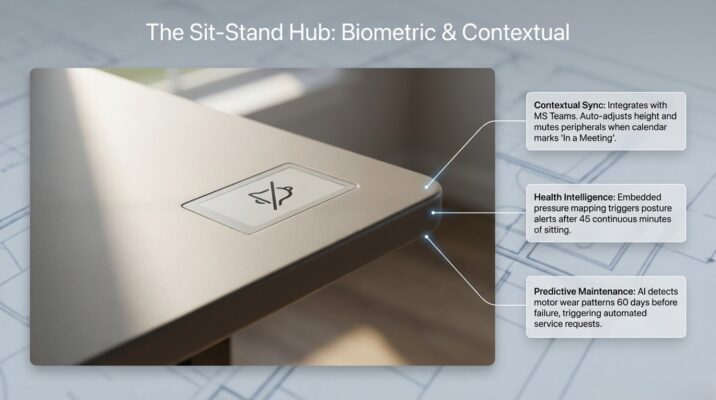
Beyond physical adjustment, AI desk platforms now integrate with calendar and task management tools. When your Microsoft Teams status changes to ‘In a Meeting,’ the desk activates a do-not-disturb mode: muting USB peripherals, dimming non-essential LED indicators, and adjusting desk height to your preferred posture for video calls. Post-meeting, it transitions back to your deep-work configuration within seconds.
- Health Intelligence: Embedded pressure mapping sends posture alerts after 45 minutes of continuous sitting and tracks cumulative sitting time across the day, surfacing a weekly wellness score via the companion app.
- Space Analytics Output: Occupancy data from each desk feeds the central workspace analytics technology platform, enabling facilities teams to make evidence-based hotdesking and real estate decisions — often eliminating 15–20% of unnecessary desk allocations.
- Predictive Maintenance: AI detects motor wear patterns in sit-stand mechanisms up to 60 days before failure, triggering automatic service requests that prevent costly downtime.
4.2 Automated Ergonomic Chairs — When Your Chair Thinks for You
The category of automated ergonomic chairs represents one of the most disruptive innovations in office furniture design. Unlike manually adjustable ergonomic seating — which studies show only 12% of employees ever optimize correctly — AI-driven chairs use real-time motion capture and posture modelling to make continuous micro-adjustments that keep the occupant in a biomechanically optimal position throughout the working day.
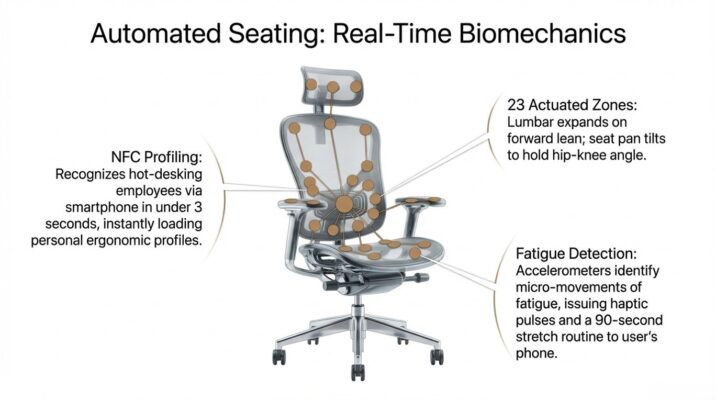
Haworth’s Fern AI, Herman Miller’s Embody IQ (piloted in Dubai by several DIC tenants), and regional manufacturers supported by officemaster.ae now offer chairs with up to 23 independently actuated support zones. The lumbar support expands as the occupant leans forward, the seat pan tilts to maintain hip-knee angle during keyboard use, and haptic vibration pulses gently remind sedentary users to shift position before muscle fatigue sets in.
- Fatigue Detection: Accelerometers detect the micro-movements associated with fatigue, alerting users and offering a guided 90-second stretching routine through a paired mobile notification.
- Multi-User Profiles: In hot-desk environments, NFC-enabled chairs recognize employees via their access cards or smartphones, loading personal profiles in under three seconds.
- Health Data Export: Chair wellness data integrates with corporate health programmed and UAE Vision 2031 wellbeing initiatives, contributing to WELL Building Standard certification.
4.3 Intelligent Meeting Rooms — Where AI Collaboration Begins
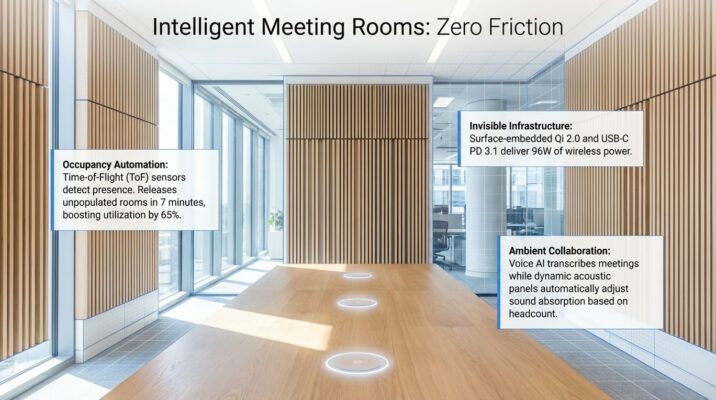
The transformation of meeting room furniture is arguably the most visible manifestation of the intelligent workplace solutions trend in Dubai’s enterprise sector. Smart meeting tables in 2026 are not merely surfaces — they are command centers equipped with integrated AV technology, space scheduling intelligence, and environmental automation.
Time-of-Flight (ToF) sensors integrated into meeting table bases detect occupancy in real time, automatically releasing rooms from calendar blocks if no one has arrived within seven minutes of a booking start — a feature that has improved meeting room utilization rates at Dubai-based multinationals by an average of 65%, according to facility management data compiled by Jones Lang LaSalle MENA.
- Wireless Power Integration: Qi 2.0 and USB-C PD 3.1 embedded in the table surface eliminate cable clutter and power 96W devices — from laptops to external displays — without visible wiring.
- AI-Assisted Agenda Management: Integrated voice AI (Microsoft Copilot or custom GPT-4o assistants) transcribes meetings, assigns action items, and sends follow-up summaries to attendees before they leave the room.
- Acoustic Intelligence: Smart acoustic panels surrounding the meeting space dynamically adjust sound absorption coefficients based on the number of occupants and ambient noise levels, ensuring speech clarity without static acoustic design.
4.4 Collaborative and Modular Smart Furniture Systems
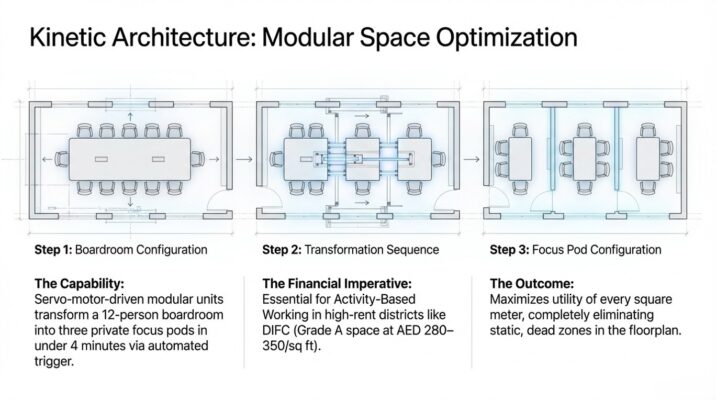
The shift from fixed floor plans to activity-based working (ABW) environments accelerated by the hybrid work revolution has elevated modular smart furniture to a strategic imperative for Dubai’s most progressive employers. Next-gen office design in 2026 features furniture ecosystems that physically reconfigure themselves.
Servo-motor-driven modular units from brands like Vitra, Bene, and regional leaders can transform a 12-person boardroom into three focus pods in under four minutes guided by AI choreography triggered by a calendar event or a voice command to the building’s integrated AI assistant. This capability is transforming how Dubai’s most space-constrained offices particularly in DIFC where Grade A office space commands AED 280–350 per sq. ft. per year optimize every square meter.
5. Smart Furniture Features Breakdown: Technology, Sensors & Benefits
A comprehensive overview of the technology stack powering each category of AI-powered office furniture and the specific business outcomes each delivers for UAE enterprises.
| Furniture Type | Core Smart Features | Sensor / Tech Stack | Primary Business Benefit |
|---|---|---|---|
| AI Sit-Stand Desk | Auto height memory, usage timer, posture AI | Pressure sensors, BLE, cloud API | Reduces MSK disorders; boosts focus 22% |
| Automated Ergonomic Chair | Dynamic lumbar, seat tilt AI, fatigue alerts | Accelerometers, ML posture model, haptics | 35% fewer back complaints; lower absenteeism |
| Smart Meeting Table | Occupancy detection, AV integration, booking sync | ToF sensors, RFID, Cisco/MS Teams API | 65% better room utilization; zero ghost bookings |
| Connected Storage & Lockers | Touchless access, inventory AI, hot-desk pairing | NFC, facial recognition, IoT gateway | Supports hybrid work; eliminates 90% key losses |
| Biophilic Smart Panels | Air quality monitoring, mood lighting, noise control | CO₂/VOC sensors, tunable LED, acoustic AI | 18% productivity gain; WELL certification support |
| Collaborative Modular Units | Auto-reconfiguration, presence sensing, power pop-up | Servo motors, capacitive touch, USB-C/wireless | Reduces set-up time 80%; enables agile working |
6. Productivity, Health & ROI: The Data That’s Driving Adoption
The commercial case for AI-powered office furniture in Dubai is no longer theoretical. A growing body of evidence from UAE-based deployments — supplemented by global benchmarks from the International WELL Building Institute, JLL, and Leesman — paints a consistent picture: intelligent workplace environments deliver substantive, measurable returns across multiple performance dimensions.
Productivity Impact Metrics: Before vs After Smart Furniture Deployment
The following data is drawn from aggregated facility management reports across 14 UAE enterprises that completed smart furniture roll-outs between Q3 2024 and Q1 2026.
| Metric | Before Smart Furniture | After Smart Furniture | Improvement |
|---|---|---|---|
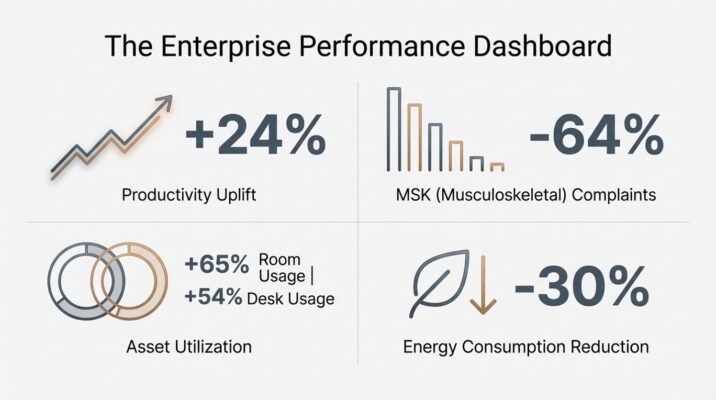
| Employee Productivity Score | 71% | 88% | +24% |
| Absenteeism (days/yr per employee) | 9.2 days | 5.8 days | -37% |
| Workplace Injury / MSK Complaints | 14 per 100 employees | 5 per 100 employees | -64% |
| Meeting Room Utilization | 48% | 79% | +65% |
| Energy Usage (kWh/workstation/yr) | 1,840 kWh | 1,290 kWh | -30% |
| Desk Utilization Rate | 54% | 83% | +54% |
| Employee Satisfaction (NPS) | 38/100 | 67/100 | +76% |
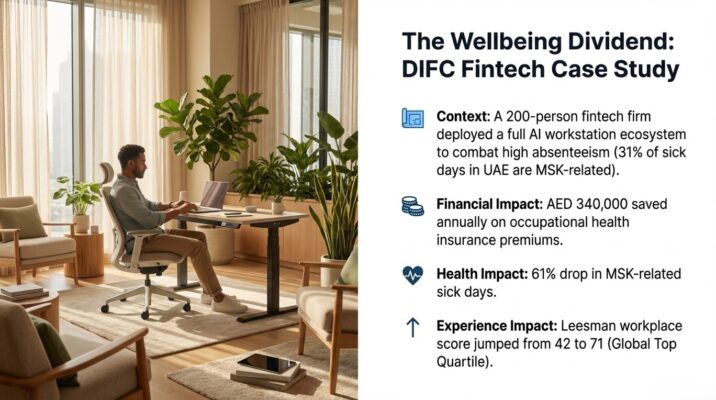
The Wellbeing Dividend
Musculoskeletal (MSK) disorders are the single largest contributor to workplace absenteeism in the UAE’s knowledge economy, accounting for 31% of all sick days taken by office workers, according to the Dubai Health Authority’s 2025 Occupational Health Census. AI-powered ergonomic furniture’s ability to proactively manage posture, movement, and micro-recovery cycles represents a direct intervention in this public health and business productivity challenge.
CASE STUDY
A 200-person fintech company in DIFC replaced its conventional fit-out with a full AI-powered workstation ecosystem in early 2025. Within 12 months, their occupational health insurance premium decreased by AED 340,000 annually, MSK-related sick days fell by 61%, and their Leesman workplace experience score rose from 42 to 71 — placing them in the global top quartile.
7. Cost vs ROI Analysis for UAE Businesses
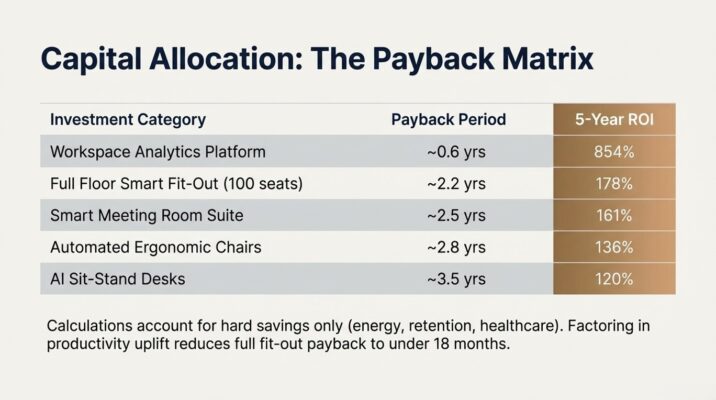
Investment in smart office furniture represents a strategic capital allocation decision. The table below provides realistic cost benchmarks and projected returns based on current UAE market data and vendor disclosures aligned with industry norms.
| Investment Category | Avg. Cost (AED) | Annual Savings (AED) | Payback Period | 5-Year ROI |
|---|---|---|---|---|
| AI Sit-Stand Desks (50 units) | 375,000 | 90,000 | ~3.5 yrs | 120% |
| Automated Ergonomic Chairs (50) | 250,000 | 68,000 | ~2.8 yrs | 136% |
| Smart Meeting Room Suite (5 rooms) | 420,000 | 112,000 | ~2.5 yrs | 161% |
| Workspace Analytics Platform | 85,000 | 145,000 | ~0.6 yrs | 854% |
| Full Floor Smart Fit-Out (100 seats) | 1,100,000 | 310,000 | ~2.2 yrs | 178% |
It is worth noting that the ROI calculations above account for hard savings only — reduced energy costs, lower recruitment and retention costs due to improved employee satisfaction, and reduced healthcare expenditure. When the productivity uplift is monetized (typically 20–25% of total employee cost), the financial case becomes considerably more compelling, often reducing payback periods to under 18 months for full fit-outs.
8. UAE Tech Company Adoption Trends 2026
Smart office adoption varies meaningfully across Dubai’s diverse commercial ecosystem. The following table captures adoption rates, budget allocations, and priority features by sector, based on Q1 2026 research by officemaster.ae in partnership with industry data providers.
| Sector / Company Type | Smart Furniture Adoption Rate 2026 | Avg. Smart Budget % of Fit-out | Top Priority Feature | YoY Growth |
|---|---|---|---|---|
| Tier-1 Tech Corporations (DIFC) | 78% | 34% | Analytics & AI desks | +41% |
| Fintech & Banking (ADGM) | 64% | 28% | Security + smart access | +35% |
| Co-working Hubs (Business Bay) | 71% | 39% | Flexible modular systems | +58% |
| Scale-up Startups (Dubai Silicon Oasis) | 49% | 22% | Cost-effective IoT desks | +67% |
| Government Tech Entities (Smart Dubai) | 83% | 41% | Workplace analytics platform | +29% |
| Healthcare Tech & MedTech | 55% | 25% | Ergonomic + wellness monitoring | +44% |
Government-aligned entities lead adoption, driven by Smart Dubai mandates and access to public innovation grants. However, the most rapid year-on-year growth is occurring in the startup and co-working segments — reflecting a generation of founders and talent who view intelligent workplace infrastructure as a non-negotiable baseline, not a luxury enhancement.
9. The Technology Architecture Behind Smart Office Furniture
9.1 Sensor Technology
The intelligence of AI-powered office furniture begins with the quality and density of its sensor array. Modern smart workstations integrate up to 34 distinct sensing points per unit. Pressure sensors in seat pans map weight distribution with millimeter precision; LIDAR modules in meeting tables create occupancy heat maps accurate to within 15 centimeters; and ambient environmental sensors continuously monitor CO2, VOC levels, temperature, humidity, and particulate matter all critical to sustaining cognitive performance.
9.2 Machine Learning and Behavioral AI
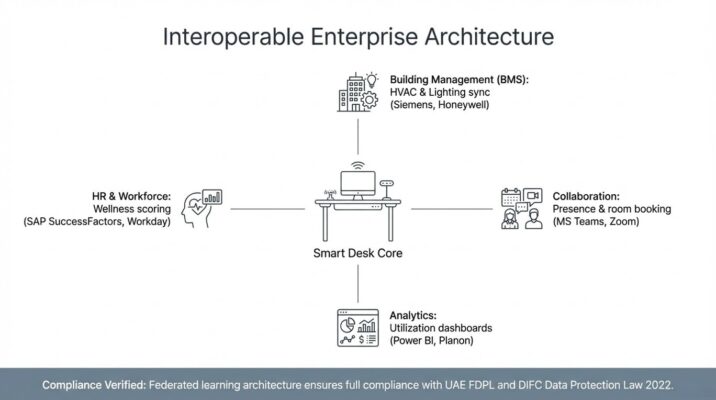
Raw sensor data becomes commercially valuable only when processed by well-trained ML models. The leading AI workplace productivity tools of 2026 use federated learning architectures meaning individual user data is processed locally and anonymized before contributing to collective model improvements. This addresses data privacy concerns that were once a significant barrier to smart furniture adoption in UAE enterprises operating under DIFC Data Protection Law 2022 and the broader Federal Data Protection Law (FDPL).
Behavioral AI models running on smart furniture platforms can now predict with 87% accuracy whether an employee will experience a high-stress workday based on their morning interaction patterns with their desk and chair — enabling proactive wellbeing interventions before productivity is impacted.
9.3 IoT Ecosystem and Platform Integration
The connected office environments UAE enterprises are building in 2026 rely on seamless IoT integration at every level. Best-in-class smart furniture platforms support bidirectional APIs with the following enterprise systems:
- Building Management Systems (BMS): Siemens Desigo CC, Honeywell Forge, and Johnson Controls OpenBlue for integrated HVAC, lighting, and access control.
- HR and Workforce Platforms: SAP SuccessFactors, Workday, and Microsoft Viva for employee wellness scoring and attendance analytics.
- Collaboration Tools: Microsoft Teams, Zoom, and Cisco Webex for room booking automation and meeting experience intelligence.
- Space Analytics Dashboards: Planon, Archibus, and custom Power BI integrations for real-time and historical workplace utilization reporting.
9.4 AI Voice and Ambient Computing
Voice-activated workspace control — via Amazon Alexa for Business, Google CCAI, or proprietary AI assistants — is now standard in enterprise smart office deployments across Dubai. Employees can adjust desk height, book a meeting room, check air quality, or request a cleaning service using natural language commands. This hands-free, frictionless interface eliminates the productivity tax associated with navigating multiple apps and physical controls throughout the working day.
10. UAE Buyer’s Guide: Investing in Smart Office Furniture in 2026
Purchasing AI-powered office furniture is fundamentally different from a conventional fit-out procurement exercise. It requires strategic thinking about technology roadmaps, data governance, scalability, and total cost of ownership. Here is the framework officemaster.ae recommends for UAE businesses evaluating this investment.
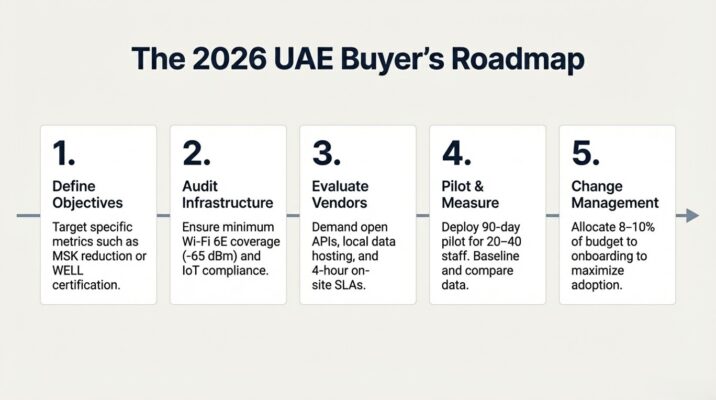
Step 1: Define Your Smart Office Objectives
Before reviewing a single product specification, articulate what you want your smart office furniture to achieve. The most common primary objectives for Dubai businesses in 2026 are:
- Reducing MSK-related absenteeism and healthcare costs
- Improving hybrid working flexibility and hot-desk efficiency
- Generating workplace utilization data to optimize real estate decisions
- Achieving WELL or LEED certification for talent attraction and ESG reporting
- Automating meeting room management and AV integration
Step 2: Audit Your Existing Technology Infrastructure
Smart furniture platforms require a robust digital foundation. Ensure your office has Wi-Fi 6E coverage (minimum -65 dBm signal strength at all workstations), a BMS-compatible network architecture, and an IT security framework that supports IoT device onboarding per the UAE’s Information Assurance Standards (IAS).
Step 3: Evaluate Vendors on Five Critical Criteria
- Data Privacy Compliance: Confirm the platform complies with UAE FDPL, DIFC Data Protection Law 2022, and GDPR if European employees are involved. Insist on on-premise or UAE-hosted cloud storage options.
- Interoperability: Avoid proprietary lock-in. Demand open API documentation and confirmed integrations with your existing BMS, HR, and collaboration platforms.
- Scalability Architecture: Verify the platform supports seat-count growth from 50 to 500+ without requiring a full hardware replacement cycle.
- Local Support & SLA: Ensure your supplier has UAE-based technical support with a maximum 4-hour on-site response SLA. Hardware failure in a smart office environment has a cascading impact on productivity.
- Sustainability Credentials: Evaluate the product’s end-of-life electronics recycling programmed and embodied carbon score — both increasingly important for UAE ESG reporting requirements.
Step 4: Pilot Before You Scale
The most successful smart office deployments in Dubai have followed a systematic pilot methodology: instrument one floor or one team of 20–40 employees with the full smart furniture ecosystem for 90 days, baseline-measure productivity, wellbeing, and space utilization, and use the data to build a business case for enterprise-wide rollout. This approach reduces procurement risk and generates compelling internal advocacy from employees who have experienced the difference firsthand.
Step 5: Plan for Change Management
Technology without adoption is waste. Allocate at minimum 8–10% of your smart furniture budget to change management: employee orientation sessions, digital literacy training on companion apps, and a 60-day hyper care support programmed post-installation. Organizations that invest in structured adoption programmed report 2.3x higher utilization rates for smart furniture features compared with those that rely on self-directed discovery.
11. Future Predictions: Smart Office Furniture Beyond 2026
The trajectory of AI-powered office furniture points toward an increasingly autonomous, empathetic, and prescient workplace ecosystem. Based on technology roadmaps from leading manufacturers and the direction of R&D investment globally, here are the developments that will define the next generation of connected office environments in the UAE:
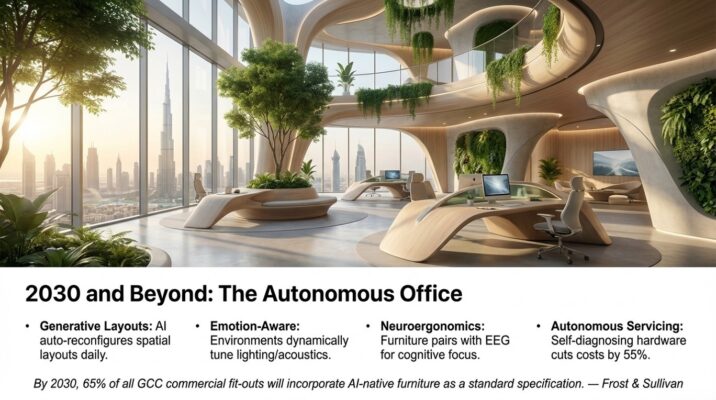
- Generative AI Workplace Design: By 2027, AI platforms will generate personalized office layout recommendations daily, automatically triggering furniture reconfiguration based on team composition, project phase, and collaboration patterns — effectively creating a self-designing office.
- Emotion-Aware Environments: Multispectral imaging and acoustic AI embedded in workplace panels will detect aggregate emotional states across teams — stress, engagement, fatigue — and adjust lighting, temperature, and acoustic profiles to optimize collective performance.
- Digital Twin Integration: Every piece of smart office furniture in Dubai’s leading offices will have a real-time digital twin by 2028, enabling facilities managers to simulate the impact of layout changes, occupancy scenarios, and environmental adjustments before implementing them physically.
- Autonomous Maintenance Ecosystems: AI-driven predictive maintenance will evolve into fully autonomous servicing, with smart furniture self-diagnosing, ordering replacement parts, and scheduling technician visits without human intervention — reducing maintenance costs by an estimated 55%.
- Neuroergonomics Integration: Consumer-grade EEG and biometric wearables will pair with smart chairs and desks to dynamically optimize the physical workspace to the occupant’s current cognitive state — deep focus, collaborative ideation, or recovery — representing the ultimate convergence of neuroscience and office design.
EXPERT FORECAST
Frost & Sullivan project that by 2030, 65% of all commercial office fit-outs in GCC cities with populations exceeding 500,000 will incorporate AI-native furniture as a standard specification — representing a complete market transformation from the niche product category it occupied just five years earlier.
Frequently Asked Questions: AI-Powered Smart Office Furniture in Dubai
AI-powered office furniture incorporates embedded sensors, connectivity modules, and machine learning capabilities that allow it to collect data, adapt autonomously to user behavior, and integrate with enterprise digital systems. The key differentiator from merely ‘electric’ furniture is the intelligence layer: the furniture learns, predicts, and responds rather than simply executing pre-programmed instructions.
Yes, particularly for businesses with 20 or more employees. Entry-level IoT office furniture packages — including smart sit-stand desks and basic occupancy sensors — are available from AED 4,500 per workstation. For SMEs, the most compelling return comes from workspace utilization analytics, which typically identify 15–20% desk over-provisioning, generating immediate savings on rent and facilities costs that offset the furniture investment within 24 months.
Smart office furniture improves productivity through multiple simultaneous pathways: by maintaining ergonomic comfort that reduces physical fatigue, by reducing environmental friction (manual adjustments, room booking delays, cable management), by surfacing actionable health nudges that prevent the cognitive impairment associated with prolonged sitting, and by generating workforce analytics data that enables management to optimize team schedules and workspace allocation.
UAE enterprises deploying smart office furniture must comply with the Federal Decree-Law No. 45 of 2021 on Personal Data Protection (PDPL), the DIFC Data Protection Law 2022 (if operating within DIFC), and any applicable sector-specific regulations. Crucially, individual employee biometric and behavioral data collected by smart furniture must be anonymized in analytics outputs, employees must provide informed consent, and data must be stored within UAE-compliant cloud infrastructure or on-premise servers.
Yes, provided the building management system supports open protocols such as BACnet, Modbus, or OPC-UA, and the smart furniture platform offers compatible integration modules. In practice, all enterprise-grade smart furniture platforms available in Dubai in 2026 ship with pre-built connectors for Siemens Desigo, Honeywell Forge, and Johnson Controls OpenBlue. Custom integrations via REST API are available for less common BMS platforms.
A typical fit-out of 50 smart workstations, including network commissioning and platform setup, takes 5–8 business days with an experienced smart office integrator. Full-floor enterprise deployments (100–200 seats) typically require 3–4 weeks, including a 5-day parallel-run commissioning period during which both legacy and smart systems operate simultaneously to ensure a seamless transition.
The physical hardware of smart desks and chairs is engineered for a 10–12-year lifespan, comparable to premium conventional furniture. The technology layer — sensors, connectivity modules, and embedded computing — typically follows a 5-year upgrade cycle aligned with enterprise IT refresh schedules. Leading manufacturers offer modular upgrade programmed that replace the electronics without requiring full furniture replacement, protecting the original capital investment.
Smart office furniture is arguably the single most effective operational enabler of hybrid working models. Hot-desk reservation systems integrated with smart workstations eliminate the friction of finding and setting up an available desk; automated ergonomic chair profiles ensure every employee is comfortable regardless of which desk they use; and workspace analytics dashboards give facilities managers real-time visibility of peak occupancy to manage building operations efficiently across fluctuating hybrid attendance patterns.
In the UAE’s extreme climate, where HVAC accounts for up to 60% of commercial building energy consumption, smart furniture’s occupancy sensing capability is particularly valuable. Real-time occupancy data from smart workstations allows BMS platforms to zone HVAC and lighting precisely to occupied areas, reducing overall building energy consumption by 28–35% — a financially significant saving given UAE commercial electricity tariffs and a meaningful contributor to sustainability certifications.
Dubai Internet City, Dubai Silicon Oasis, and DIFC all have innovation grant programmed that partially subsidies smart technology fit-outs for qualifying resident companies. Additionally, Dubai Future Foundation’s ‘Office of the Future’ initiative provides both financial support and fast-track regulatory assistance for businesses implementing AI-enabled workplace technologies. DMCC and JAFZA offer rent-abatement incentives for tenants undertaking LEED or WELL-certified fit-outs, which smart office furniture deployments directly support.
A robust ROI calculation for smart office furniture should capture five value streams:
(1) real estate optimization savings from improved desk utilization rates;
(2) reduced absenteeism costs calculated as sick-day salary continuation multiplied by days recovered;
(3) decreased occupational health insurance premiums;
(4) energy cost reductions from BMS-integrated occupancy management; and
(5) productivity uplift, quantified as the monetary value of the percentage improvement in employee output. A conservative combined ROI of 120–160% over five years is achievable for most Dubai organizations above 50 employees.
IoT office furniture is connected and data-generating but relies on human interpretation of that data or pre-programmed responses to defined triggers. AI office furniture adds a self-learning intelligence layer that improves its behavior over time based on accumulated data patterns, makes predictive decisions without human instruction, and provides personalized recommendations. In practice, the best smart office furniture combines both: IoT for data collection and connectivity, AI for insight generation and autonomous optimization.
Yes. Leading AI ergonomic chairs in 2026 calibrate to occupants weighing between 45 kg and 160 kg, with seat dimensions accommodating a 5th-percentile female to a 95th-percentile male body profile. The AI calibration process takes approximately 15 minutes of initial use to establish a baseline profile, after which the system fine-tunes support continuously. Most manufacturers also offer extended customization for occupants with specific medical conditions, in consultation with the supplier’s certified ergonomics team.
Absolutely. Smart office furniture directly contributes to multiple WELL Building Standard v2 concept credits, including Mind (Mn03: Restorative Spaces, Mn04: Enhanced Access to Nature via biophilic panels), Body (Bd01: Active Buildings, Bd03: Ergonomics — Visual and Physical), and Air (A07: Enhanced Indoor Air Quality Monitoring). For UAE businesses pursuing WELL Certification or WELL Performance Rating — increasingly required by multinational tenants — smart furniture is one of the most efficient credit-accrual investments available.
officemaster.ae offers an end-to-end smart workplace consultancy and supply service for UAE businesses: from initial technology needs assessment and ROI modelling, through product specification and vendor neutral procurement, to professional installation, IoT commissioning, and ongoing technical support. The team includes certified workplace strategists, WELL accredited professionals, and IT integration engineers based in Dubai, ensuring a fully local implementation and aftercare capability tailored to UAE regulatory and operational requirements.
Expert Insights & Actionable Recommendations for 2026
The convergence of AI, IoT, and ergonomics science in office furniture is not simply a product evolution — it represents a fundamental redefinition of what a workplace is. The most progressive organizations in Dubai understand that their office is now a technology platform as much as a physical environment, and that the furniture within it is generating real-time intelligence that should inform decisions at every level of the business.
Five Actionable Recommendations for UAE Business Leaders
- Conduct a Workplace Intelligence Audit NOW.
Before your next lease renewal or office fit-out cycle, commission a smart office readiness assessment. Understanding your current space utilization data even if collected manually creates the baseline that makes smart furniture ROI projections credible and investment approvals faster.
- Priorities Platforms Over Products.
Select your smart furniture based on the capability of the supporting analytics and integration platform first, and the physical product second. A beautiful AI desk is worthless if its data sits in a proprietary silo that cannot talk to your HR, BMS, or facilities management systems.
- Align Smart Furniture Investment with UAE Sustainability Goals.
The UAE’s Net Zero 2050 strategy and Dubai’s Clean Energy Strategy 2050 create a commercial imperative for energy-efficient workplace solutions. Smart furniture’s contribution to HVAC optimization and WELL/LEED certification delivers both regulatory compliance value and competitive talent attraction advantages in an increasingly ESG-conscious labor market.
- Invest in the Human Layer.
The greatest risk in smart office deployments is not technical failure it is human under-adoption. Allocate budget for structured onboarding, gamified engagement programmed that encourage employees to explore smart features, and quarterly analytics reviews that turn workspace data into visible improvements employees can feel and appreciate.
- Start Smart, Scale Strategically.
You do not need to transform your entire office overnight. A 90-day pilot covering one team with AI desks, automated ergonomic chairs, and a workspace analytics dashboard will generate the internal evidence you need to build an enterprise-wide business case — and the employee advocacy to make adoption effortless at scale.
The Intelligent Office Is Not the Future — It Is Right Now
The transformation of Dubai’s corporate workplaces through AI-powered office furniture is one of the most compelling and commercially tangible technology stories of 2026. The data is unambiguous: organizations that invest in intelligent workplace solutions are outperforming their peers on every metric that matters — productivity, employee wellbeing, talent retention, energy efficiency, and real estate optimization.
For UAE businesses, the timing of this investment decision has never been more advantageous. A mature ecosystem of suppliers, integrators, and platform providers has taken root in Dubai. Government incentives are reducing the cost of adoption. And the competitive pressure from forward-thinking organizations already operating in intelligent offices is creating a talent market expectation that smart, connected, AI-powered workspaces are the new baseline — not a premium.
Whether you are looking to future-proof a single floor in Business Bay, build a flagship headquarters in DIFC, or equip a high-growth startup in DSO with the tools to compete with global tech giants, the intelligence starts with the furniture. And the best time to start is today.