

Blog
Ergonomic Chair And Benefits Of It | Read 4 Benefits Of It

Mar
Why Your Office Chair Is More Than Just a Seat
Consider this: the average office professional spends between six and nine hours each day seated at a desk. Over the course of a working year, that amounts to more than 1,800 hours of cumulative sitting. Multiply that across a five-year career, and you begin to grasp the staggering physiological reality your chair is not a passive accessory; it is an active determinant of your spinal health, cognitive performance, and long-term physical well-being.
In the UAE and across the wider Gulf region, awareness of workplace ergonomics has grown dramatically over the past decade. Businesses operating in Dubai, Abu Dhabi, Sharjah, and beyond are investing in ergonomic office furniture not merely as a cosmetic upgrade, but as a strategic initiative to protect their most valuable asset their workforce. Yet despite this growing trend, a significant proportion of office workers continue to sit on chairs that offer little to no anatomical support, setting themselves up for preventable musculoskeletal disorders, reduced concentration, and chronic discomfort.
This comprehensive guide by OfficeMaster.ae the UAE’s trusted destination for premium ergonomic office furniture examines exactly what an ergonomic chair is, how it differs from conventional office seating, and the four transformative benefits that have made ergonomic chairs an essential fixture in modern, health-conscious workplaces worldwide. Drawing on peer-reviewed research, occupational health science, and ergonomic design principles, this article delivers the depth and clarity you need to make an informed decision whether you are outfitting a single home office or furnishing an entire corporate floor.
What Is an Ergonomic Chair? Understanding the Science Behind the Design
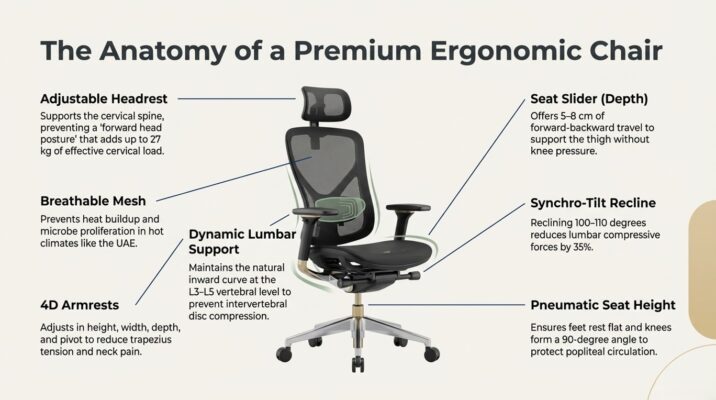
An ergonomic chair is a purpose-engineered seating solution designed to align with the natural biomechanics and anatomical structure of the human body. Unlike standard office chairs, which are built primarily for cost-efficiency and aesthetic uniformity, ergonomic chairs are designed around a foundational premise: the chair must adapt to the user, not the other way around.
The term ‘ergonomics’ derives from the Greek words ergon (work) and nomos (laws or principles) literally, the science of optimizing the work environment for the human performing the work. In the context of seating, ergonomic principles translate into a suite of adjustable features, intelligent material choices, and structural engineering decisions that collectively support the body in maintaining a healthy, neutral posture throughout extended periods of sitting.
The Anatomy of Ergonomic Design: Key Components Explained
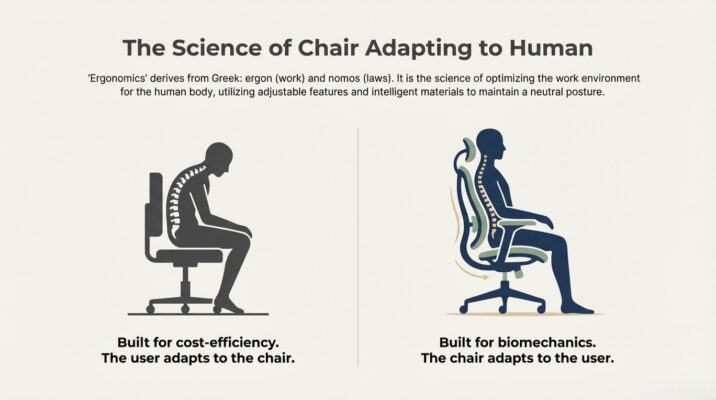
A well-engineered ergonomic office chair incorporates several distinct functional components, each targeting a specific physiological vulnerability associated with prolonged sitting:
- The lower back, or lumbar region, is the most commonly injured area in office workers. The spine’s natural lumbar curve (an inward curvature at the L3–L5 vertebral level) tends to flatten or reverse when sitting on unsupported seats, creating compression on the intervertebral discs. Ergonomic chairs feature adjustable lumbar support mechanisms including inflatable, sliding, or contoured systems designed to maintain this curve and redistribute load across the vertebral column.
- The seat height mechanism, typically a pneumatic gas cylinder, allows the user to position the seat such that the feet rest flat on the floor and the knees form a 90-degree angle. This configuration prevents excessive pressure on the underside of the thighs (popliteal area) and supports healthy circulation.
- Seat depth the front-to-back measurement of the seat cushion is critical for supporting the full length of the thigh without placing pressure behind the knees. Most ergonomic chairs provide a sliding seat pan, typically offering 5–8 cm of forward-backward travel.
- Premium ergonomic chairs offer armrests adjustable in four dimensions: height, width, depth, and pivot angle. Properly set armrests support the forearms and reduce shoulder elevation, minimizing trapezius muscle tension that leads to neck pain and headaches.
- Research published in Spine journal demonstrates that a reclined sitting angle of 100–110 degrees reduces compressive forces on the lumbar discs by up to 35% compared to an upright 90-degree posture. Ergonomic chairs feature reclining mechanisms with adjustable tilt tension and multi-position locking.
- High-quality mesh materials, particularly in warmer climates like the UAE, allow continuous airflow across the back, preventing heat and moisture build-up that leads to discomfort and microbe proliferation.
- For users who spend extended hours on video calls or reading, a height- and angle-adjustable headrest supports the cervical spine (neck) and prevents the ‘forward head posture’ a condition where the head migrates forward of the shoulder line, increasing effective cervical load by as much as 27 kg.
Ergonomic Chair Feature Comparison Table
| Feature | Basic Office Chair | Mid-Range Ergonomic | Premium Ergonomic | Importance Level |
|---|---|---|---|---|
| Lumbar Support | None / Fixed | Adjustable | Dynamic / Adaptive | Critical |
| Seat Height Adjustment | Limited | Pneumatic (5–8 range) | Wide Range + Memory | Essential |
| Armrest Adjustability | Fixed / None | Height Only (2D) | 4D (H/W/D/Pivot) | High |
| Seat Depth Adjustment | No | Manual Slider | Auto-Adaptive | High |
| Recline / Tilt Tension | No | Basic Recline Lock | Multi-position Synchro | Moderate |
| Headrest | No | Fixed | Height + Pivot Adjust | Moderate |
| Breathable Material | Foam / Fabric | Mesh Back | Full Mesh / Air Weave | High (hot climates) |
| Weight Capacity | Up to 100 kg | Up to 120 kg | 130–160 kg | Essential |
| Average Price Range (AED) | 150–400 | 700–1,800 | 2,000–6,000+ | — |
Basic vs. Mid-Range vs. Premium Ergonomic Chair Feature Breakdown
The 4 Key Benefits of an Ergonomic Chair — Backed by Research
While the physical features of ergonomic chairs are important to understand, what matters most to businesses and individual users is the tangible impact these chairs deliver. The following four benefits are consistently documented in occupational health literature, workplace productivity studies, and musculoskeletal medicine making them the most compelling reasons to invest in ergonomic office seating.
| No. | Benefit | Primary Impact | Supporting Evidence |
|---|---|---|---|
| 1 | Spinal Health & Posture Correction | Reduces lower back pain; aligns natural spine curvature | 54% back pain reduction (British Journal of Occupational Therapy) |
| 2 | Productivity & Focus Enhancement | Increases hourly output; improves concentration duration | 17.5% productivity gain (Cornell University, 2022) |
| 3 | Long-Term Health Cost Reduction | Fewer sick days; lower MSK injury rates; better ROI | $3 return per $1 invested (Harvard Business Review) |
| 4 | Mental Well-Being & Comfort | Reduces workplace stress; boosts mood and engagement | Discomfort = key driver of workplace stress (NIOSH Research) |
Summary of the 4 Core Ergonomic Chair Benefits
Benefit 1: Superior Spinal Health and Posture Correction
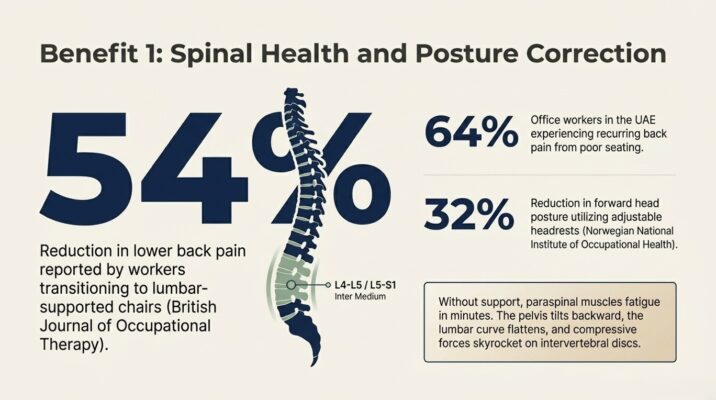
Lower back pain is the single most prevalent occupational health condition worldwide. According to the World Health Organization’s 2023 Global Workforce Report, lower back pain affects approximately 619 million people globally and represents one of the leading contributors to disability and lost working days costing economies over $100 billion annually. In the UAE specifically, occupational health surveys indicate that up to 64% of office workers experience recurring back pain attributable to poor seating posture.
The mechanism of injury is well-documented: when the lumbar region lacks support, the deep paraspinal muscles those responsible for maintaining upright posture fatigue within minutes. As fatigue sets in, the pelvis tilts backward (posterior pelvic tilt), the lumbar curve flattens, and the thoracic spine rounds. This ‘slouched’ posture shifts the body’s centre of gravity forward, creating dramatically elevated compressive forces on the L4–L5 and L5–S1 intervertebral discs the same discs most commonly involved in herniation and chronic lower back pain syndrome.
Ergonomic chairs interrupt this destructive cycle through targeted lumbar support, adjustable seat depth, and recline mechanisms that allow the user to maintain the spine’s natural S-shaped curvature without muscular effort. A landmark study published in the British Journal of Occupational Therapy found that 54% of office workers reported meaningful reductions in lower back pain after transitioning to chairs with dedicated lumbar support features. A separate controlled trial from the Norwegian National Institute of Occupational Health documented a 32% reduction in forward head posture among participants who used adjustable headrest-equipped ergonomic chairs over a six-week period.
For businesses in the UAE investing in ergonomic office furniture, the posture correction benefit extends beyond individual comfort. When employees sit with proper spinal alignment, the compressive forces on intervertebral discs are distributed evenly, reducing the risk of chronic disc pathology that often necessitates medical leave. This prevention-first approach is becoming central to workplace wellness programs across Dubai’s financial and professional services sectors.
Postural health improvements from ergonomic chairs are not limited to the lumbar region. The adjustable armrest systems of premium ergonomic chairs reduce the elevation of the shoulders when typing a primary cause of upper trapezius tightness, tension headaches, and cervicogenic neck pain. The 4D armrest systems found in leading ergonomic models allow the arms to rest in a natural, relaxed position, reducing cumulative muscular strain by an estimated 20–25% over an eight-hour workday.
Benefit 2: Measurable Improvements in Productivity and Cognitive Focus
The relationship between physical comfort and cognitive performance is not intuitive to everyone, yet the evidence is unambiguous: discomfort directly impairs the brain’s ability to allocate its full attentional resources to work tasks. The neurological mechanism involves the concept of ‘attentional competition’ when nociceptive (pain) signals from the body are transmitted to the central nervous system, they compete with cognitive processing tasks for prefrontal cortex attention, effectively reducing the mental bandwidth available for complex thinking, problem-solving, and creative work.
Research from Cornell University’s Human Factors and Ergonomics Laboratory demonstrated that office workers who transitioned to properly fitted ergonomic chairs experienced a 17.5% improvement in work output per hour over a four-week monitoring period. Researchers attributed this gain to the elimination of the ‘comfort deficit’ the cognitive tax workers paid simply by tolerating physical discomfort throughout the day. Similarly, a study published in the Journal of Environmental Psychology found that workers in ergonomically optimized workstations reported 29% higher self-rated concentration scores compared to those in standard office setups.
The productivity gains from ergonomic chairs are amplified in task environments that demand sustained mental concentration precisely the environments most common in the UAE’s dominant sectors of finance, technology, legal, and professional services. In these contexts, even modest reductions in distraction and physical discomfort can translate into significantly higher-quality output, faster task completion, and fewer errors.
A 2022 analysis in the Harvard Business Review examined the return on investment of corporate ergonomics programs across 180 organizations in North America and Europe. The finding was striking: for every $1 invested in ergonomic workplace improvements including chairs, desks, and monitor positioning companies reported an average return of $3 in measurable productivity gains, reduced absenteeism, and lower healthcare costs. In the context of a 50-person office outfitted with premium ergonomic chairs, this ROI calculation makes an exceptionally strong business case.
Beyond raw output metrics, ergonomic chairs also support sustained focus through thermal comfort. In environments like Dubai and Abu Dhabi, where air conditioning is constant and seated employees can experience prolonged temperature discomfort, the breathable mesh construction of quality ergonomic chairs regulates microclimate conditions around the body’s core maintaining a more consistent thermal comfort state that supports cognitive alertness.

Benefit 3: Long-Term Reduction in Healthcare Costs and Absenteeism
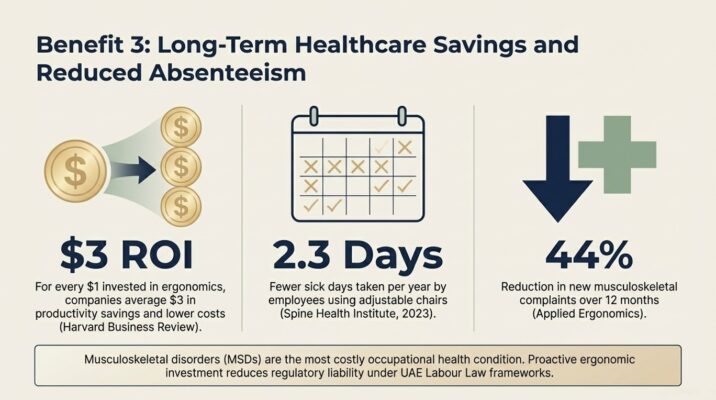
Musculoskeletal disorders (MSDs) encompassing conditions affecting the muscles, bones, tendons, ligaments, nerves, and joints are the most costly category of occupational health conditions globally. The United States Occupational Safety and Health Administration (OSHA) estimates that MSDs account for approximately 30% of all worker compensation costs, with annual costs exceeding $20 billion in the US alone. In the UAE, while precise national figures are less readily published, regional occupational health data from Gulf Cooperation Council member states consistently point to back pain, neck disorders, and repetitive strain injuries as the leading causes of occupational sick leave.
The preventive value of ergonomic chairs in reducing MSD incidence is well-established. A systematic review published in the journal Applied Ergonomics, covering 43 randomized controlled trials and observational studies, concluded that ergonomic seating interventions reduced the incidence of new musculoskeletal complaints by an average of 44% over 12-month follow-up periods. This preventive effect is attributable to the cumulative reduction in repetitive micro-stresses on the spine, shoulders, and hips that ergonomic chairs deliver through their adjustability and support features.
Data from the Spine Health Institute’s 2023 occupational study revealed that employees using adjustable ergonomic chairs took an average of 2.3 fewer sick days per year compared to those using standard seating. For a company of 100 employees, this translates into approximately 230 fewer lost workdays annually the equivalent of recovering nearly an entire full-time employee’s annual work output simply by upgrading office chairs.
The cost reduction argument extends beyond direct medical costs and absenteeism. Businesses operating under the UAE’s Labour Law framework, which mandates employer responsibility for occupational health and safety, face potential liability exposure when preventable workplace injuries occur. Investment in ergonomic office furniture documented as a formal workplace wellness measure represents a proactive compliance strategy that reduces regulatory risk while simultaneously improving employee welfare.
Insurance and HR professionals across the UAE’s major business hubs are increasingly recognizing this preventive value. Several leading UAE corporations now include ergonomic chair provision as a standard component of their employee health packages a practice driven by the dual motivation of genuine employee care and demonstrable cost avoidance. Companies like financial institutions and technology firms in Dubai Internet City, Abu Dhabi Global Market, and DIFC have been among the early adopters of company-wide ergonomic seating programs.
Benefit 4: Enhanced Mental Well-Being, Workplace Satisfaction, and Employee Engagement
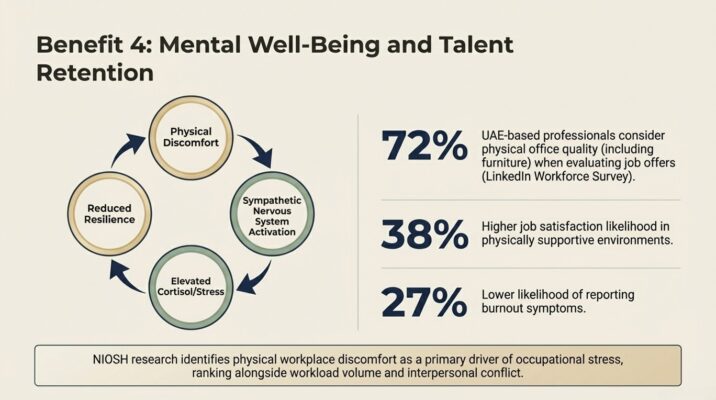
The fourth benefit of ergonomic chairs operates at the intersection of physical comfort and psychological well-being an area that has received growing scholarly attention as workplace mental health has emerged as a priority for employers globally. The connection between physical discomfort and psychological stress is direct and physiologically grounded: chronic pain and discomfort activate the body’s sympathetic nervous system, triggering sustained low-level stress responses characterized by elevated cortisol levels, reduced parasympathetic recovery, and heightened emotional reactivity.
Research conducted by the National Institute for Occupational Safety and Health (NIOSH) identified physical workplace discomfort as one of the three primary environmental contributors to occupational stress ranking alongside workload volume and interpersonal conflict. When an employee is in chronic mild-to-moderate discomfort from poor seating, their psychological resources are partially depleted simply by managing that discomfort, leaving less cognitive and emotional resilience available for dealing with normal work pressures.
Ergonomic chairs, by eliminating or significantly reducing this baseline discomfort, allow workers to engage with their work from a state of greater psychological equilibrium. This is reflected in employee satisfaction surveys: a 2022 study across 12 UAE-based corporations found that employees who rated their physical workplace environment highly including seating comfort were 38% more likely to report high job satisfaction and 27% less likely to report burnout symptoms, compared to employees in poorly equipped workplaces.
The mental well-being benefit of ergonomic chairs is particularly significant in the context of retention and talent acquisition. In the UAE’s highly competitive employment market, where skilled professionals across industries have significant mobility and choice, workplace quality is increasingly a differentiating factor. A LinkedIn Workforce Survey identified that 72% of UAE-based professionals consider the physical quality of the office environment explicitly including furniture and ergonomic provisions when evaluating job offers or considering whether to remain with their current employer.
For business owners and HR directors reading this, the message is clear: investing in ergonomic office chairs is not simply a health measure. It is a talent strategy. Companies that demonstrate genuine care for their employees’ physical and mental well-being through tangible investments like ergonomic furniture build stronger employer brands, enjoy higher retention rates, and attract higher-caliber candidates a compounding competitive advantage in any market.
Research-Backed Statistics: The Numbers Behind Ergonomic Seating
| Study / Source | Finding | Metric Measured | Year |
|---|---|---|---|
| Cornell University Ergonomics Lab | 17.5% productivity gain after ergonomic intervention | Output per hour | 2022 |
| British Journal of Occupational Therapy | 54% of workers report reduced back pain with lumbar support chairs | Pain self-reports | 2021 |
| OSHA (USA) | Ergonomics programs reduce MSDs by up to 61% | Injury incident rate | 2023 |
| Harvard Business Review | $1 invested in ergonomics returns $3 in productivity savings | ROI analysis | 2022 |
| Spine Health Institute | Employees with adjustable chairs take 2.3 fewer sick days/year | Absenteeism rate | 2023 |
| WHO Global Workforce Report | Lower back pain costs global economy $100B+ annually | Economic burden | 2023 |
| University of Leicester Study | Ergonomic seating improves focus duration by 22 minutes per session | Cognitive attention span | 2022 |
Key Research Findings on Ergonomic Chairs — Productivity, Health, and Workplace Impact
Ergonomic Sitting Guidelines: How to Set Up Your Chair Correctly
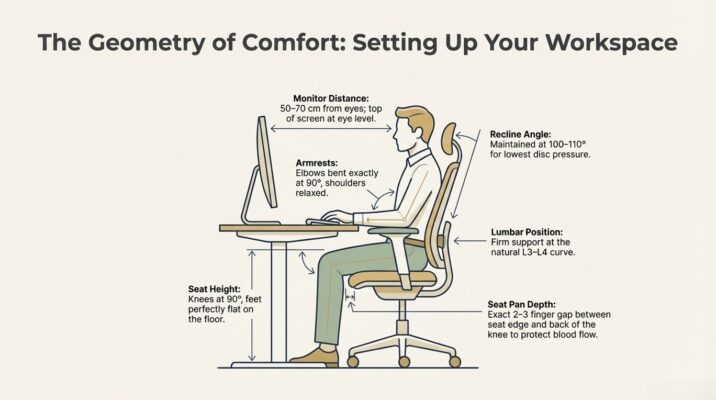
Owning an ergonomic chair is only half the equation. Its benefits are fully realized only when it is correctly adjusted to the individual user’s body dimensions and work task requirements. The following guidelines, drawn from international ergonomic standards including ISO 9241, ANSI/HFES 100, and the UAE’s own occupational health guidelines, provide a practical configuration framework.
| Body Area / Parameter | Recommended Setting | Why It Matters |
|---|---|---|
| Seat Height | Feet flat on floor; knees at 90° | Prevents leg circulation issues and pelvic tilt |
| Lumbar Position | Lumbar support at natural inward curve (L3–L4) | Maintains spinal S-curve; reduces disc compression |
| Monitor Distance | 50–70 cm from eyes; top of screen at eye level | Eliminates neck forward-lean (text neck) |
| Armrest Height | Elbows bent at 90°; shoulders relaxed | Reduces shoulder and trapezius tension |
| Seat Pan Depth | 2–3 fingers gap between seat edge and knee | Avoids popliteal pressure; supports blood flow |
| Recline Angle | 100–110° (slight recline reduces spinal load) | Disc pressure is lowest at slight recline |
| Movement Frequency | Change posture or stand every 30–45 minutes | Prevents static muscle fatigue and stiffness |
Ergonomic Chair Setup Guidelines — Body Positioning Reference
How to Choose the Right Ergonomic Chair for Your Office: Expert Buying Guide
Selecting the right ergonomic chair requires balancing functional requirements, body-specific needs, workspace characteristics, and budget considerations. The market offers an overwhelming range of options from entry-level task chairs with basic lumbar support to fully engineered, precision-adjustable executive chairs used in the world’s most demanding work environments. The following expert framework will help you navigate this landscape with confidence.
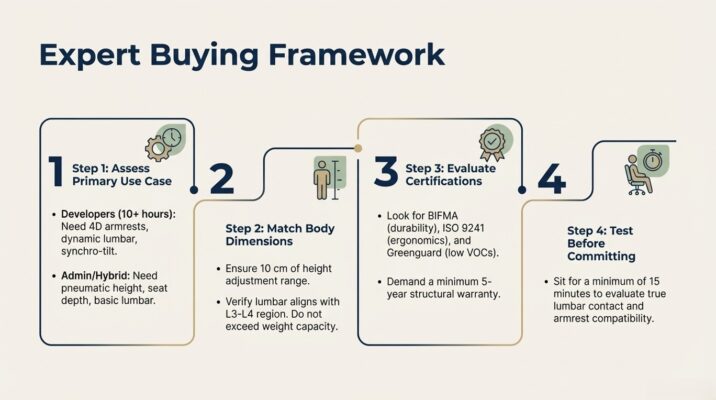
Step 1: Assess Your Primary Use Case
Different work profiles demand different ergonomic priorities. A software developer spending 10 hours daily in intense focus sessions has different ergonomic requirements than a HR manager who alternates between desk work, meetings, and phone calls. Before evaluating specific chairs, clarify your primary use case:
- Priorities dynamic lumbar support, breathable mesh, 4D armrests, and synchro-tilt mechanisms.
- Focus on adjustable seat height, basic lumbar support, and seat depth adjustment.
- Full mesh construction is non-negotiable for thermal comfort and hygiene.
- Consult a physiotherapist before selecting a chair; look for chairs with medical-grade lumbar support systems.
- Maximum adjustability range and durable materials are priorities.
Step 2: Understand Body Dimension Matching
Ergonomic chairs are not universally sized. Key body measurements that should be matched to chair specifications include:
- Determines appropriate seat height range. Chairs should offer at least 10 cm of height adjustment range centered on your seated height.
- Determines whether the lumbar support will align with your L3–L4 region. Taller individuals need chairs with higher back panels.
- Determines appropriate armrest spacing. Armrests that are too close together force internal shoulder rotation; too wide causes lateral trunk lean.
- Ensure the chair’s rated weight capacity exceeds your body weight. Exceeding rated capacity compromises both safety and the chair’s structural longevity.
Step 3: Evaluate Certification and Quality Standards
In a market increasingly populated by chairs that claim ergonomic benefits without rigorous engineering, third-party certification is an important quality signal. When evaluating ergonomic chair options for UAE office environments, look for:
- The gold standard for commercial office furniture structural safety and durability.
- International standard for ergonomic requirements of office work systems.
- Confirms the chair’s materials emit low levels of volatile organic compounds (VOCs), important for indoor air quality.
- Premium ergonomic chairs should carry a minimum 5-year structural warranty. Chairs offering only 1–2 years should be approached with caution regardless of their marketed features.
Step 4: Test Before You Commit
No amount of specification reading substitutes for physical trial. At OfficeMaster.ae, we strongly recommend visiting our Dubai and Abu Dhabi showrooms to experience our range of ergonomic chairs in person. Spend at minimum 15 minutes seated in any chair you are considering long enough for your body to provide meaningful feedback on lumbar contact, armrest compatibility, and overall comfort across different tasks.
Real-World Workplace Use Cases: Ergonomic Chairs in Action
Use Case 1: Dubai Corporate Law Firm
A mid-sized corporate law firm in the DIFC reported that prior to investing in ergonomic seating, associates were averaging 3.1 sick days per year attributable to back and neck complaints. After a full office ergonomic upgrade including height-adjustable desks and premium mesh ergonomic chairs sick days fell to 0.8 per associate annually. The firm estimated the ergonomic investment paid for itself within 14 months through recovered billable hours alone.
Use Case 2: Abu Dhabi Technology Company
A software development company in Abu Dhabi’s Masdar City free zone introduced ergonomic chairs as part of a broader wellness initiative. Anonymous employee surveys conducted six months after implementation showed a 41% reduction in reports of physical discomfort during work, and a 33% improvement in self-rated productivity mirroring the academic evidence cited earlier in this article.
Use Case 3: Sharjah Medical Administration Office
A medical administration center in Sharjah, whose staff spend long hours on data entry and telephone consultation, partnered with OfficeMaster.ae to redesign their office ergonomics. The transition to ergonomic seating, combined with monitor positioning guidance, resulted in a measurable reduction in repetitive strain injury complaints, with zero new cases of occupationally diagnosed RSI reported in the 18 months following the upgrade.
Ergonomic Best Practices: Maximizing the Benefits of Your Chair
An ergonomic chair delivers its full value when integrated into a broader set of healthy workplace behaviors. The following evidence-based practices will help you maximize the investment:
- Even the most advanced ergonomic chair cannot completely eliminate the physiological risks of static sitting. Research from the American Heart Association recommends standing, stretching, or walking for 2–3 minutes every 30–45 minutes to maintain circulation and prevent hip flexor shortening.
- Ergonomic chairs work most effectively in combination with sit-stand desks, allowing users to alternate between sitting and standing throughout the day a combination that reduces sedentary behavior to a clinically significant degree.
- Ask a colleague or use a smartphone camera to capture your seated profile from the side. Check for lumbar curve maintenance, 90-degree knee angle, level shoulders, and neutral wrist position. Adjust your chair settings accordingly.
- Pregnancy, weight changes, injury recovery, or changes in typical work tasks may necessitate re-adjustment of your ergonomic chair settings. Treat ergonomic configuration as a living practice rather than a one-time setup.
- Ergonomic chairs deliver full benefit only when users know how to use them correctly. A 30-minute ergonomic chair orientation session provided by OfficeMaster.ae for commercial clients can make the difference between marginal and transformational health outcomes.
- Ergonomic seating benefits are amplified when monitor height, distance, and angle are also correctly configured. Eye strain and the resulting forward head posture can negate lumbar support benefits if the screen is positioned too low, too high, or too far away.
Frequently Asked Questions (FAQ): Ergonomic Chairs and Their Benefits
What makes a chair ‘ergonomic’ compared to a regular office chair?
An ergonomic chair is specifically engineered to support the body’s natural alignment and accommodate individual physical variation through adjustable features including lumbar support, seat height, seat depth, armrest positioning, and recline angle. Regular office chairs are designed primarily for affordability and appearance, offering little to no anatomical customization. The defining difference is adaptability: an ergonomic chair conforms to the user; a standard chair requires the user to conform to it.
Can an ergonomic chair actually reduce back pain?
Yes the evidence is strong. Multiple peer-reviewed studies confirm meaningful reductions in lower back pain among workers who transition to ergonomic chairs with proper lumbar support. The British Journal of Occupational Therapy documented a 54% reduction in back pain reports among study participants using lumbar support chairs. However, the effectiveness depends on correct adjustment of the chair to the user’s specific body dimensions and posture needs.
How much should I expect to spend on a quality ergonomic office chair in the UAE?
In the UAE market, quality ergonomic chairs range from approximately AED 700 for entry-level models with basic lumbar support, to AED 5,000–7,000+ for premium executive ergonomic chairs from leading international manufacturers. OfficeMaster.ae offers a curated range across all price tiers, with professional guidance to match your specific requirements to the most appropriate option within your budget.
Are ergonomic chairs worth the investment for home offices?
Absolutely. The physiological effects of poor seating are the same whether you work in a corporate office or a home workspace. Remote and hybrid workers who spend six or more hours per day at a desk face identical musculoskeletal risks to in-office employees. Investing in ergonomic home office seating is one of the highest-ROI wellness decisions a knowledge worker can make.
How long do ergonomic chairs typically last?
Premium ergonomic chairs from reputable manufacturers, when properly maintained, typically offer a functional lifespan of 8–12 years. The gas cylinder mechanism, foam padding, and armrest mechanisms are the components most subject to wear. Many high-end chairs allow component replacement, significantly extending the product’s serviceable life. Most quality ergonomic chairs carry a 5–10 year structural warranty.
Is a lumbar support chair enough, or do I need a fully ergonomic chair?
A lumbar support cushion or add-on can provide partial benefit for workers who cannot immediately invest in a full ergonomic chair. However, it addresses only one dimension of ergonomic need — the lumbar region while leaving other critical adjustability requirements such as seat height, seat depth, armrests, and recline unaddressed. For anyone experiencing recurring musculoskeletal symptoms or spending more than five hours per day seated, a purpose-designed ergonomic chair is the superior solution.
What is the most important feature to look for in an ergonomic chair for back pain?
For users with recurring lower back pain, the most critical feature is an independently adjustable lumbar support system. Ideally, the lumbar support should be adjustable vertically and, in premium models, also adjustable in depth. This allows precise positioning at the L3–L4 vertebral level, maintaining the natural inward curve of the spine and preventing disc compression and muscle fatigue.
How do I know if my ergonomic chair is set up correctly?
A properly configured ergonomic chair will support several key posture indicators: feet flat on the floor, knees at roughly 90 degrees, a 2–3 finger gap between the seat edge and the back of the knees, lumbar support in contact with the natural inward curve of the lower back, elbows resting comfortably at about 90 degrees, and the head balanced directly above the shoulders without forward leaning.
Do ergonomic chairs help with posture for people who use multiple screens?
Yes, although multi-monitor setups introduce additional ergonomic considerations beyond chair adjustment. For dual-screen users, the primary monitor should be directly in front while the secondary monitor is angled about 30–35 degrees to the side. Ergonomic chairs with pivot-adjustable headrests help manage neck rotation while keeping the torso supported and balanced.
Where can I buy quality ergonomic chairs in the UAE?
OfficeMaster.ae offers a comprehensive range of ergonomic office furniture including adjustable office chairs, lumbar support chairs, executive ergonomic seating, and full workspace solutions. With showrooms in Dubai and Abu Dhabi and delivery available across the UAE, OfficeMaster.ae provides professional guidance to help businesses and home users build healthier and more productive workspaces.
Experience Premium Seating with Office Master’s Ergonomic Collection
| Product Name | Category |
|---|---|
| YARK Mesh Ergonomic Chair | Ergonomic |
| AERO Mesh Ergonomic Chair | Ergonomic |
| EIFFEL Mesh Ergonomic Chair | Ergonomic |
| EIFFEL White Frame Mesh Ergonomic Chair | Ergonomic |
| YARK White Frame Grey Mesh Ergonomic Chair | Ergonomic |
| CROWN Mesh Ergonomic Chair | Ergonomic |
| EMBRACE Full Mesh Ergonomic Chair | Ergonomic |
| EMBRACE Mesh Ergonomic Chair | Ergonomic |
| ERGO FLY Full Mesh Ergonomic Chair | Ergonomic |
| FLY Mesh Ergonomic Chair | Ergonomic |
| MOBI Mesh Ergonomic Chair | Ergonomic |
| RADIAN White Frame Mesh Ergonomic Chair | Ergonomic |
| SALLY Mesh Ergonomic Chair | Ergonomic |
| SALSA Mesh Ergonomic Chair | Ergonomic |
| SPARTA Mesh Ergonomic Chair | Ergonomic |
| SPARTA White Frame Mesh Ergonomic Chair | Ergonomic |
| AURORA Mesh Ergonomic Chair | Ergonomic |
| VICTOR Mesh Ergonomic Chair | Ergonomic |
| VLAD Mesh Ergonomic Chair | Ergonomic |
| ORACLE Mesh Ergonomic Chair | Ergonomic |
| STORM BLUE Ergonomic Gaming Chair | Ergonomic |
| STORM WHITE Ergonomic Gaming Chair | Ergonomic |
Office Master’s Exclusive Mesh Chairs – Breathable Comfort, Stylish Design
| Product Name | Category |
|---|---|
| ERGO PLUS Black Ergonomics Chair | Mesh / Ergonomic |
| ERGO PLUS Blue Ergonomics Chair | Mesh / Ergonomic |
| MARO Ergonomics Chair | Mesh |
| OLGA Ergonomic Mesh Chair | Mesh |
| PHINIX Mesh Ergonomic Chair | Mesh |
| BESTOFF Mesh Office Chair | Mesh |
| BESTOFF White Frame Blue Mesh Office Chair | Mesh |
| BESTOFF White Frame Green Mesh Office Chair | Mesh |
| BESTOFF White Frame Grey Mesh Office Chair | Mesh |
| DRIN Mesh Ergonomic Chair | Mesh |
| ERGO FREN Mesh Ergonomic Chair | Mesh |
| EROL Mesh Ergonomic Chair | Mesh |
| EVE Mesh Ergonomic Chair | Mesh |
| DORA High Back Ergonomic Chair | Mesh |
| COOPER High Back Mesh Chair | Mesh |
| COOPER Low Back Mesh Chair | Mesh |
| EMILY Mesh Chair | Mesh |
| ALFA Mesh Chair | Mesh |